
Stand close to a well carved marble Krishna carving details and you start noticing things a quick glance would miss entirely. The way a single curl of hair falls just slightly differently from the one beside it. The subtle taper of a finger holding a flute. The tiny beads of a necklace, each one distinct rather than a blurred suggestion of jewelry. These individual features are where a huge amount of the actual skill in marble carving lives, and understanding them makes it much easier to appreciate what you are really looking at.
This piece walks through the specific carved elements that come together in a traditional Krishna statue, and what each one actually involves from a carving perspective.
The Mukut: Crown Detailing
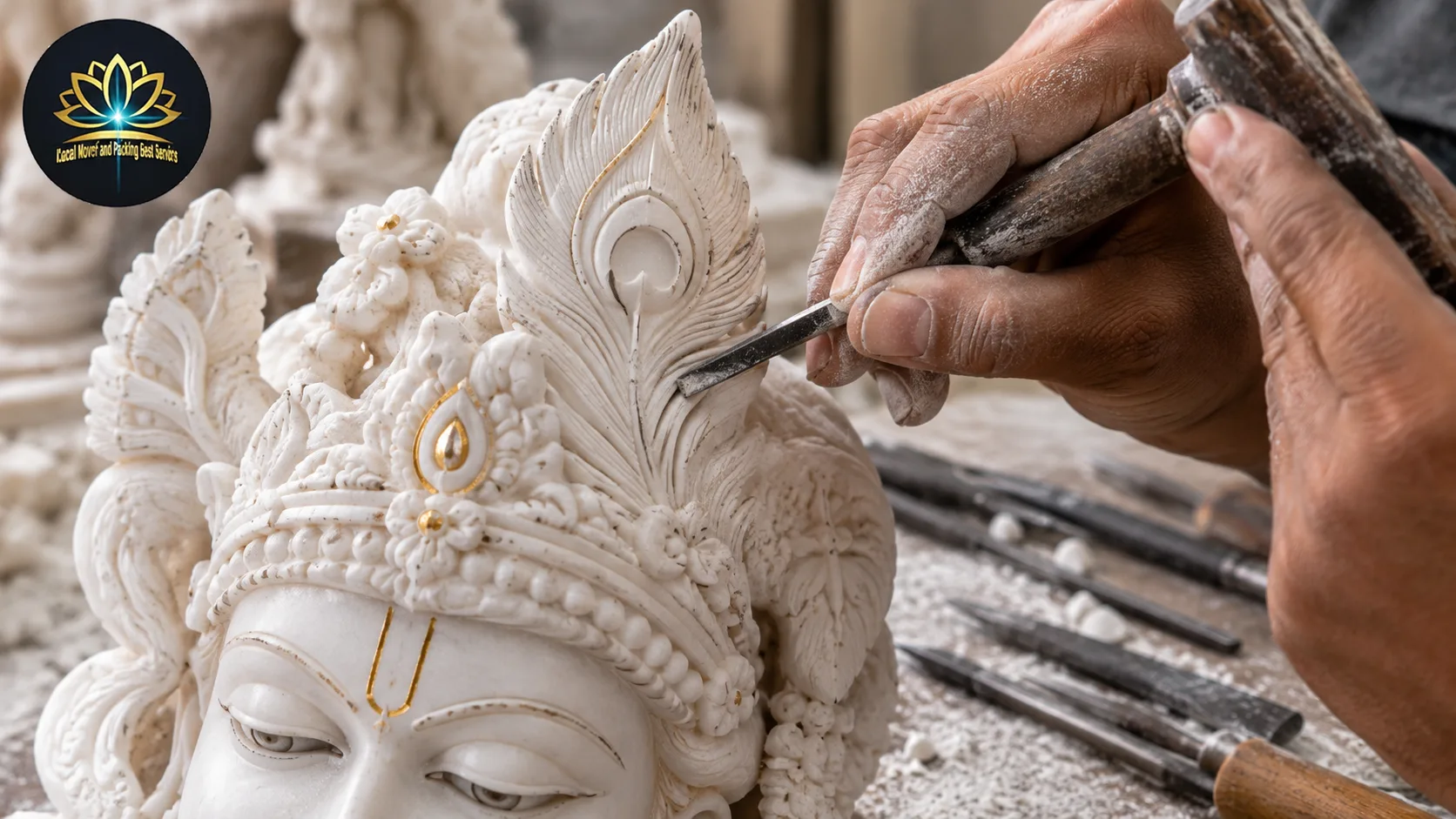
The crown, traditionally called the mukut, is often one of the most elaborately carved sections of an entire statue. It typically features tiered, layered carving meant to suggest an ornate headpiece, often incorporating a peacock feather as a central design element, along with smaller decorative motifs running along its base and sides.
Carving the mukut well requires precision at a very small scale, since the tiers and layers need to remain distinct and crisp rather than blending into a single undefined shape. This is also frequently where gold leaf detailing is concentrated, meaning the underlying carved structure needs to be clean and well defined enough to hold that painted and gilded detailing clearly once the piece moves into the finishing stage.
The Peacock Feather
The peacock feather is one of the most recognizable elements associated with Krishna, traditionally worn tucked into his crown. Carving this feature involves capturing the delicate, elongated curve of the feather along with the distinct eye shaped pattern near its tip, all within a relatively small, raised section of stone that has to remain structurally sound.
Because this element often projects slightly outward from the main crown structure, it is one of the more delicate areas of the entire statue, and skilled carving keeps it proportionate enough to avoid becoming a fragile point prone to chipping over years of handling.
Facial Features and Expression
The face is, understandably, where the most attention tends to concentrate, both from the artisan and from anyone viewing the finished piece. Carving Krishna’s face involves capturing a specific emotional register, calm, gently amused, quietly serene, rather than a neutral or blank expression. The curve of the lips, the shape and depth of the eyes, and the overall proportion of the face relative to the rest of the head all contribute to whether the final piece feels genuinely expressive or simply generic.
Eyes in particular carry a lot of weight here. Well carved eyes have a gentle, slightly downward or contemplative gaze in most traditional poses, avoiding a stiff, wide open look that can make a statue feel less serene than intended.
Hair and Curls
Krishna is traditionally depicted with dark, curled hair, often styled with a distinctive curl or lock framing the forehead. Carving individual curls with enough definition that they read as soft, flowing hair rather than a solid mass takes considerable patience, since each curl needs to be shaped with enough depth to catch light and shadow naturally, giving the impression of texture and movement even in solid stone.
Jewelry: Necklaces, Armlets, and Anklets
Jewelry detailing across the neck, arms, wrists, and ankles is another area where carving quality becomes immediately obvious. Individual beads in a necklace, the layered bands of an armlet, or the small bells sometimes carved into anklet detailing all require careful, consistent spacing and depth to look genuinely crafted rather than roughly suggested.
This detailing often continues into the finishing stage as well, discussed in our piece on hand painted marble statues, where gold leaf work builds on the carved foundation to add further richness and definition to these ornamental elements.
Drapery and Garment Folds
The folds of Krishna’s dhoti or garment are far more than a decorative afterthought. Well carved drapery follows a natural, gravity informed flow, suggesting soft fabric rather than rigid, flat panels. This requires the artisan to understand how cloth actually falls and gathers, then translate that understanding into stone, keeping the folds fluid and believable even though the underlying material is completely rigid.
This is one of the clearest areas where rushed carving becomes visible, since flattened or overly simplified drapery immediately reads as less refined compared to detailing where the folds feel genuinely dynamic and layered.
The Flute: A Small Detail With Outsized Importance
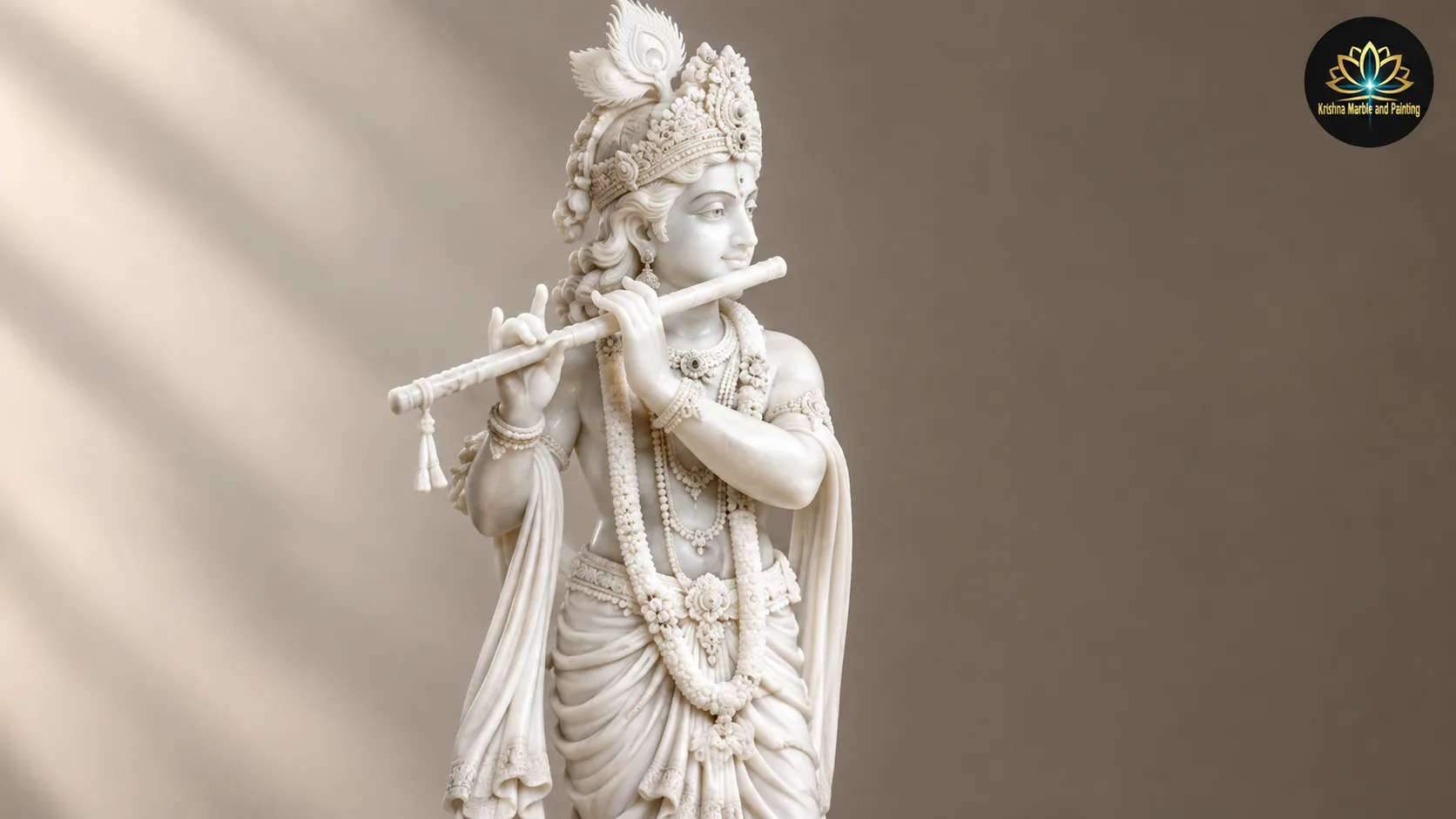
Given how central the flute is to Krishna’s most recognized pose, its carving deserves particular attention. The flute itself is typically a slender, elongated element held delicately between the fingers, and getting its proportion and angle correct relative to the hands and mouth is essential to the overall balance of the pose.
Because the flute is often one of the thinnest projecting elements on the entire statue, it also represents a genuine structural challenge, requiring the artisan to keep it delicate looking while still substantial enough to avoid becoming a fragile point over the statue’s lifetime.
Hand Positions and Mudras
The positioning of the hands, sometimes following specific traditional mudras or gestures, communicates meaning within the pose itself. A hand raised in a gesture of blessing, fingers gently curved around a flute, or a palm turned upward in an offering gesture all carry symbolic weight beyond their visual appearance. Carving hands convincingly is considered one of the more technically demanding skills in figure carving generally, since hands have complex, subtle anatomy that is easy to get slightly wrong in ways that immediately look unnatural.
Base and Pedestal Detailing
While often overlooked, the base a statue stands on frequently carries its own detailing, whether a simple polished platform, a carved lotus design, or decorative motifs running along its edge. This detailing frames the overall piece and contributes to how finished and intentional the complete statue feels, rather than looking like an afterthought beneath the main figure.
How These Features Come Together
No single feature defines a statue’s overall quality on its own. It is the consistency of attention across all of these elements, crown, face, hair, jewelry, drapery, flute, and hands, working together as a unified composition, that separates a genuinely well carved piece from one where only certain sections received real care. A skilled artisan brings the same level of attention to a small jewelry detail as they do to the face itself, which is part of what makes examining a statue closely such a rewarding way to appreciate the work involved.
Frequently Asked Questions
Why does the peacock feather carving matter so much in a Krishna statue?
It is one of Krishna’s most recognizable iconographic elements, and because it often projects slightly from the crown, it requires particularly careful, precise carving to remain both detailed and structurally durable.
What is the hardest feature to carve well on a Krishna statue?
Hands and flute detailing are often considered among the most technically demanding, since both involve delicate, thin elements that require precise proportion and structural care.
Why do drapery folds matter if they are just decorative?
Well carved drapery gives the statue a sense of natural movement and realism, and it is one of the clearest indicators of skilled versus rushed carving work.
Does jewelry detailing get added during carving or only during painting?
The jewelry shapes themselves are carved into the stone first, then often enhanced further with gold leaf and painted detailing during the finishing stage.
Can I request specific jewelry or crown detailing on a custom statue?
Yes, custom requests around specific ornamental detailing are possible, and it helps to describe or share reference images of what you have in mind before carving begins.
Appreciating the Craft in Every Detail
A marble Krishna statue is really a collection of individually mastered details, each one requiring its own patience and precision, coming together as a single expressive piece. You can see this level of intricate carving across the marble Krishna statues collection at Kamal Moorti, or explore the Shree Radhe Krishna pair designs to see this same detailing carried across a paired composition.
To ask about specific carved detailing for a custom piece, reach out through the contact page, learn more via the About Us page, or call +91-9829678999 to discuss your requirements.

Pingback: Radha Krishna Marble Statue Manufacturing Kitchener