Agra is one of the few cities in India where marble is part of everyday life. The Taj Mahal is the obvious example, but the stone shows up everywhere else too, in the inlay workshops near the monument, in the emporiums selling boxes, plates and miniature monuments, and in the families who have worked with it for generations. If you live here and want a marble Krishna for your home, it would be natural to assume the best place to buy one is somewhere in your own city Krishna marble moorti manufacturing Agra.
It is a fair assumption, and it is also where many buyers run into confusion. Agra’s marble craft is real and skilled, but it is largely a different craft from carving a devotional statue. This guide explains the difference, shows what to check when you look for Krishna marble moorti manufacturing in Agra, and describes how to order a hand carved idol from a Jaipur workshop without leaving the city.
Agra’s Marble Craft and Idol Carving Are Not the Same Thing
Agra is best known for marble inlay, where thin pieces of coloured stone are set into a marble surface in careful patterns. It is delicate, patient work, and it is what gives a tabletop, a plate or a small box its detailed floral design. Agra also produces a lot of decorative and souvenir marble, much of it aimed at visitors.
Carving a devotional figure is another job entirely. The carver has to shape a three dimensional face, hands, clothing and ornament out of a solid block, following iconography that families expect to be correct. The skills involved are closer to sculpture than to inlay. That trade has long been concentrated in Jaipur, where the stone is sourced within reach and the carving is passed down inside workshops and families.
So the two crafts share a material, but not a method. A fine inlay artist is not automatically a fine idol carver, and the reverse is also true.
What a Local Search Usually Turns Up
Look for a Krishna moorti supplier in Uttar Pradesh and, in Agra, you will mostly meet three kinds of seller.
The first is the souvenir or emporium shop, where marble Krishna figures sit among other decorative items. These pieces are often made as gifts for visitors, and the quality varies a lot.
The second is a pooja goods shop that buys finished statues from a distributor and sells them on. These can be honest businesses, and seeing the statue before you pay is a real advantage. But they usually cannot say who carved a piece or what exactly it is made of.
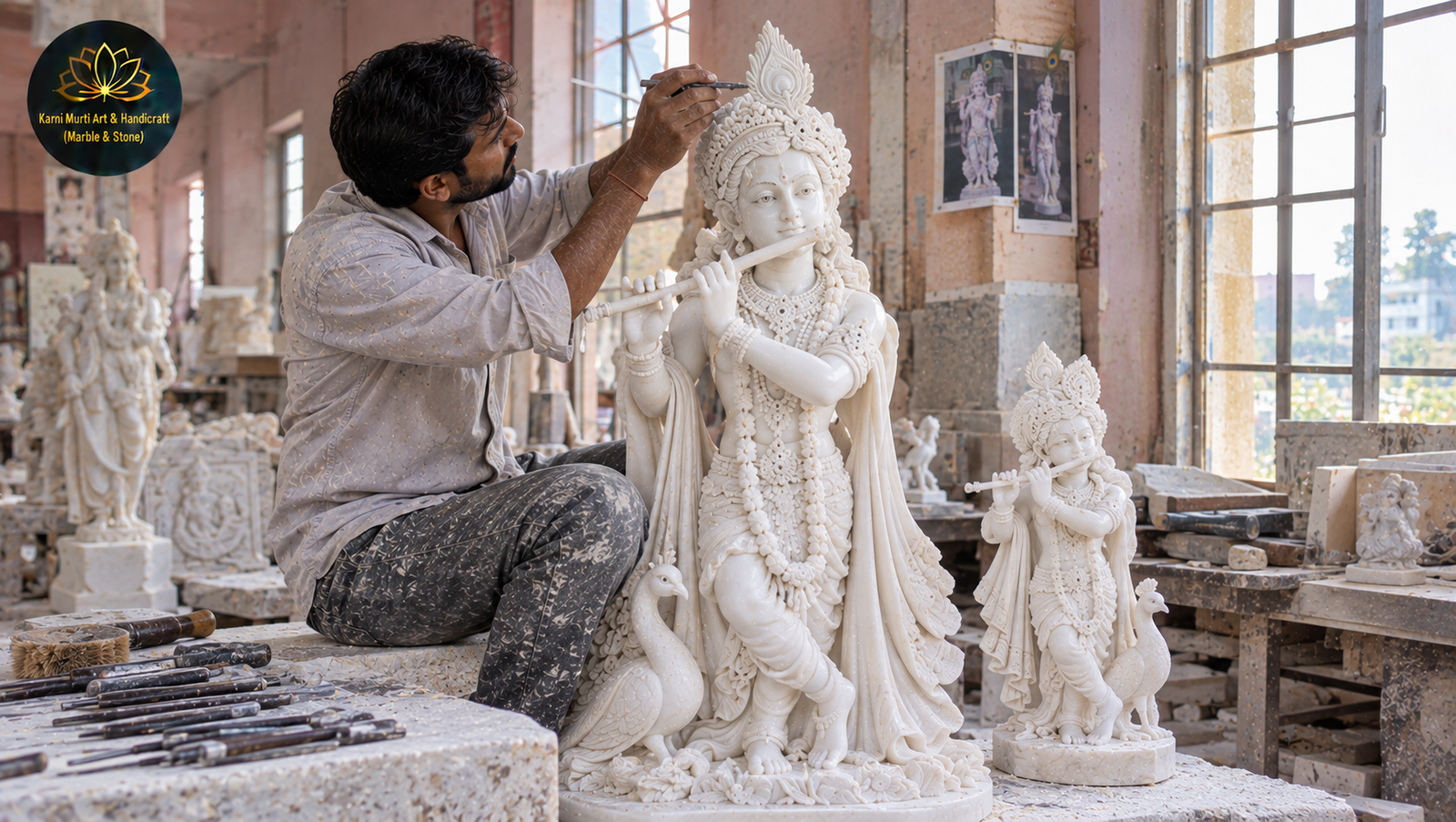
The third is a workshop that carves its own statues. At Kamal Moorti & Painting Kala Kendra in Jaipur, artisans work each piece by hand from a raw marble block through to the final polish, and the painting is done in the same place. Krishna and Radha Krishna statues are the core of the range, and orders are shipped to Agra and across Uttar Pradesh.
Why This Matters When You Are Buying a Devotional Statue
A decorative piece and a statue you will worship are judged by different standards. For a gift item, a pleasant look may be enough. For a statue that will sit in your pooja room for years, you care about the expression on the face, the proportions of the pose, whether the iconography is right and whether the stone is solid marble.
Marble is also an easy material to imitate. Pieces made from marble dust and resin, or from plaster, can be polished and painted until they look much like the real thing. This is common enough in tourist markets that it is worth asking directly what a statue is made of, and checking the answer yourself. Our guide to identifying authentic marble statues covers simple checks, such as weight, touch and veining.
What You Gain by Ordering From the Workshop
Dealing with the maker changes three things.
You get straight answers. Someone who has handled the block can tell you what the stone is and how the statue was finished. You get choices. Pose, size, base and the amount of painted detail can usually be discussed before carving begins. And you usually get a fairer price, because every seller between the workshop and your home adds a margin.
Krishna Forms Agra Families Often Choose
Agra sits within the wider Braj region, with Mathura and Vrindavan a short drive away, so Krishna devotion here has a strong local flavour. Many families already visit those temples through the year, and they often want a statue that echoes what they see there.
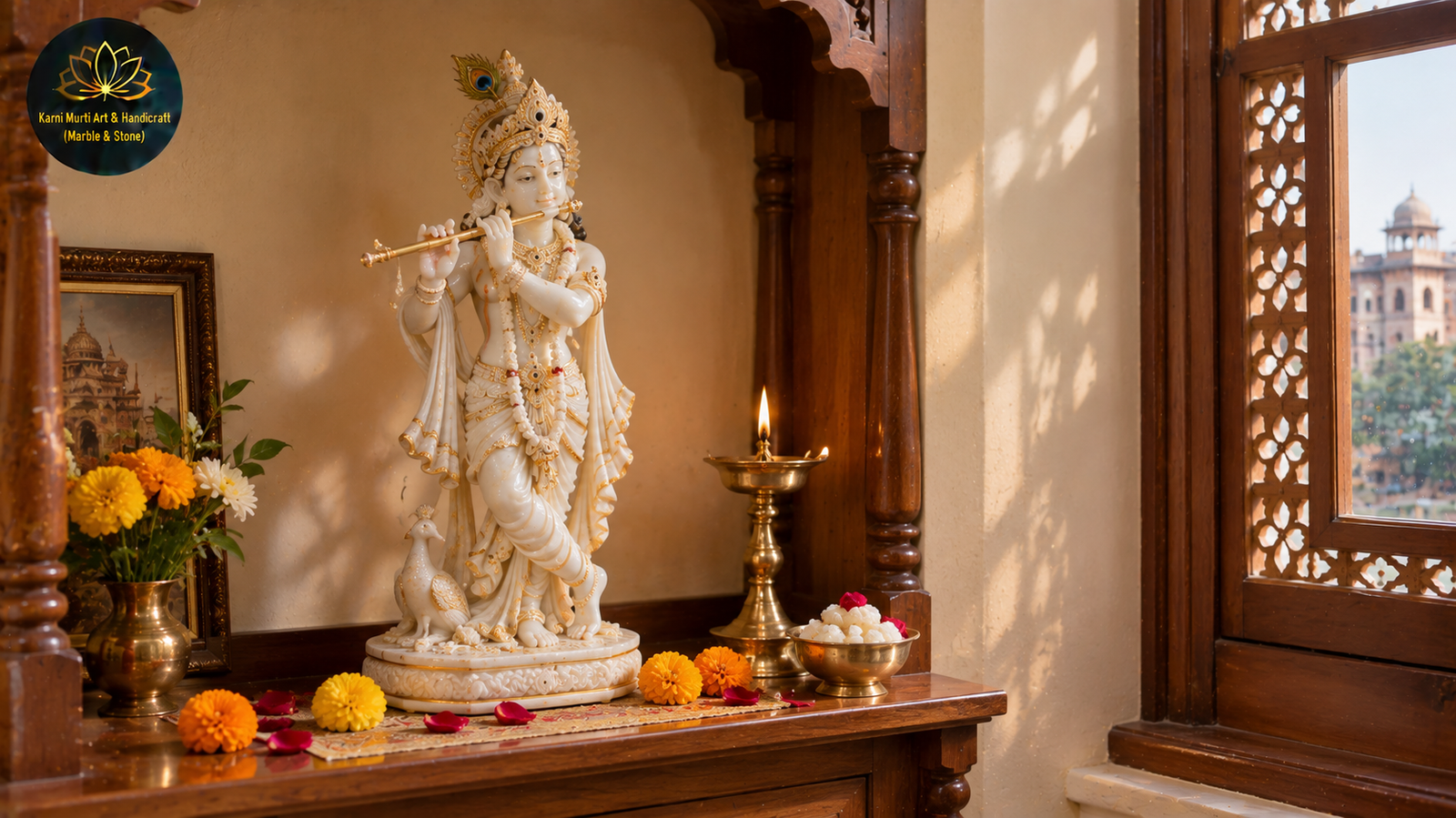
Murlidhar. Krishna standing in the graceful tribhanga pose, flute raised to his lips. It is the most popular form for a home temple.
Bal Krishna and Laddu Gopal. The child form, crawling or seated, often with a ball of butter. Many families care for this form daily, dressing and offering to it, so size and weight matter.
Radha Krishna together. The paired form, often chosen for weddings and housewarmings. The Shree Radhe Krishna collection covers this.
Govardhan Giridhari. Krishna lifting the hill on one finger, a form that has particular meaning in the Braj region.
Our guide to Krishna statue poses and meanings explains what each form represents, which can help you choose.
Finish: Painted or Plain White
A fully painted Krishna, with blue skin, a yellow dhoti and gold on the crown and jewellery, feels closest to the traditional temple image. A plain polished white marble Krishna is calmer and lets the carving speak for itself. A middle choice is white marble with light gold on the crown, the flute and the ornaments. Painted details need gentler care over the years, so think about how much upkeep you want.
Size and Weight
Marble is heavy, and a statue gets heavy quickly as it grows. Before you decide, measure the shelf, platform or corner where the statue will stand, and check that the surface can carry the load. If you live in an older house or a flat with a narrow stair, measure the stair and the doors as well. Our guide to marble statue weight goes into this in more detail, and our guide to Krishna statue placement by room size explains how to match a statue to a space.
Climate: Agra’s Heat and Dust
Agra’s summers are hot and dusty, and its winters can be foggy and damp. Marble copes with heat well, but dust settles on a polished surface and, mixed with humidity, can leave a film. Wipe the statue regularly with a soft dry cloth, keep it away from direct afternoon sun on painted areas, and avoid chemical cleaners. Our guide on daily cleaning of a marble Krishna statue gives a simple routine.
Timing: Janmashtami and Other Occasions
Many families bring home a new Krishna statue for Janmashtami. Others do it for a housewarming, a wedding or a child’s naming ceremony. Hand carving cannot be rushed without it showing in the finish, and shipping takes extra days. If you want the statue in place for a particular date, enquire several weeks ahead and ask the workshop for an honest estimate.
How Ordering From Agra Works
You do not need to travel to Jaipur. A typical order starts with a conversation. You describe the form, the size that fits your space and the finish you prefer. Reference photos help a great deal. The workshop confirms what is possible, gives a timeline and quote, and shares progress photos during carving. When the statue is finished, it is packed and sent to Agra.
If you would like to see the work first, you can ask the team about visiting the Jaipur workshop. It is best to call ahead.
Packing and Delivery
The fragile points on a Krishna statue are the flute, the raised hand, the peacock feather on the crown and the edge of the base. Ask how the statue will be padded and crated and whether those parts get extra protection. A statue that is properly packed makes the road trip from Jaipur without trouble. A poorly packed one is the usual reason for chips on arrival.
Questions to Ask Any Seller
Ask whether the workshop carves the statue itself or resells it. Ask what marble is used and where it comes from. Ask whether you can see work in progress. Ask what customisations are possible and how they affect the timeline. Ask how the statue will be packed. And ask for the quote in writing so you know what is included.
Frequently Asked Questions
Does Agra have marble Krishna moorti manufacturing?
Agra has a well known marble craft, mostly inlay and decorative work. Hand carved devotional statues are a different trade and mostly come from Jaipur, so many Agra buyers order from a workshop there.
How long does a Krishna statue take to reach Agra?
It depends on the size and the amount of detail. Expect a few weeks for carving and finishing, plus shipping time. Confirm an estimate once your design is fixed, especially before Janmashtami.
Are the marble Krishna statues sold in tourist markets real marble?
Some are, and some are made from marble dust and resin or plaster. Ask what a piece is made of and check its weight, touch and veining before you buy.
Can I get a Krishna statue in a custom size or pose?
Yes. Because each statue is carved individually, the pose, size, base and finish can be discussed before carving begins.
How is a marble Krishna statue kept safe on the way to Agra?
It should be padded and crated to the shape of the piece, with extra care around the flute, the hands and the crown. Ask the workshop about packing before you order.
A Krishna Made by Hand for Your Agra Home
If you want a Krishna moorti carved by hand from real marble, the simplest step is to talk directly to the people who make it. You can look at the full range of marble Krishna statues at Kamal Moorti, or the Shree Radhe Krishna pair designs if you want Radha and Krishna together. If you are planning a full shrine, the marble temple collection is worth a look. Everything is made in the Jaipur workshop and shipped across India, including Agra and the rest of Uttar Pradesh.
To discuss your requirements, share reference images and get a quote and timeline for delivery to Agra, reach out through the contact page, read more on the About Us page, or call +91-9829678999 to place your order.