
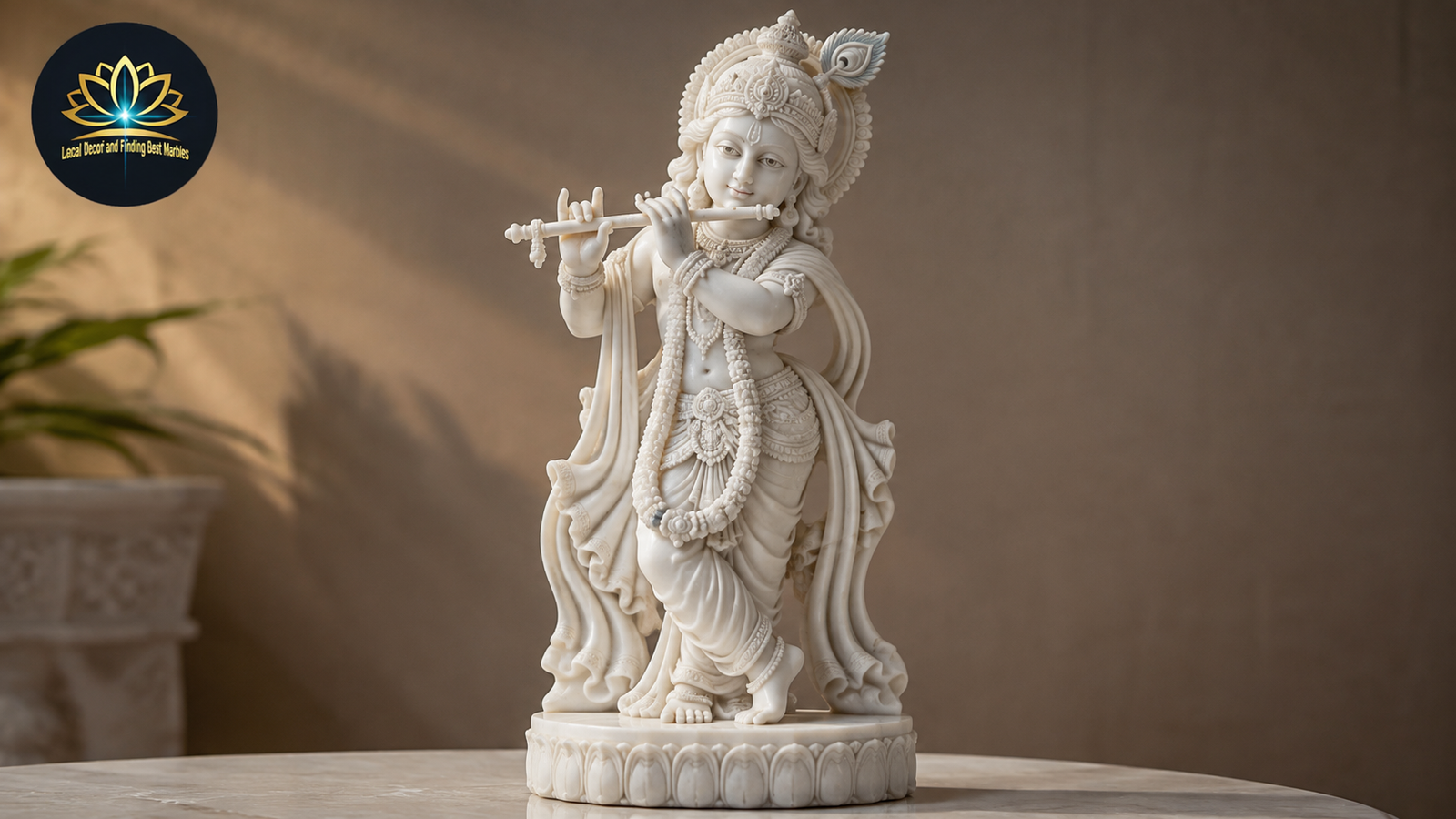
There’s a moment that happens in almost every workshop where marble Krishna statues are made, and it usually happens on the second or third day of carving, not the first. The rough block has come down to something recognisably human – head, shoulders, the outline of the arms – and the karigar stops, steps back, and looks at the angle of where the flute will go. Not measures. Looks. Because getting that angle wrong, even by a few degrees, is the difference between a statue that feels alive and one that just looks like a man holding a stick to his mouth.
We’ve watched this happen more times than we can count, and it never stops being interesting how much weight sits on that one small decision. So this piece is really an attempt to explain why – why the flute matters as much as it does, where the pose comes from, and what separates a Krishna flute statue that was actually carved with understanding from one that was just copied off a photograph.
Where this image actually comes from
If you grew up around Krishna devotion, you’ve heard some version of this story: Krishna as a boy in Vrindavan, herding cows through the forest, would play his flute in the evenings, and the sound of it was said to be so beautiful that everything stopped to listen – the cows, the birds, the river itself supposedly slowed down. The gopis, the cowherd women of the village, would leave whatever they were doing the moment they heard it and go looking for him. It’s one of the most retold images in the whole Krishna tradition, and it isn’t really a story about music. It’s a story about being pulled toward something you can’t explain, and that’s the emotional core that every carved flute statue is trying to hold onto.
There’s an older layer to this too. In a lot of devotional poetry – the Bhagavata Purana, later the work of poets like Surdas – the flute isn’t just an instrument Krishna happens to play. It’s described almost as a rival to Radha, jealous even, because it gets to touch his lips constantly in a way she can’t. That’s a strange, very human idea to attach to a religious object, and it tells you something about how central the flute is to how Krishna is imagined. Take it away, and a lot of that emotional weight disappears with it. That’s part of why, when someone asks us for a Krishna statue and mentions “maybe without the flute, just standing,” we usually explain what gets lost. It’s not that a flute-less Krishna is wrong exactly – there are plenty of forms of Krishna without one – it’s that the specific mood of tenderness and playfulness this pose is known for depends on it being there.
The pose itself: tribhanga, and why it’s so easy to get wrong
The technical name for the stance is tribhanga – literally “three bends.” The neck tilts one way, the torso curves the opposite way at the waist, and the hip shifts again at the knee, so the whole body reads as a gentle S-curve rather than a straight vertical line. It’s one of the oldest conventions in Indian sculpture, going back over a thousand years in temple carving, and it was never meant to look like a person standing at attention. It was meant to look like someone caught mid-movement, weight settled naturally on one leg, completely unselfconscious.
This is where a lot of mass-produced or rushed statues fall apart, honestly. It’s much easier – and much faster – to carve a figure standing straight up, arms symmetrical, weight evenly distributed. It’s structurally simpler too; less risk of anything looking unbalanced. But it also looks nothing like the tradition it’s supposed to represent. A karigar who understands tribhanga will deliberately carve one hip higher than the other, one shoulder dropped slightly, the head tilted just enough to suggest Krishna is listening to his own music rather than looking straight ahead at whoever’s in the room. None of this is written down as a formula you can just apply. It’s judged by eye, checked from a distance, adjusted, checked again.
Why the flute is carved the way it is
Look closely at a well-made Krishna flute statue and you’ll notice the flute is never held level. It rests at a downward diagonal, angled from the upper lip toward the lower hand, and the fingers aren’t all doing the same thing – three curl over the holes, one is often left slightly raised, and the thumb sits underneath, almost hidden. That’s not artistic license. It mirrors how a bansuri, the traditional Indian bamboo flute, is actually held and played, and getting that detail right is one of the clearest signs that whoever carved the statue has actually studied the instrument, not just the idea of it.
There’s a layer of meaning built into the instrument itself that’s worth knowing. A bansuri is made from a single length of hollow bamboo – nothing added, nothing reinforcing it, just emptied-out reed. In a lot of devotional interpretation, that emptiness is the whole point: the flute makes no sound at all until breath moves through it, and Krishna’s breath is often read as a stand-in for the divine animating an empty vessel. A devotee who “empties” themselves of ego, in this reading, becomes like the flute – capable of carrying something larger than themselves. It’s a small piece of symbolism, easy to miss, but it’s part of why this particular pose has stayed so consistent for centuries instead of drifting into simpler variations. People kept carving it carefully because it was always understood to mean something specific.
What actually happens on the workshop floor
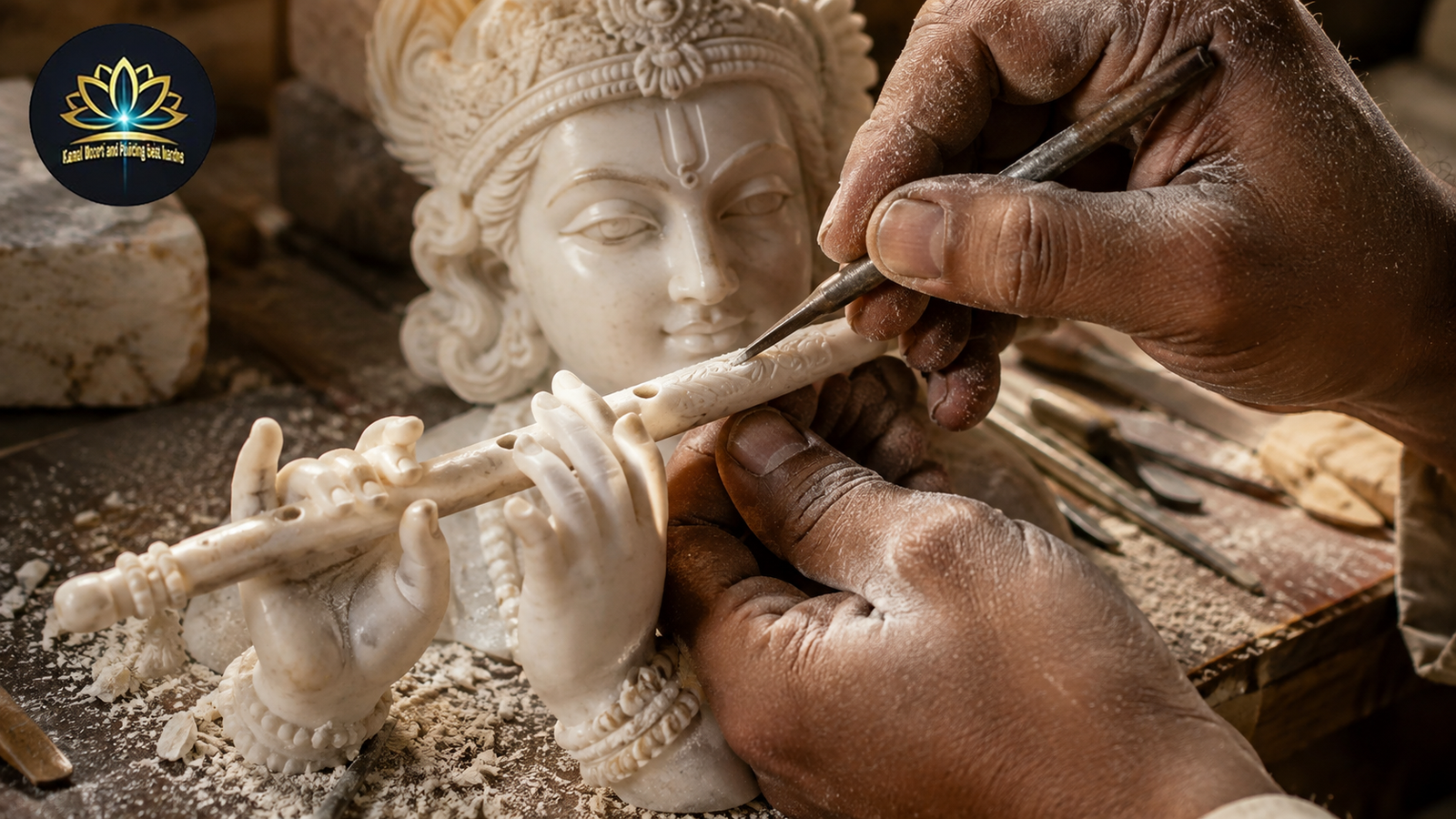
Most of what makes a flute statue difficult isn’t really about artistic vision – it’s structural. Marble is strong under compression but genuinely brittle when it comes to thin, unsupported details, and a curled finger holding a slender flute is about as unsupported as a detail gets. This is why experienced carvers plan the whole statue backwards from that point. The block is chosen with enough depth around where the hands and flute will sit, and that area is deliberately left thicker and rougher than the rest of the figure for most of the carving process – sometimes right up until the final week of work – because thinning it out too early leaves it vulnerable to cracking from vibration every time a chisel strikes anywhere nearby on the same block.
The sequence usually goes something like this. First, the block is roughed into a basic silhouette with the tribhanga lean already established – this is the stage where the whole feel of the statue gets decided, and it’s genuinely hard to fix later if the lean is wrong. Then the major forms come in: torso, legs, the crown, the general shape of the arms. The face is often left until surprisingly late, because expression is easiest to judge once the body language around it is already settled – you can’t really get the tilt of the head right until you know what the shoulders and hips are doing. Last of all comes the flute and the hands, worked slowly with finer chisels and eventually hand files, right up to the point where a single wrong strike could snap a finger clean off after weeks of work on the rest of the piece. Polishing comes after that, done by hand in most workshops that care about the outcome, because machine polishing tends to round off the crisp lines of the fingers and flute in exactly the details that took the longest to carve.
None of this is mysterious craftsmanship dressed up for a sales page – it’s just what the material actually demands if you’re not willing to compromise on the pose. A statue that skips these steps isn’t necessarily fake or low-quality in every sense, but it usually shows in small ways: a flute that looks slightly too thick because it needed the extra strength, fingers that are more suggested than carved, a lean that’s been softened because a stronger tribhanga felt riskier to attempt.
Reading the difference: what to actually look for
If you’re comparing a few options – in photos or in person – a handful of details tell you more than the overall impression does. Look at whether the flute and the hand holding it appear to come from one continuous piece of stone, with no visible seam or filled join; a genuinely single-block carving won’t have a hairline gap where the flute meets the fingers. Look at the lean of the body from the side, not just head-on – a real tribhanga pose should read clearly as an S-curve in profile, not just a slight lean when viewed from the front. And look at the fingers themselves: are they distinct, slightly curved, resting naturally on the flute, or are they more of a flattened suggestion, a rounded lump where fingers should be?
None of these things show up well in a thumbnail image, which is part of why it’s worth asking for a few close-up photos of the hands and flute specifically before ordering, especially for a piece you’re planning to keep for years in a home temple.
Placement, size, and care
A Krishna flute statue tends to work best somewhere it can be approached from a slight angle rather than dead-on, simply because the tribhanga pose was designed to be seen that way – carvers plan the “best” viewing angle into the lean of the body itself. In a home temple, that often means positioning it slightly off-centre in its alcove, or angling the surrounding decor rather than the statue itself. For larger garden or entrance pieces, the same idea applies at a bigger scale: a path or sightline that approaches from the side the lean favours will show the pose properly, where a head-on approach flattens it.
Marble itself needs very little upkeep – a soft cloth and water, occasionally a mild stone-safe cleaner, and keeping it away from harsh chemical polishes that can dull the surface over time. The flute and fingers, being the most delicate part of the carving, are worth handling carefully during cleaning or if the statue is ever moved; that’s really the only part of the piece where a careless knock could do real damage.
Choosing one that’s actually carved this way
At Statues World, our marble Krishna flute statues are hand-carved in Jaipur by karigars who work within this same tradition single-block carving through the hands and flute, proper tribhanga proportions rather than a simplified lean, and hand-finishing on the fine details rather than a quick machine polish. Sizes and finishes can be adjusted for a home temple, a gifting piece, or a larger installation. You can browse the current range of marble Krishna statues, including flute and Radha-Krishna variations, or get in touch if you’d like something carved to a specific size.

Pingback: Krishna Marble Statue Manufacturing Surrey | Kamal Moorti
Pingback: Krishna Marble Statue Manufacturing Laval | Kamal Moorti