
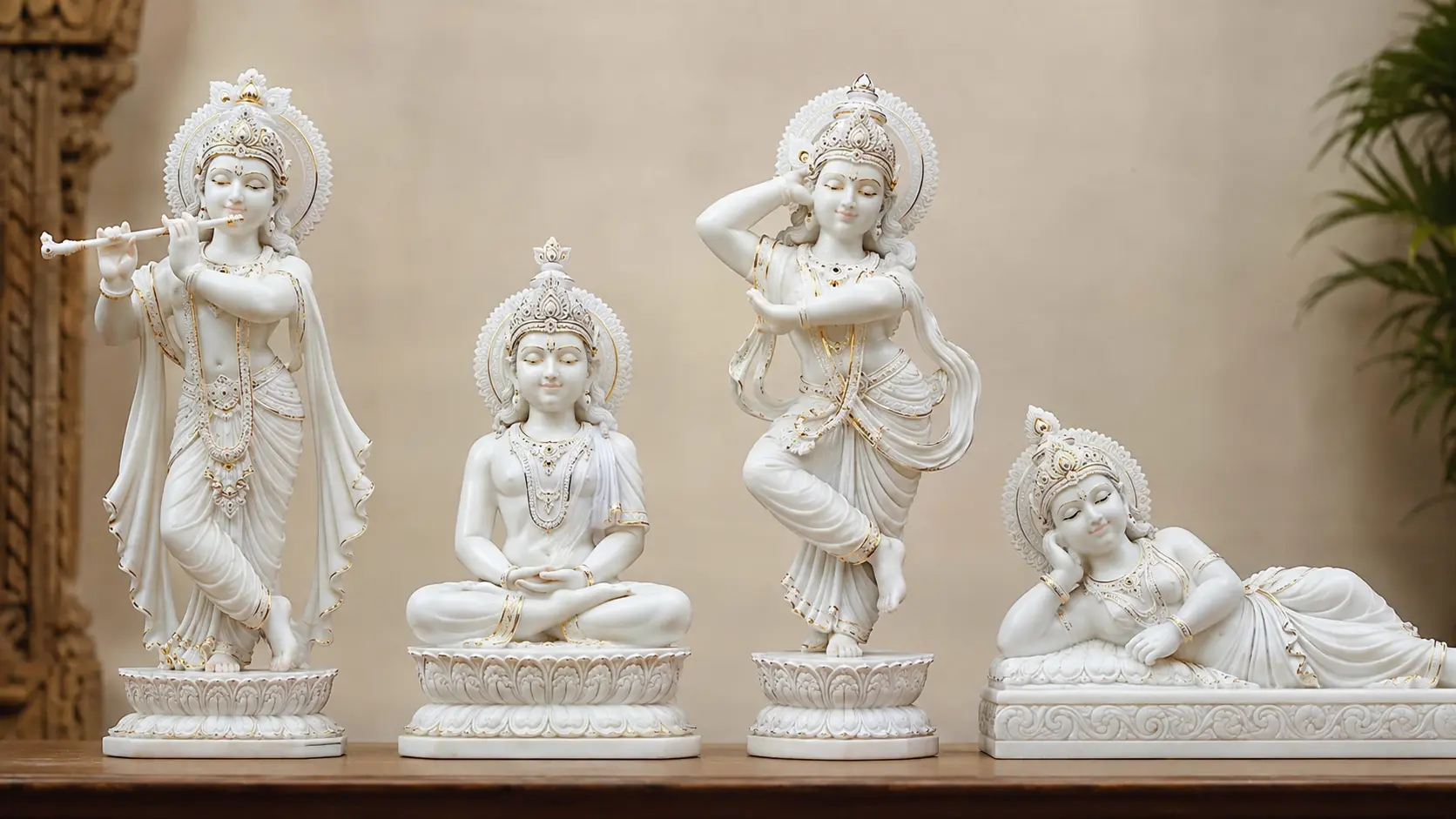
When you’re shopping for a marble Krishna statue, you quickly notice they’re not all the same. The pose matters far more than most people realize. It’s not just about aesthetics, though that’s certainly important. The pose tells a story. It represents a specific moment from Krishna’s life or philosophy. And honestly, choosing the right pose can completely change how the statue feels in your space.
At Kamal Moorti in Jaipur, we work with customers every week who initially didn’t understand why pose selection was such a big decision. Then they saw their statue installed at home, and suddenly it made perfect sense. The pose you choose shapes everything from the spiritual energy of your temple space to how the sculpture interacts with your room’s architecture.
Let me walk you through the main Krishna statue poses you’ll encounter. Once you understand the differences, selecting the right one becomes much clearer.
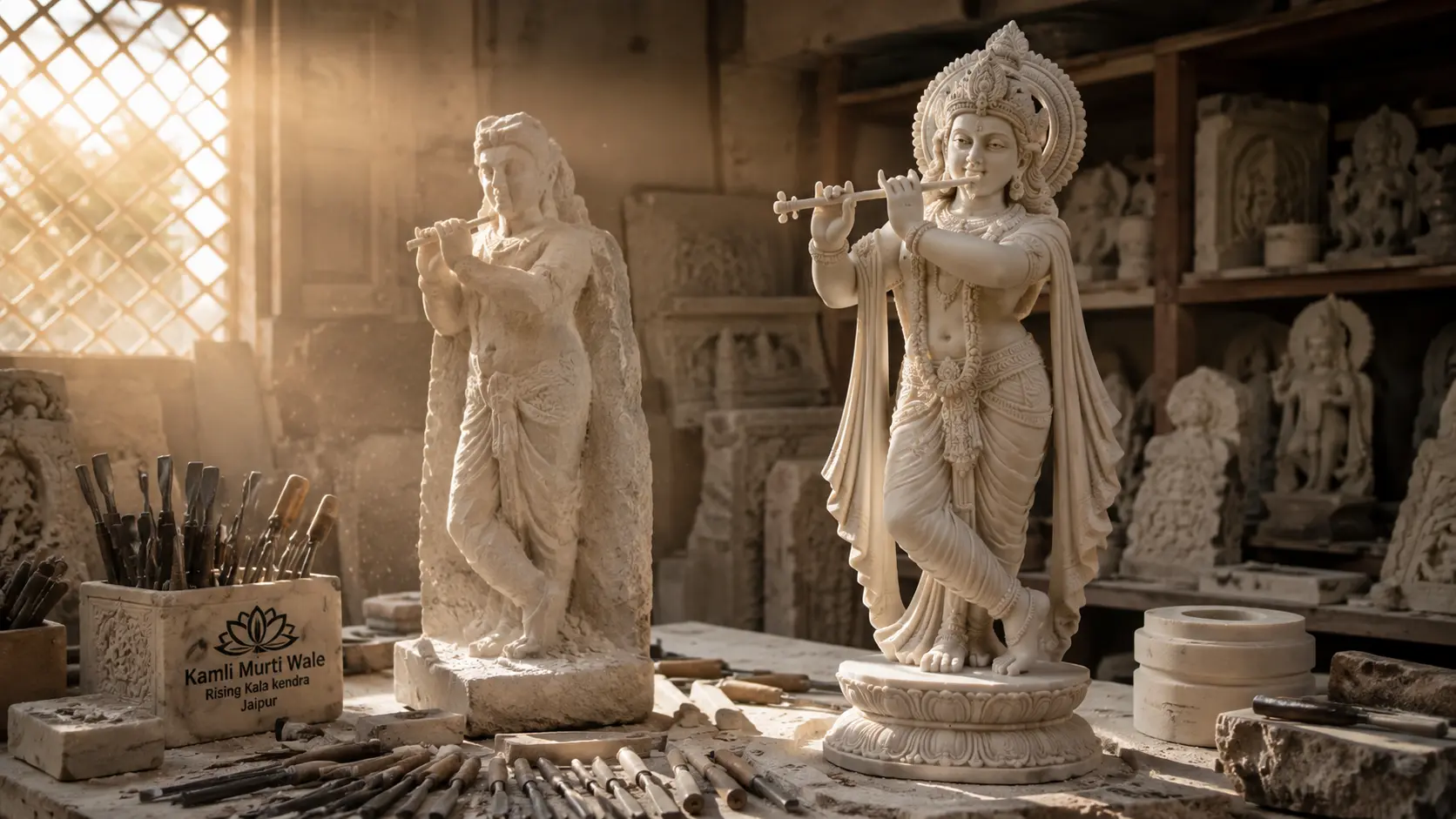
The Standing Krishna Pose – Classic and Versatile
The standing pose is probably the most common Krishna statue you’ll see. Krishna stands upright, typically with one hand raised in blessing and the other holding a flute or resting at his side. There’s something immediately calming about this pose. It conveys peace, approachability, and divine grace all at once.
This pose works beautifully in almost any space. Whether your home temple is a dedicated room or a corner shelf, a standing Krishna fits naturally. The proportions feel right. The height works with standard wall heights and shelf spaces. You’re not fighting the architecture of your room.
The standing pose is also the most forgiving in terms of marble quality visibility. When Krishna stands straight, you see the full frontal carving details clearly. The facial features are prominent. The flute details, the draping, the hand gestures-everything is visible from the front viewing angle. If the artisan did careful work on the face and hands, a standing pose will show that craftsmanship beautifully.
Most people position standing Krishna statues on a dedicated temple shelf or altar table, facing the main viewing area. The statue becomes a focal point naturally. It draws your eye immediately when you enter the space.
The Sitting Pose – Meditative and Intimate
The sitting Krishna pose is different. Instead of standing tall, Krishna is seated, often cross-legged or in a relaxed sitting posture. Sometimes his hand still holds the flute. Sometimes he’s in a more meditative gesture. The sitting pose feels more intimate, more personal.
This pose works particularly well if you have a smaller temple space or a corner setup. A sitting statue takes up less vertical space than a standing one. If you have limited shelf height or you’re worried about proportions, sitting Krishna can be the perfect solution.
There’s also something about the sitting pose that invites closer observation. You find yourself bending down to really see the details. The facial expression becomes more important because you’re viewing it more directly, at eye level rather than looking up. Artisans often lavish extra attention on the face when creating sitting poses because they know it will be seen intimately.
Sitting poses also photograph beautifully. If you ever take a photo of your home temple or share it, a sitting Krishna seems more photogenic. The composition feels balanced. The proportions look right in a photograph.
The Dancing Pose – Dynamic and Energetic
Now here’s where things get visually exciting. The dancing Krishna pose-sometimes called the Natraj pose-captures Krishna mid-movement. His body curves. One leg may be raised. His arms position dynamically as if mid-dance. There’s energy frozen in marble.
This pose requires serious skill from the artisan. The balance has to be perfect. You can’t actually carve a statue of someone dancing unless you nail the weight distribution. If the pose isn’t perfectly centered, the statue feels unstable. Customers worry it will topple over. The artisan has to position the internal marble structure so the center of gravity stays true.
But when it’s done right, a dancing Krishna is absolutely stunning. It becomes a conversation piece. People notice it immediately. It commands attention without being aggressive about it. The pose conveys Krishna’s playful, joy-filled nature. It captures movement in a still medium.
The dancing pose works best in spaces where you want visual interest and energy. It’s ideal if your temple is the centerpiece of your home. It works less well if you prefer a more serene, meditative atmosphere. The pose’s inherent dynamism can shift the entire feel of a space.
The Reclining Pose – Peaceful and Restful
The reclining Krishna pose shows Krishna lying down, often with his head resting on his hand in a relaxed position. It’s peaceful. It feels restful. In Hindu iconography, this pose also connects to Krishna’s role as the cosmic form, the Vishnu aspect that reclines during the cosmic sleep.
This pose is less common than standing or sitting, but when installed correctly, it’s breathtaking. It requires a different kind of shelf or display space, though. You need horizontal display area rather than vertical shelf space. The statue extends lengthwise, so your furniture arrangement matters.
Reclining Krishna works best in larger spaces where you have room to appreciate the full length of the statue. It’s not ideal for small shelves or compact temple corners. You need visual breathing room to do it justice.
The intimacy level of a reclining pose is high. It invokes a sense of trust and peace. Devotees often report that reclining Krishna statues create a particularly serene temple atmosphere.
The Playing Flute Pose – Artistic and Symbolic
This deserves special mention because the flute is so integral to Krishna’s identity in Hindu tradition. Many Krishna statues show him playing the flute, and this pose has become iconic. The flute-playing pose can be standing or sitting, but the key element is the precise hand positioning and the detailed carving of the flute itself.
The flute symbolizes Krishna’s divine music, his call to the soul, his enchanting nature. When you choose a flute-playing Krishna, you’re selecting a statue deeply connected to that spiritual aspect of Krishna’s character. It’s not just a visual choice. It’s a philosophical one.
Artisans take flute details seriously. The flute has to be in proper proportion to the body. The hands holding it need precise positioning. Get this wrong, and the whole statue feels off balance aesthetically. Get it right, and it’s poetry in marble.
Pose Size and Space Considerations
Here’s something practical that often doesn’t get discussed enough. The pose you choose affects the size statue you’ll actually want to buy.
A standing Krishna naturally looks right at smaller sizes. You can get a beautiful standing Krishna statue at one foot height and it looks complete and properly proportioned.
A dancing or reclining pose requires more space to really showcase the details. A one-foot dancing Krishna might feel cramped. The dynamic energy gets lost if the scale is too small. These poses typically work better at two feet or larger.
Sitting Krishna kind of bridges the gap. It can work at smaller sizes, but also scales beautifully to larger dimensions.
Think about your actual space before deciding on pose. If you have a small shelf and limited space, a standing or sitting pose makes more sense. If you have dedicated wall space or a larger temple room, you have more freedom to choose the pose that speaks to you regardless of size.
Marble Quality and Pose Visibility
Different poses show different parts of the statue. This matters for marble quality and carving excellence.
Standing poses show frontal details beautifully. You see the face, hands, and chest details immediately.
Sitting poses reveal the back and sides more prominently. The marble quality becomes evident when light hits the back and curves of the seated form.
Dancing poses show the entire three-dimensional form because of the dynamic posture. Every angle becomes important.
If you’re buying from a reputable artisan, this shouldn’t matter. They maintain quality standards across the entire statue. But it’s worth knowing that different poses emphasize different aspects of the carver’s work.
The Spiritual Significance of Pose
Different poses also carry different spiritual meanings in Hindu tradition.
Standing Krishna represents his role as a guide and protector. He’s accessible, grounded, present.
Sitting Krishna invokes meditation and introspection. It’s the pose of a teacher sharing wisdom.
Dancing Krishna celebrates joy, play, and the divine nature of existence. It’s celebratory.
Reclining Krishna connects to the cosmic form and the ultimate reality beyond form.
When you understand these connections, choosing a pose becomes more meaningful. You’re not just picking based on aesthetics. You’re selecting a pose that aligns with how you want to experience Krishna’s presence in your spiritual practice.
Common Mistakes When Choosing Pose
Most mistakes come from not thinking through the space first.
People buy a large dancing Krishna only to realize their shelf isn’t designed to handle the dynamic proportions. Or they choose a reclining Krishna without measuring whether they have the horizontal space.
Others pick a pose based purely on a picture without considering how it will feel in person in their actual space. A stunning dancing Krishna in a photograph might feel too chaotic in a small, intimate home temple.
The key is to think practically before deciding spiritually. Measure your space. Consider the lighting. Think about viewing angles. Then choose the pose that checks all those boxes.
Getting Custom Poses
Here’s the good news. If you have a specific pose in mind that you don’t typically see, artisans like those at Kamal Moorti can create custom variations. They can adjust the exact positioning, the hand gestures, and the overall posture.
Custom poses take longer and cost more, obviously. But if you have a clear vision of how you want Krishna to be represented, it’s absolutely possible to bring that to life in marble. You work with the artisan, share reference images, discuss exact positioning, and they bring your vision to marble.
Caring for Your Chosen Pose
Once you’ve selected and installed your Krishna statue, the pose you chose affects how you care for it.
Standing statues are easiest to clean and maintain. You have clear access to all surfaces.
Sitting statues require more careful attention to crevices and the spaces between limbs and body.
Dancing and reclining poses with more dramatic curves need gentle, careful cleaning to reach all the details without risk.
Regular dusting with a soft cloth is fine for all poses. Occasionally, a gentle cleaning with marble-specific cleaner maintains the shine. Avoid harsh chemicals and abrasive materials regardless of pose.
The basic principle remains: protect from extreme temperature changes, avoid direct water spray, and clean gently.
Making Your Final Decision
Choosing a Krishna statue pose comes down to three things: your space, your spiritual connection, and your personal aesthetics.
Measure your actual space realistically. Account for the viewing angles and lighting in your home temple. Consider whether you prefer a serene atmosphere or one with more dynamic energy.
Think about which Krishna narrative speaks most deeply to you. Do you connect with Krishna the protector (standing), the teacher (sitting), the joyful celebrant (dancing), or the cosmic form (reclining)?
Look at various poses in photographs and in person if possible. Kamal Moorti’s gallery showcases multiple pose variations. See how different poses make you feel. That emotional response often points toward the right choice.
When you combine practical considerations with spiritual resonance and aesthetic preference, the decision becomes clear. You’ll know which pose belongs in your space.
FAQ
Can I have Krishna in a pose that’s not traditional?
Yes. Custom poses are absolutely possible. Work with an experienced artisan to create your vision.
Which pose is best for a small space?
Standing or sitting poses work best for compact spaces. They require less horizontal or dynamic space than dancing or reclining poses.
Does the pose affect the price?
Generally, no-price depends more on size and marble quality. However, extremely complex custom poses with difficult weight distributions may cost more due to the artisan’s effort.
How do I position a dancing Krishna safely?
Professional installation is important for dynamic poses. Ensure it’s on a stable base and positioned so the center of gravity is secure. A good artisan provides guidance on this.
Which pose is most popular?
Standing Krishna is most common because it works in almost any space. But sitting and dancing poses are gaining popularity as people seek unique spiritual spaces.
Connect With Kamal Moorti for Your Perfect Krishna Statue
Now that you understand the different poses and how they work in real spaces, the next step is actually choosing the Marble statue that’s right for you. This is where expertise matters.
The artisans at Kamal Moorti & Painting Kala Kendra in Jaipur have been creating hand-carved marble Krishna statues for decades. They understand poses, proportions, marble quality, and how these elements come together in your home.
Whether you’re drawn to a traditional standing pose, an intimate sitting design, or a dynamic dancing Krishna, they can guide you through the selection process. They’ll discuss your space, your vision, and your spiritual preferences. Then they’ll create or source the perfect statue.
You can reach them at +91-9829678999 or +91-7014383187. Their workshop is located at 2459, Khazane Walo Ka Rasta, Chandpol Bazar, Jaipur (302001).
Or visit their complete collection at statuesworld.com to browse marble Krishna statues in all the poses we’ve discussed. See how different designs feel to you. Then reach out to discuss your specific space and preferences.
Your perfect Krishna statue – in the pose that speaks to you – is waiting.

Pingback: Krishna Marble Statue Manufacturing Toronto | Statues World