
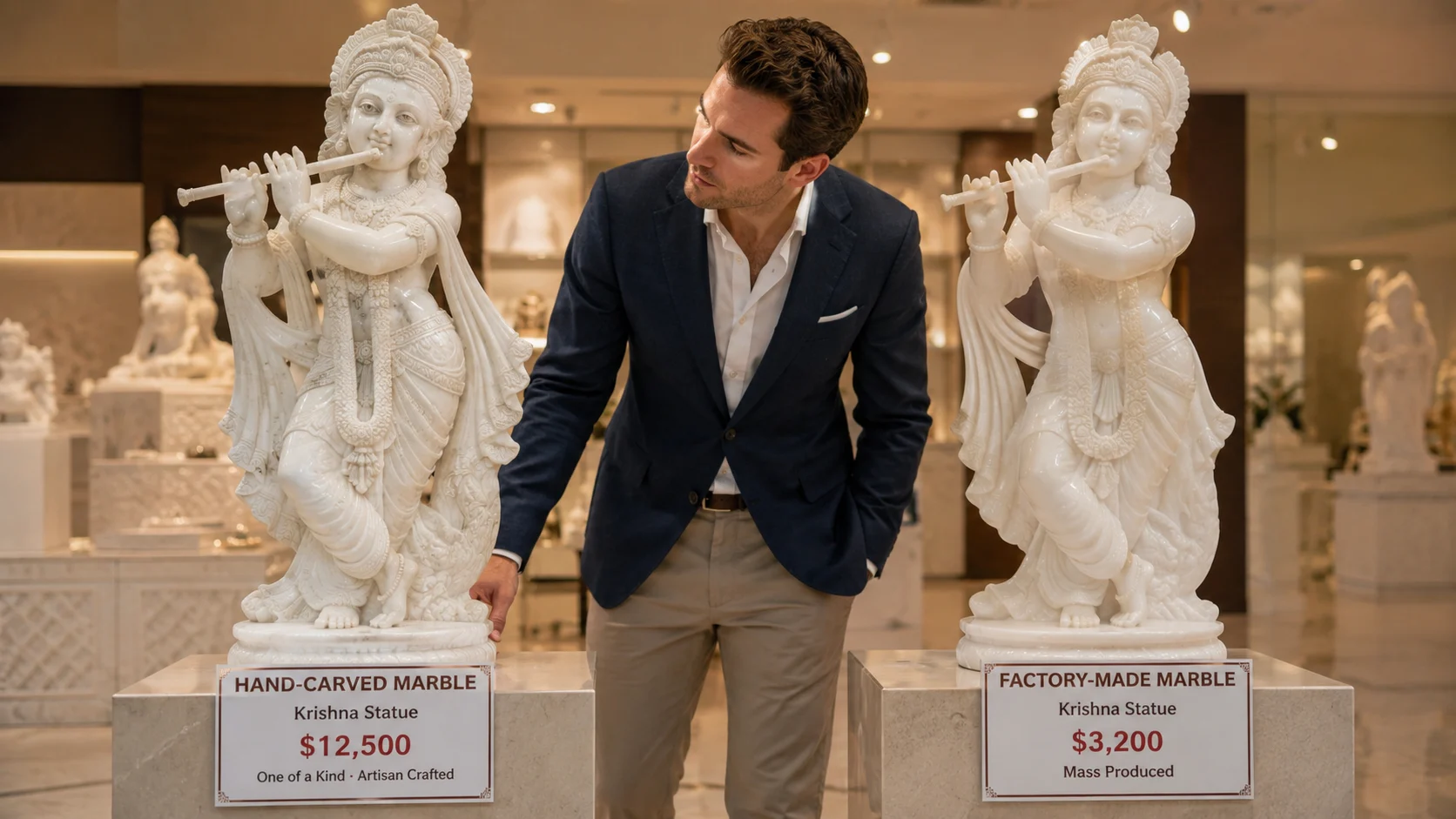
Walk into any marble showroom or browse online retailers and you’ll see marble statues at drastically different prices. Identical-looking Krishna statues priced at $500 and $2,500. Ganesh pieces at $300 and $1,200. The price differences are so dramatic that it’s tempting to assume cheaper options are equivalent. Why pay more when the design looks the same?
Then you look closer. The cheaper statue has smooth generic features. Details feel mass-produced. The expensive piece has nuanced expression. Carved details show individual artisan attention. They’re not actually the same at all.
This is the hand-carved versus factory-made divide. And understanding the difference transforms how you evaluate marble statues. It’s not just about aesthetics. It’s about investment, longevity, authenticity, and real value.
At Kamal Moorti’s USA marble statue collection, we create only hand-carved pieces. We don’t mass-produce. We don’t use molds. Every statue is individually carved by skilled artisans. This costs more. It takes longer. It’s worth it completely.
This guide explains what actually differentiates hand-carved from factory-made. Not just cosmetically. But structurally, artistically, and in terms of real-world value.
Understanding Factory-Made Marble Statues
Factory production is efficient and profitable. That’s exactly why many suppliers use it.
Most factory-made marble statues start with molds. A master mold is created. Then marble is poured, pressed, or shaped using that mold repeatedly. The result is multiple identical statues from one mold.
Variations exist in factory methods. Some use actual marble dust combined with binders, essentially creating artificial marble. Some use lower-quality natural marble. Some involve minimal hand-finishing after molding.
The efficiency is remarkable. A single mold produces dozens of identical pieces. Labor is minimized. Quality control means ensuring consistency, not individual artistry.
From a manufacturer’s perspective, this is brilliant. Factory production scales. One mold creates hundreds of statues. That’s why factory pieces are affordable. They’re manufactured, not crafted.
Characteristics of factory-made marble statues:
Identical faces and expressions across multiple pieces. No individual variation.
Smooth generic features lacking subtlety or emotional nuance.
Uniform proportions across all pieces from same mold.
Shallow carved details that look flat compared to hand-carved depth.
Minimal variation in decorative elements. Details appear uniform.
Missing the irregularities and unique character of hand-carved work.
These aren’t necessarily flaws from manufacturing perspective. They’re consequences of mass production efficiency.
Understanding Hand-Carved Marble Statues
Hand-carved means what it sounds like. Master artisans carve each statue individually from marble blocks using traditional tools.
The process is labor-intensive. A single artisan might work on one statue for weeks. The carving requires constant decision-making. The artisan responds to the marble itself. Flaws in stone, grain variations, hidden stress points all require adjustment.
Every hand-carved statue is unique. Even if ten artisans carve the same design, each piece varies subtly. Proportions differ slightly. Expressions carry individual interpretation. Decorative details show artisan personality.
This individuality is the magic of hand-carved work. You’re not buying a manufactured product. You’re owning a unique artwork created by a skilled human.
Characteristics of hand-carved marble statues:
Individual expression in faces and features. Each piece shows unique artistry.
Subtle nuanced details that show depth and complexity.
Unique proportions reflecting artisan interpretation.
Deep carved details with three-dimensional complexity.
Variation in decorative elements showing individual creativity.
Irregularities that make each piece genuinely unique.
These differences mean hand-carved work is never perfectly uniform. Some people see this as imperfection. It’s actually authenticity.
Visual Quality Differences
The easiest way to understand the difference is visual comparison.
Face and Expression:
Factory-made statues have generic faces. The expression is pleasant but impersonal. Features look simplified. Eyes, nose, mouth are present but lack subtlety.
Hand-carved statues show genuine expression. Eyes look alive. Facial features carry emotional depth. The face feels like an individual person rather than generic representation.
Jewelry and Decorative Details:
Factory pieces have simplified jewelry. Details are present but shallow. Necklaces and bracelets look like surface decoration rather than three-dimensional elements.
Hand-carved pieces show intricate jewelry with real depth. Necklaces drape. Bracelets show individual links or design elements. Decorative details feel textured and complex.
Clothing Folds and Drapery:
Factory pieces show basic clothing representation. Folds look simplified. The garment appears flat.
Hand-carved pieces show complex drapery with real folds. Clothing looks like actual fabric with weight and movement. Details show genuine three-dimensional complexity.
Hair and Ornamental Details:
Factory pieces have simple hair representation. Often looks like surface texture rather than individual strands or ornamental elements.
Hand-carved pieces show distinct hair with individual character. Ornaments in hair show clear detail. The overall presentation feels refined.
Overall Finish:
Factory pieces feel smooth and manufactured. They look like products.
Hand-carved pieces feel artisanal. They look like art.
These differences aren’t subtle to anyone examining pieces closely.
Durability and Longevity Differences
Material quality and carving technique affect how statues age.
Marble Quality:
Hand-carved artisans personally select marble. They examine grain, identify flaws, choose optimal stone. Premium marble is more expensive but more durable.
Factory production often uses lower-grade marble to reduce costs. Cheaper marble has more internal stress points and vulnerabilities.
Carving Technique:
Hand-carved work reinforces potential stress points. Artisans understand marble and carve carefully to minimize vulnerability.
Factory carving follows molds without regard for marble grain or structural integrity. Weak points aren’t reinforced because molds can’t adapt.
Structural Longevity:
Hand-carved statues, properly maintained, can last centuries. Historical examples exist worldwide showing centuries-old hand-carved pieces still intact.
Factory-made statues typically last decades. They’re susceptible to deterioration earlier than hand-carved work.
This isn’t guaranteed. But statistically, hand-carved work outlasts mass-produced alternatives significantly.
Weathering:
Hand-carved marble ages beautifully. Patina develops. Surfaces deepen. The statue improves with age.
Factory marble often shows visible deterioration as it ages. Stress cracks appear. Surface flaking develops. Weathering looks like degradation rather than aging.
Investment and Resale Value
This matters if you view statues as investments.
Hand-carved statues appreciate or maintain value.
Because they’re unique, artisan-created pieces, they retain investment value. Collectors value hand-carved work. Resale value stays strong.
Museum-quality hand-carved pieces sometimes appreciate significantly. Rare designs or exceptional artistry command higher prices over time.
Factory-made statues depreciate rapidly.
Because they’re manufactured products, they follow typical product depreciation curves. Initial value drops quickly. Resale value is minimal.
If you ever need to resell, factory pieces bring little return. Hand-carved pieces retain value far better.
This matters if you view statues as long-term investments rather than disposable purchases.
Authenticity and Cultural Value
Beyond physical quality, authenticity matters spiritually and culturally.
Hand-carved statues connect directly to traditions. Master artisans learn from family, from elders, from centuries of tradition. They’re creating within authentic cultural lineage.
Factory-made statues are products. They might represent deities, but they lack the cultural authenticity of hand-carved work.
Many serious spiritual practitioners specifically seek hand-carved work because of this authenticity. Factory pieces feel insufficient for genuine spiritual practice.
This is subjective. But cultural and spiritual authenticity carries real value for many people.
Price Differences Explained
Hand-carved statues cost more. Here’s why.
Labor cost is primary factor:
Hand-carving is labor-intensive. A master artisan might spend weeks on one statue. That labor is expensive.
Factory production minimizes labor. One artisan might manage multiple machines or assembly line stations.
Material cost is secondary:
Hand-carved work uses better-quality marble. Better marble is more expensive.
Factory work uses lower-grade marble to maximize profit.
Artisan expertise premium:
Master artisans with decades of experience command higher prices than junior carvers. But their work is objectively superior.
Factory work is often performed by less experienced carvers following standardized processes.
Scarcity and uniqueness:
Hand-carved pieces are unique. Scarcity supports higher pricing.
Factory pieces are manufactured in volume. Abundance supports lower pricing.
Business model differences:
Hand-carved artisans operate at smaller scale. Lower volume means higher per-unit pricing.
Factory operations optimize for volume. High volume means lower per-unit pricing.
None of this means factory pieces are bad. They serve a purpose. But the price difference reflects real material, labor, and quality differences.
When Factory-Made Might Be Acceptable
Let’s be fair. Factory-made isn’t always wrong.
Budget constraints:
If you have a limited budget and want any marble statue, factory-made is accessible. It’s better than no statue.
Casual decor:
If you want inexpensive decorative marble pieces without spiritual significance, factory-made works fine.
Testing before investing:
If you’re new to marble statues and unsure what you want, factory-made is lower-risk experimentation.
Casual gifts:
If you’re giving a small gift where investment value doesn’t matter, factory-made is acceptable.
Large quantity needs:
If you need many statues for institutional settings where individuality doesn’t matter, factory-made is practical.
In these contexts, factory-made serves legitimate purposes. It’s not ideal. But it’s defensible.
Why Hand-Carved Is Worth the Investment
Beyond the obvious aesthetic differences, hand-carved work offers genuine value.
Uniqueness:
You own something no one else owns. Your statue is literally one-of-a-kind.
Longevity:
Properly maintained, your hand-carved statue will outlive you. Your children and grandchildren see it. That’s meaningful.
Spiritual authenticity:
Hand-carved work carries cultural and spiritual authenticity that factory pieces lack.
Artistic quality:
You own actual art, created by a skilled human. Not a manufactured product.
Investment value:
Hand-carved pieces retain value. Some appreciate. Factory pieces depreciate.
Connection to artisan:
You’re supporting master craftspeople and cultural traditions. Your purchase directly funds artisan livelihoods.
These aren’t trivial considerations. They add genuine value beyond physical characteristics.
How to Verify Hand-Carved vs Factory-Made
When shopping for marble statues, how do you actually verify what you’re getting?
Request artist information:
Ask who carved the statue. Get the artisan’s name. Factory-made uses generic labor. Hand-carved work has individual artisans.
Examine closely for uniformity:
If you see multiple identical pieces, it’s likely factory-made. Hand-carved pieces always show variation.
Look at facial details:
Examine the face closely. Factory faces look generic. Hand-carved faces show nuance and individuality.
Check decorative details depth:
Jewelry, clothing, ornaments should show three-dimensional complexity. Surface-level details suggest factory work.
Ask about marble selection:
Reputable hand-carved suppliers discuss marble type and selection process. Factory suppliers use standardized lower-grade marble.
Inspect for stress points:
Hand-carved work reinforces potential weakness points. Factory work follows molds regardless of structural concerns.
Compare multiple pieces:
If buying multiple statues, identical uniformity suggests factory-made. Variation suggests hand-carved.
Ask for process documentation:
Legitimate hand-carved suppliers provide photos of the carving process. Factory producers can’t show individual artisan work.
Verify supplier reputation:
Research the supplier. Reputable hand-carved suppliers have histories. Factory operations often lack deep histories.
Our USA team can verify hand-carved origin for any statue you’re considering. We document everything.
The Real Question: Value
Ultimately, this isn’t about factory versus hand-carved as absolutes. It’s about value.
What do you want from a marble statue? If you want decoration at minimal cost, factory-made serves that purpose.
If you want investment, longevity, authenticity, and genuine artistry, hand-carved work is worth the cost.
Ask yourself: Will I want this statue in ten years? In twenty years? Will my children see this? Do I want something truly unique? Do I care about supporting artisans?
If these questions matter to you, hand-carved work is worth the investment.
Moving Forward With Your Marble Statue Selection
Browse our USA marble statue collection and examine pieces closely. Look at facial expressions. Study decorative details. Feel the artistry.
Compare to factory-made alternatives. The difference becomes obvious immediately.
Then decide based on your values and budget. Both paths are valid. But the difference is real and worth understanding.
Hand-carved marble statues represent centuries of artistic tradition. They’re created by skilled humans. They’ll age beautifully in your American home.
That’s worth investment.


Pingback: Saraswati Marble Statue Manufacturing Boston | Kamal Moorti
Pingback: Lakshmi Marble Statue Manufacturing Dallas: Kamal Moorti
Pingback: Swaminarayan Statue Manufacturing Jersey City: Kamal Moorti
Pingback: Saraswati Marble Statue Manufacturing Denver: Kamal Moorti
Pingback: Nataraj Marble Statue Manufacturing San Diego: Kamal Moorti
Pingback: Shiva Marble Statue Manufacturing Austin: Kamal Moorti
Pingback: Hanuman Marble Statue Manufacturing Portland: Kamal Moorti
Pingback: Lakshmi Marble Statue Manufacturing Miami: Kamal Moorti