The Dallas-Fort Worth area has a well-established Indian community, and it shows in the number of Hindu temples serving the region, including the DFW Hindu Temple, also known as Ekta Mandir, in Irving, which has served the metroplex since the founding effort began in the early 1980s. Lakshmi, the goddess of wealth, fortune, and prosperity, is one of the most commonly sought statues in homes across this community, especially around Diwali, when she is worshipped in nearly every household that celebrates the festival. What a lot of buyers here don’t know is where the statue itself actually comes from, or what to check before ordering one internationally.
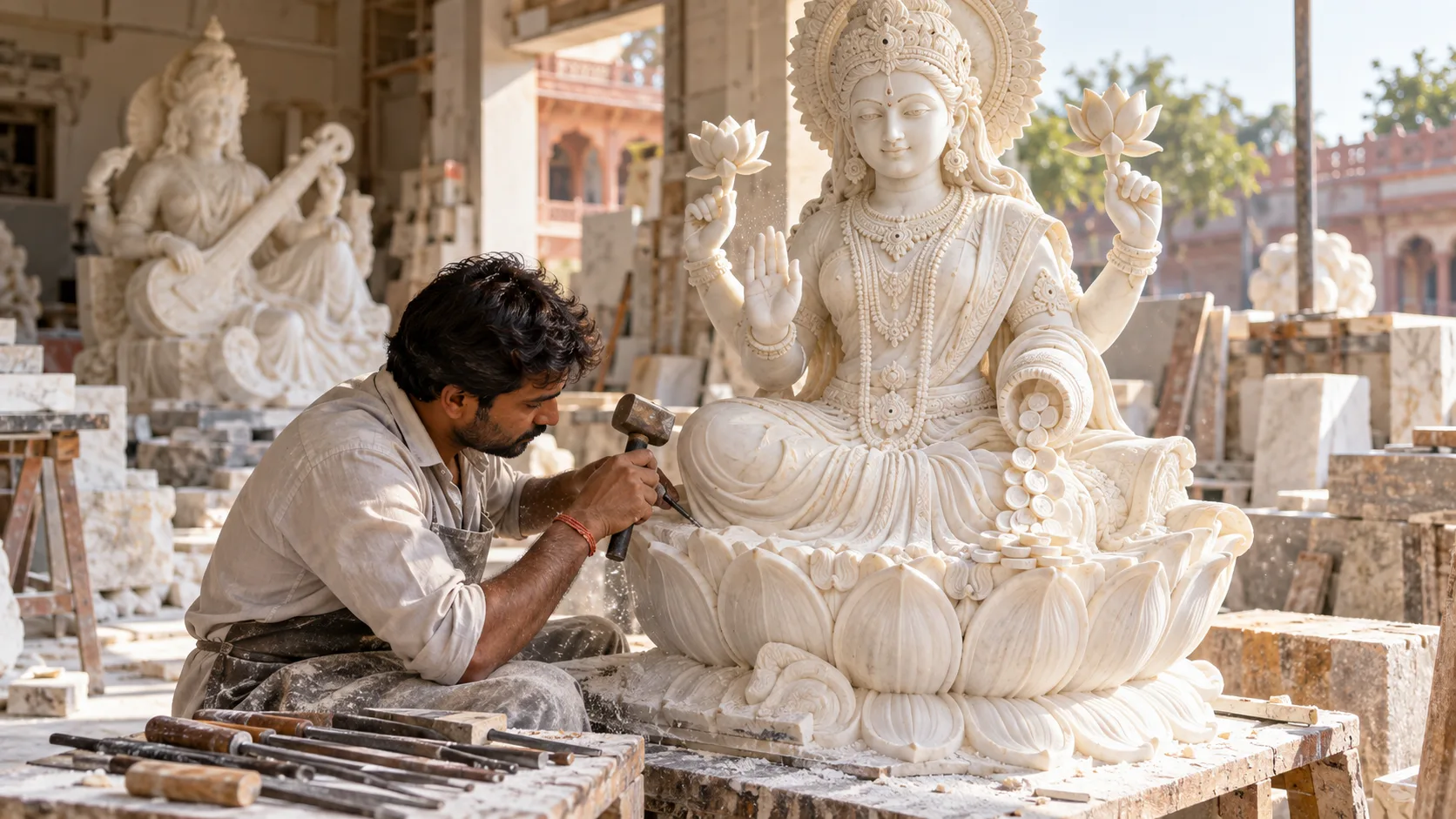
Kamal Moorti & Painting Kala Kendra, the manufacturer behind statuesworld.com, carves marble Lakshmi statues at its own facility in Jaipur, Rajasthan, alongside a wide catalog of other Hindu deity moortis. This guide covers how that manufacturing process works, what Lakshmi’s iconography represents, and the practical side of ordering a statue for delivery to Dallas.
Manufacturing in Jaipur, Serving the Dallas Market
To be clear from the start, the carving happens in Jaipur, not Texas. When people search for a “Lakshmi statue supplier in Dallas,” they usually mean a manufacturer that reliably ships to and serves this market, not a workshop physically based here. Kamal Moorti & Painting Kala Kendra runs an in-house setup with a fabrication unit, a design unit, and a warehouse, built around polishing machines, electrical cutting saws, and other stone-working equipment. That matters because it means each piece moves through selection, carving, polishing, and finishing under one roof, rather than being sourced from unrelated third parties and resold.
What a Lakshmi Statue Represents
Lakshmi is the Hindu goddess of wealth, fortune, prosperity, and beauty, and the consort of Vishnu. Her iconography is fairly consistent across regional styles. She is generally shown seated or standing on a fully bloomed lotus, holding one or two lotus buds in her hands as a symbol of purity and spiritual growth arising from worldly life. A common feature across statues is one hand shown with gold coins flowing from an open palm, representing continuous blessings of wealth and abundance. In many depictions, particularly the Gaja Lakshmi form, she is flanked by two elephants pouring water from raised trunks, a motif tied to purification and royal auspiciousness that appears across both Hindu and Buddhist art. Some traditions also associate her with an owl as a vehicle, symbolizing intelligence and the ability to navigate confusion or darkness.
These details matter when comparing statues, since a piece that gets the coin gesture or the lotus placement wrong loses part of what actually identifies it as Lakshmi rather than a generic seated goddess figure.
Why Hand-Carved Marble Holds Up
Marble is a metamorphic rock, formed when limestone recrystallizes under intense heat and pressure over long geological periods. Its main mineral, calcite, sits at roughly 3 on the Mohs hardness scale, soft enough to allow fine detailing on features like coin motifs and drapery, while the recrystallized structure still gives the finished stone genuine durability. Denser, higher-grade marble is also less porous, which is part of why a well-finished statue holds its polish and resists staining far longer than a lower-grade block.
According to the manufacturer’s own description of its process, raw marble selection, carving, polishing, and final detailing are handled as separate stages, combining hand-carving with modern tools to get proportions and facial expression right. On a Lakshmi statue, the coin gesture and the elephants in a Gaja Lakshmi piece are usually where the skill difference between workshops shows up most. For a closer comparison of hand-carved versus factory-produced work, the hand-carved versus factory marble quality comparison and the general hand-carved quality standards guide both go into more depth.
Choosing the Right Statue for a Dallas Home
Most home temples and Diwali display setups in Dallas houses and apartments work with a defined shelf, console, or altar space, so size needs real thought before ordering. A Lakshmi statue with elephants on either side, as in the Gaja Lakshmi form, needs meaningfully more width than a solitary standing or seated Lakshmi of the same height. If you haven’t settled on dimensions yet, a general statue size guide for American homes is worth reading before ordering, since a solid carved statue can’t be resized after the fact.
Timing is also worth planning around if it matters to you. Diwali is Lakshmi’s primary festival, and many households specifically bring home a new statue in the lead-up to it. Given international shipping timelines, ordering well ahead of the festival rather than close to it avoids unnecessary stress.
Customization
Because the statues come from an in-house workshop rather than fixed third-party stock, there’s generally more flexibility to request changes than with a pre-made import. That can include the color detailing on the sari, choosing between a plain white finish or a painted and gilded one, or specifying the base and lotus style. The custom marble statue design and pricing process covers how these requests typically affect cost and turnaround.
What Affects the Price
A handful of factors consistently drive the cost of a marble Lakshmi statue:
- Size. Cost does not scale in a straight line with height, since larger pieces need proportionally more raw marble and carving time.
- Complexity of the form. A Gaja Lakshmi piece with elephants and additional figures costs more than a solitary Lakshmi statue of similar height.
- Marble grade. Whiter, more uniform stone with fewer visible mineral veins costs more than marble with heavier natural streaking.
- Painted versus plain marble. Statues with painted sari color or gold detailing on the coins and jewelry cost more than plain white finishes, and the black and white marble comparison guide is worth a look if you’re deciding between finishes.
- Customization. Any request outside the standard catalog design adds both cost and lead time.
Shipping From Jaipur to Dallas
A few things are worth confirming before placing an order, not after:
Packaging and insurance. Ask directly how the statue will be crated, and whether the shipment is insured for its full value against transit damage. Marble cracks or chips rather than flexing if it shifts inside a poorly padded crate, and a Gaja Lakshmi piece with separate elephant figures has more surfaces at risk than a single solid statue.
Customs classification. Under U.S. tariff rules, “original sculptures and statuary” made by a recognized professional artist, generally one-of-a-kind or very limited-edition pieces, can qualify for a duty-free classification. A manufactured devotional statue produced as part of a standard catalog is typically classified differently and may carry duty. Since classifications and rates are updated periodically and vary by country of origin, confirm current details with U.S. Customs and Border Protection or a licensed customs broker before finalizing an order, rather than assuming a figure in advance.
Timeline. International stone shipments take real time. If you’re ordering with Diwali in mind, build in enough buffer with the manufacturer directly rather than working backward from the festival date.
Caring for the Statue in a Texas Climate
Dallas summers bring extended heat and strong direct sun, which is worth accounting for if the statue will sit near a window. Dust it with a soft, dry cloth rather than a wet one where possible, avoid placing it in direct, prolonged sunlight that can gradually affect surface finish, and keep it away from acidic liquids used in some puja rituals, since marble is calcium carbonate and reacts with acids, which can dull or etch the surface over time. The USA-focused marble statue care guide covers a fuller routine than fits here.
A marble statue also tends to become a long-term family piece rather than short-term decor. The guide to marble statues as heirlooms is worth reading if you’re thinking about the statue’s place in the household for years, not just for this Diwali.
Checking for Authenticity
Not everything sold as a “marble Lakshmi statue” online is solid carved marble. Some are marble-dust composite or resin pieces finished to resemble the real thing in photographs. Genuine marble feels noticeably heavy for its size, is cool to the touch, and shows faint, non-repeating natural veining, since no two blocks of marble carve identically. A composite piece tends to be lighter, warmer, and more uniform in surface texture. The natural versus artificial marble guide walks through how to tell the two apart before ordering internationally.
Since Lakshmi and Ganesh are traditionally worshipped together during Diwali, buyers weighing a pair often look at both statues at once. The Ganesh marble statue symbolism and selection guide for the USA and the Ganesh marble statue manufacturing guide for Chicago buyers cover the companion piece from a similar sourcing angle.
Frequently Asked Questions
Is the Lakshmi statue carved in Dallas or somewhere else?
It’s carved at the manufacturer’s facility in Jaipur, India. Dallas is the destination the statue ships to, not the place it’s produced.
Why does Lakshmi hold lotus flowers and pour gold coins?
The lotus represents purity and spiritual growth, and the flowing gold coins represent continuous blessings of wealth and abundance. Together with the elephants seen in the Gaja Lakshmi form, these details are what identify the statue as Lakshmi rather than a generic goddess figure.
Should I get Lakshmi and Ganesh statues together?
Many households do, since the two deities are traditionally worshipped together during Diwali, though it isn’t a strict requirement and comes down to personal or family tradition.
Will I owe customs duty on a statue shipped to Texas?
Possibly, depending on how the shipment is classified under current U.S. tariff rules. Since classifications and rates change, confirm details with U.S. Customs and Border Protection or a customs broker before ordering.
How do I know the statue is real marble and not a composite?
Genuine marble is noticeably heavy for its size, cool to the touch, and shows natural, non-repeating veining. A composite or resin piece is usually lighter and more uniformly finished.
Getting in Touch
If you’re considering a Lakshmi statue for a Dallas home or temple, especially ahead of Diwali, and want guidance on size, form, or customization, Kamal Moorti & Painting Kala Kendra can be reached at +91-9829678999 or +91-7014383187, or by email at mahendra4royals@gmail.com. The full catalog of marble moortis is available at statuesworld.com.