Every September, the Bharatiya Temple in Montgomeryville, a northwestern suburb of Philadelphia, hosts the Philadelphia Ganesh Festival, a ten-day celebration that draws thousands of families from across Pennsylvania, New Jersey and Delaware. The temple itself is a multi-deity space, founded in the late 1990s, with shrines to many deities in one building. For households around Greater Philadelphia, Ganesh is usually the first statue they buy, and often the one they care about most. What isn’t always clear is where a hand-carved marble Ganesh actually comes from, or what to check before ordering one from overseas.
Kamal Moorti & Painting Kala Kendra, the manufacturer behind statuesworld.com, carves marble Ganesh statues at its own facility in Jaipur, Rajasthan, alongside a wide catalog of other Hindu deity moortis. Ganesh is part of the standard range shown on its website. This guide covers how the manufacturing works, what the details of a Ganesh statue mean, and the practical side of ordering one for delivery to Philadelphia.
Manufacturing in Jaipur, Serving the Philadelphia Market
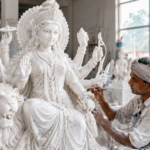
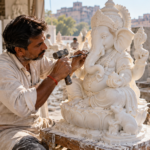
To be clear from the start, the carving happens in Jaipur, not Pennsylvania. When someone searches for a “Ganesh statue supplier in Pennsylvania,” they usually mean a manufacturer that reliably ships to and serves this market, not a workshop based here. Kamal Moorti & Painting Kala Kendra runs an in-house operation with a fabrication unit, a design unit and a warehouse, built around polishing machines, electrical cutting saws and other stone-working equipment. That matters because each statue goes through selection, carving, polishing and finishing under one roof, instead of being sourced from unrelated third parties and resold.
What a Ganesh Statue Represents
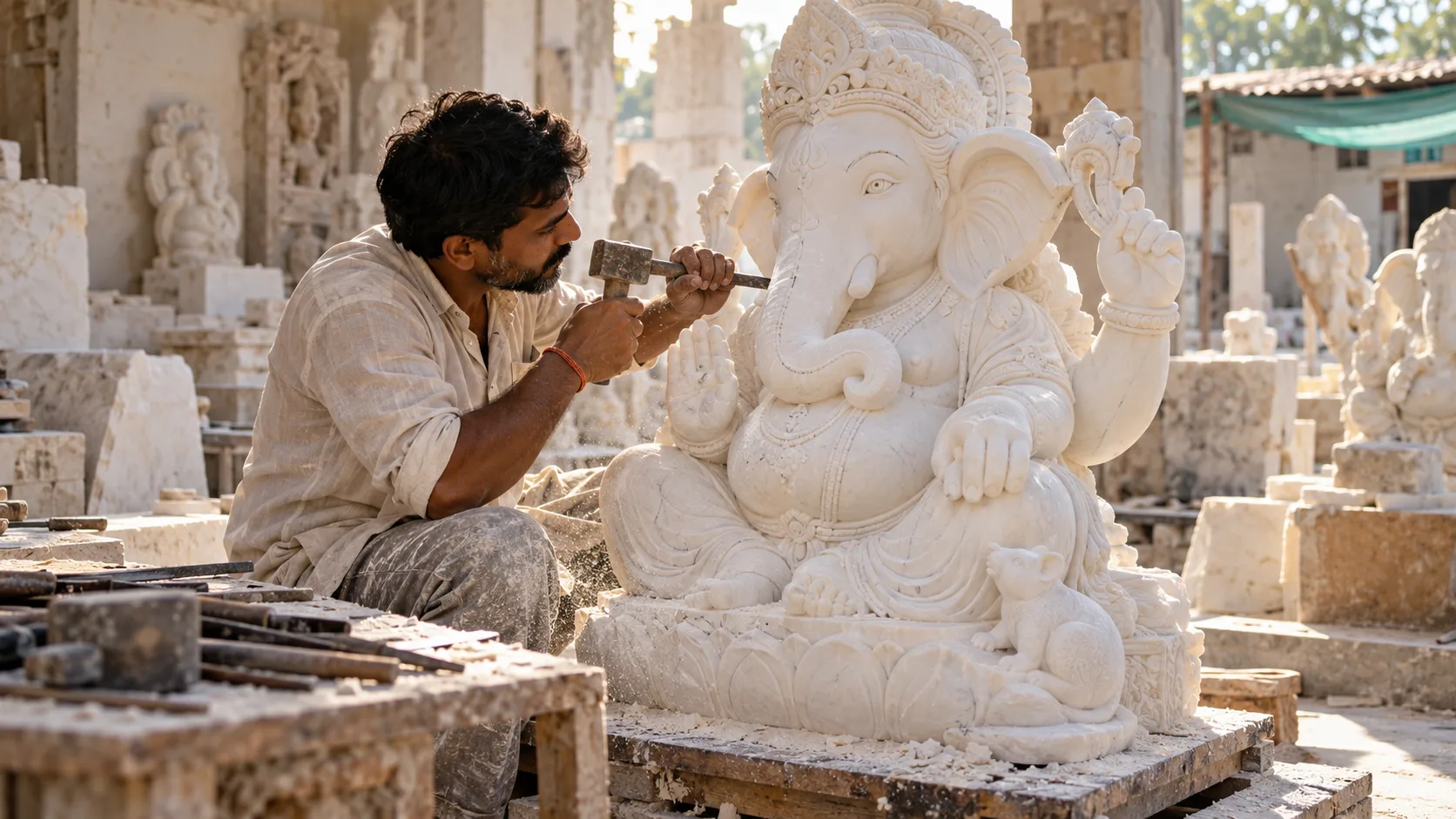
Ganesh is recognized by his elephant head and four arms, and he is worshipped as the remover of obstacles and the god of beginnings, which is why he is honored at the start of ceremonies and new ventures. In the traditional form, one hand holds his own broken tusk, another holds a sweet called a modak, and the two rear hands often hold an axe or goad and a noose. His large belly is read as a sign that he takes in everything life brings, and his large ears are a reminder to listen closely. A small mouse sits at his feet as his vehicle.
The statue’s details are not decoration. A carving that misses the broken tusk, leaves out the modak or gets the proportions of the head and belly wrong loses part of what makes it recognizably Ganesh. The Ganesh statue symbolism and selection guide for American buyers goes through the common forms in more detail, and is worth reading before you pick a pose.
Why Hand-Carved Marble Holds Up
Marble is a metamorphic rock, formed when limestone recrystallizes under intense heat and pressure over long geological periods. Its main mineral, calcite, sits at roughly 3 on the Mohs hardness scale, soft enough to allow fine detail work on a trunk or a crown, while the recrystallized structure still gives the finished stone real durability. Denser, higher-grade marble is also less porous, which is why a well-finished statue keeps its polish and resists staining far longer than a lower-grade block.
According to the manufacturer’s own description of its process, raw marble selection, carving, polishing and final detailing are treated as separate stages, with artisans combining hand-carving and modern tools to get proportions and expression right. On a Ganesh statue, the trunk curve and the face are usually where skill differences between workshops show up first. For a closer comparison of hand-carved and factory-made work, the hand-carved versus factory marble comparison and the quality standards guide go into more detail.
Choosing the Right Statue for a Philadelphia Home
Housing around Philadelphia ranges from narrow city rowhouses to large suburban homes in Montgomery, Bucks and Chester counties, so the right size varies a lot. A seated Ganesh on a low base fits a shelf or a mantel comfortably, while a tall standing pose needs a sturdy floor stand or a dedicated mandir corner. The statue size guide for American homes is a useful starting point, since a solid carved statue cannot be resized after delivery.
Timing matters too. Ganesh Chaturthi falls in late summer, and many families bring a new statue home just before it. Because international stone shipments take time, order well ahead of the festival instead of counting on a piece arriving the week before.
Customization
Because the statues come from an in-house workshop and not a fixed third-party catalog, there is generally more room to request changes than with a pre-made import. That can mean the pose, the color detailing on the crown and clothing, a plain white finish instead of a painted one, or a particular base. The custom marble statue design and pricing process explains how these requests usually affect cost and turnaround.
What Affects the Price
A few factors consistently drive the cost of a marble Ganesh statue:
- Size. Cost does not rise in a straight line with height, because larger pieces need proportionally more raw marble and carving time.
- Marble grade. Whiter, more uniform stone with fewer visible veins costs more than marble with heavy natural streaking.
- Detail level. Fine work on the crown, jewelry and trunk takes longer than a simpler finish.
- Painted or plain. Statues with painted detailing or gold work cost more than plain white pieces, and the black and white marble comparison guide helps if you are deciding between finishes.
- Customization. Any request outside the standard design adds cost and lead time.
Shipping From Jaipur to Philadelphia
A few things are worth confirming before you order, not after:
Packaging and insurance. Ask how the statue will be crated and whether the shipment is insured for its full value against transit damage. Marble cracks or chips instead of flexing if it shifts inside a poorly padded crate, and a trunk or tusk is a thin, exposed section.
Customs classification. Under U.S. tariff rules, “original sculptures and statuary” made by a recognized professional artist, generally one-of-a-kind or very limited-edition pieces, can qualify for a duty-free classification. A manufactured devotional statue produced as part of a standard catalog is typically classified differently and may carry duty. Because classifications and rates change and can vary by country of origin, confirm current details with U.S. Customs and Border Protection or a licensed customs broker before finalizing an order.
Timeline. International stone shipments take real time. Confirm an estimated delivery window with the manufacturer directly before planning around Ganesh Chaturthi or a housewarming.
Caring for the Statue in a Pennsylvania Climate
Philadelphia has humid summers and cold winters with dry indoor heating, and both are worth planning around. Dust the statue with a soft, dry cloth instead of a wet one where possible, keep it out of the direct airflow of a radiator or heating vent, and keep it away from acidic liquids used in some puja rituals, since marble is calcium carbonate and reacts with acids, which can dull or etch the surface over time. The USA-focused marble statue care guide covers a fuller routine.
A Ganesh statue often ends up as a long-term family piece. The guide to marble statues as heirlooms is worth a read if you are thinking about how long the statue will stay in your home.
Checking for Authenticity
Not everything sold as a “marble Ganesh statue” online is solid carved marble. Some are marble-dust composite or resin pieces finished to look similar in photographs. Genuine marble feels heavy for its size, is cool to the touch and shows faint, non-repeating natural veining, since no two blocks of marble carve identically. A composite piece tends to be lighter, warmer and more uniform in surface texture. The natural versus artificial marble guide walks through how to tell the two apart before ordering internationally.
If you are comparing sourcing details from another large US market, the Ganesh marble statue manufacturing guide for Chicago buyers covers much of the same ground.
Frequently Asked Questions
Is the Ganesh statue carved in Philadelphia or somewhere else?
It is carved at the manufacturer’s facility in Jaipur, India. Philadelphia is the destination the statue ships to, not where it is produced.
Why does Ganesh have a broken tusk?
Traditions differ on how it happened, but the broken tusk is one of his oldest identifying features, and he is often shown holding it. It is commonly read as a sign of sacrifice and of turning loss into wisdom.
Why is there a mouse at Ganesh’s feet?
The mouse is his traditional vehicle. It is usually read as a reminder that wisdom can reach into small, hidden places, and that even obstacles can be carried by something humble.
Will I owe customs duty on a statue shipped to Pennsylvania?
Possibly, depending on how the shipment is classified under current U.S. tariff rules. Since classifications and rates change, confirm details with U.S. Customs and Border Protection or a customs broker before ordering.
How do I know the statue is real marble and not a composite?
Genuine marble is noticeably heavy for its size, cool to the touch and shows natural, non-repeating veining. A composite or resin piece is usually lighter and more uniform.
Getting in Touch
If you are considering a Ganesh statue for a Philadelphia home or temple and want guidance on size, pose or customization, Kamal Moorti & Painting Kala Kendra can be reached at +91-9829678999 or +91-7014383187, or by email at mahendra4royals@gmail.com. The full catalog of marble moortis is available at statuesworld.com.