
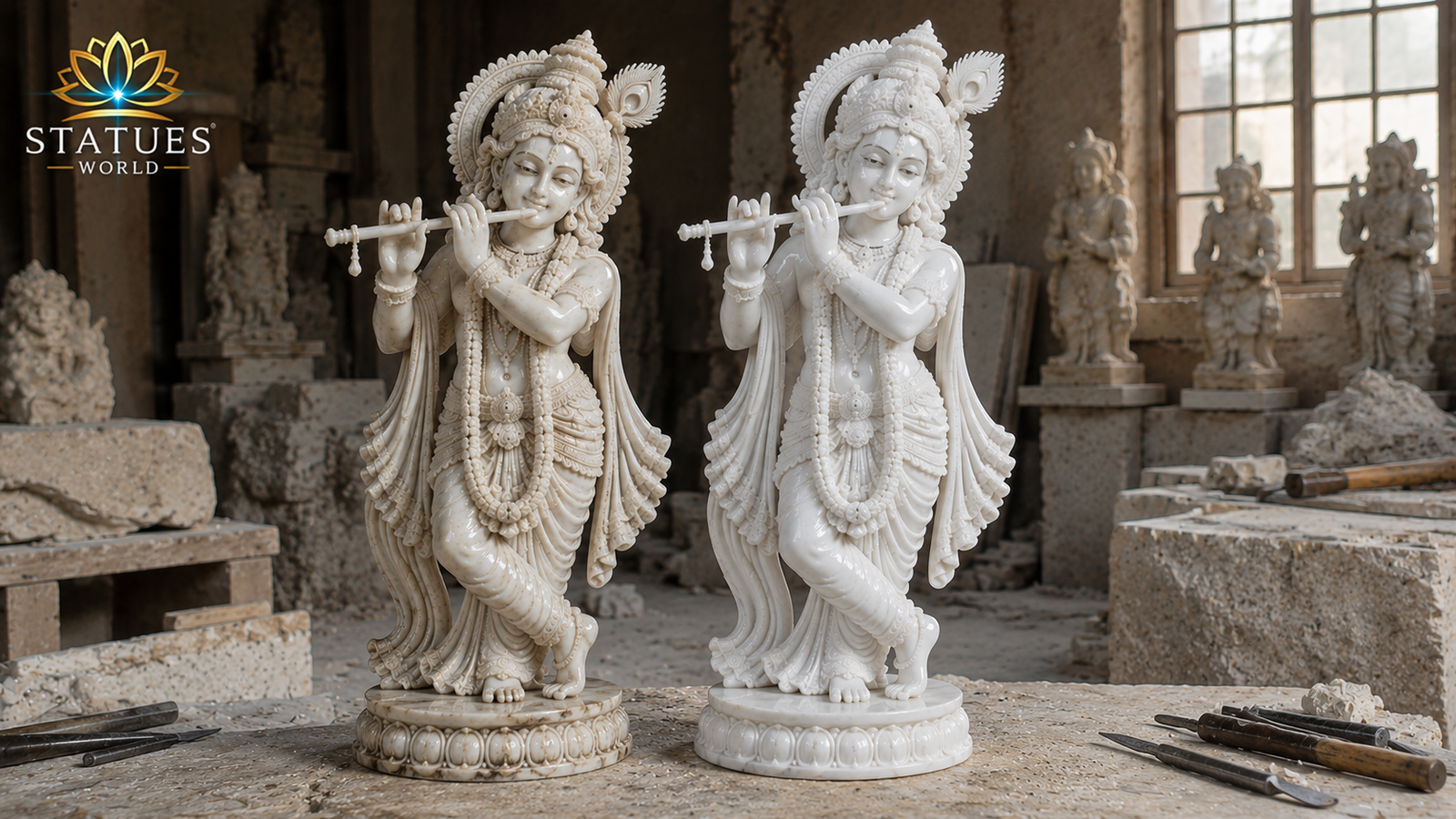
Most people buying a Krishna statue are thinking about how it looks the day it arrives. natural marble idol Fewer people stop to think about how it will look in fifteen years, or thirty. That second question matters more than it seems, because a home temple statue is not something you replace every few seasons like a cushion cover. It sits in one spot, gets handled during festivals, gets wiped down, gets exposed to lamp smoke and incense, year after year.
This is really where the difference between natural marble and artificial or composite marble becomes important. Not in the showroom, where both can look convincing, but a decade down the line, when only one of them has aged the way you hoped it would.
What “Artificial Marble” Actually Means
Before comparing the two, it helps to be clear about what artificial marble actually is. It is not a fake material pretending to be something else entirely. Most artificial or composite marble statues are made from marble dust or powder, mixed with a resin binder, then cast in a mold rather than carved by hand. Some lower end versions skip the marble dust altogether and use plaster of paris instead.
These composites exist for a reason. They are faster to produce, generally lighter, and cheaper than solid hand carved marble, which makes them attractive for buyers working with a tighter budget or a shorter timeline. There is nothing inherently dishonest about offering this as an option, as long as it is sold clearly as what it is.

Longevity: Where the Real Difference Shows Up
Natural marble is a stone that has already survived millions of years underground before it ever reaches a workshop. Once carved and polished, it continues to hold up extremely well against everyday wear, humidity, and temperature changes. A well made natural marble Krishna statue, cared for reasonably, can realistically stay in a family for generations without any structural change to the stone itself.
Composite and resin bound pieces do not age the same way. Over years of exposure to sunlight, humidity, and temperature shifts, the resin binder in marble dust composites can gradually weaken, sometimes leading to subtle surface cracking or a slightly chalky texture developing on the surface. Plaster of paris pieces age even less gracefully, becoming more brittle over time and far more vulnerable to chipping or cracking if bumped or dropped.
This does not mean a composite statue will fall apart quickly. Many last for years without visible problems. But the long term durability gap between natural stone and a resin bound alternative is real, and it tends to show up gradually rather than all at once, which is part of why it is easy to overlook when buying.
Maintenance Over the Years
Natural marble is relatively forgiving to maintain. Regular dry dusting, the occasional gentle wipe with a slightly damp cloth, and keeping it away from harsh chemical cleaners is usually enough to keep it looking good for decades. If the statue is painted, the paint and gold leaf detailing need a bit more care, but the underlying stone itself is not fragile.
Composite statues generally need a more cautious maintenance routine. Because resin bound material can be more porous and less heat resistant than solid stone, it is more sensitive to prolonged direct sunlight, which can cause discoloration or warping over time in a way natural marble does not experience. Water exposure also needs more care, since the resin binding can be more susceptible to moisture absorption than dense natural stone.
In practical terms, this means a composite statue may ask for a little more thoughtfulness about where it is placed at home, away from direct window light and away from areas with frequent moisture, whereas natural marble tolerates a wider range of placements without much concern.
Value Retention: Does It Actually Matter Here
For most people, a Krishna statue is not bought as a financial investment, and that is completely reasonable given its primary purpose is devotional. Still, value retention is worth understanding, especially for families who may pass the piece down or who occasionally consider reselling or exchanging pieces over the years.
Natural marble statues tend to hold their value far better over time. Because the material itself does not degrade structurally, an older natural marble statue in good condition often retains meaningful worth, sometimes even appreciating in sentimental and material value as a family heirloom. Composite pieces, by contrast, tend to depreciate more quickly, partly because their functional lifespan is shorter and partly because buyers in the resale or heirloom market generally place a premium on solid natural stone over cast composite material.
This is not to say composite statues have no place. For someone furnishing a temporary space, working within a tight budget, or simply wanting a lighter piece for a specific short term setting, a composite statue can be a perfectly sensible choice. The value retention difference mainly matters for those thinking long term, particularly families who see the statue as something that will stay in the household across generations.
A Side by Side Look
| Aspect | Natural Marble | Artificial or Composite Marble |
|---|---|---|
| Structural longevity | Can last for generations with minimal change | May develop surface wear or cracking over years |
| Sensitivity to sunlight | Largely unaffected | Can discolor or warp with prolonged direct exposure |
| Maintenance needs | Simple, forgiving routine | Requires more careful placement and handling |
| Weight | Noticeably heavier | Generally lighter |
| Long term value | Tends to hold or gain sentimental and material value | Tends to depreciate faster |
| Best suited for | Long term home temples, heirloom pieces | Budget conscious or temporary setups |
Weight and Feel as an Early Signal
One thing worth mentioning here, since it connects longevity to something you can actually notice at the point of purchase, is that natural marble feels distinctly heavier and cooler to the touch than composite alternatives. This is not just a curiosity. That density is part of why natural marble holds up structurally over time in a way lighter composite material generally does not. If long term durability matters to you, this is one of the simplest early indicators to pay attention to before you even get into deeper questions about maintenance or resale.
Making the Right Choice for Your Situation
If you are setting up a home temple you expect to keep for many years, possibly passing it down within the family, natural marble is generally the more sensible long term choice, both for how it ages and for how it holds its value. If you are working with a shorter timeline, a tighter budget, or a space you know is temporary, a composite piece can still serve its devotional purpose well, as long as you go in aware of its more limited lifespan and slightly more careful maintenance needs.
Either way, the decision is really about matching the material to how long you expect the statue to be part of your life, rather than assuming one option is universally better than the other.
Frequently Asked Questions
How much longer does natural marble typically last compared to composite marble?
Natural marble can realistically last for generations with minimal structural change, while composite pieces generally have a shorter functional lifespan, often showing surface wear or brittleness within a decade or two depending on conditions.
Is composite marble a bad choice if I am on a budget?
Not necessarily. It can be a reasonable choice for shorter term use or tighter budgets, as long as you understand it will need more careful placement and may not last as long as natural stone.
Does natural marble really appreciate in value over time?
It does not appreciate the way an investment asset would, but well maintained natural marble statues, especially older or hand carved pieces, often retain or grow in sentimental and material worth compared to composite alternatives.
Can I tell natural marble from composite just by looking at it?
Not always from appearance alone, but weight and touch are strong early indicators, since natural marble is noticeably heavier and feels cooler than composite material.
Does a composite statue need to be kept indoors only?
It is best kept away from prolonged direct sunlight and excess moisture, both of which affect composite material more than natural marble over time.
Choosing a Statue Built to Last
If you are planning for a home temple piece that will genuinely stay with your family for years to come, it is worth starting with hand carved natural marble. You can explore the full collection of marble Krishna statues at Kamal Moorti, or look at the Shree Radhe Krishna pair designs if you are considering a Jugal Jodi for your temple. To understand more about how each piece is hand carved from solid natural marble, visit the About Us page, or reach out through the contact page or call +91-9829678999 to discuss the right material and size for your home.


Pingback: Saraswati Marble Statue Manufacturing Edmonton: Kamal Moorti
Pingback: Ganesh Marble Statue Manufacturing Seattle | Kamal Moorti
Pingback: Ganesh Marble Statue Manufacturing Hamilton | Kamal Moorti
Pingback: Hanuman Marble Statue Manufacturing London | Kamal Moorti
Pingback: Hanuman Marble Statue Manufacturing Phoenix | Kamal Moorti
Pingback: Nataraj Marble Statue Manufacturing San Diego: Kamal Moorti
Pingback: Ganesh Statue Manufacturing Philadelphia: Kamal Moorti
Pingback: Radha Krishna Marble Statue Manufacturing San Jose
Pingback: Hanuman Marble Statue Manufacturing Markham | Kamal Moorti
Pingback: Saraswati Marble Statue Manufacturing Las Vegas
Pingback: Saraswati Marble Statue Manufacturing Richmond
Pingback: Ganesh Marble Statue Manufacturing Orlando | Kamal Moorti
Pingback: Ganesh Marble Statue Manufacturing Mississauga, Kamal Moorti
Pingback: Durga Marble Statue Manufacturing Charlotte | Kamal Moorti