Ask anyone in Chennai to picture Nataraja and they will most likely see metal. The dancing Shiva in a ring of flames is one of the great images of South Indian art, and the Chola bronzes that made it famous still shape how the whole of Tamil Nadu thinks about the form. So when a family here goes looking for Nataraj marble moorti manufacturing Chennai, they are asking for something a little different. They want the same dancing figure, but in white stone, carved by hand, and meant to sit in a home for a lifetime.
That is a perfectly reasonable thing to want, and it is also a harder thing to find than it looks. This piece explains why the best marble Nataraj statues come from Jaipur, what makes this particular form so demanding to carve, and how to order one from Chennai without ever leaving the city.
Marble and Bronze Are Different Crafts
It helps to be clear about one thing at the start. A Nataraj in bronze and a Nataraj in marble are not the same object in two materials. Bronze is cast. The artist shapes a model, a mould is made, and molten metal fills it. Because metal is strong in thin sections, a bronze Nataraj can have a lifted arm, a streaming lock of hair and a delicate flaming arch that all stand free in the air.
Marble is carved away from a solid block, and stone does not behave like metal. It is strong when it is pushed down on, but a thin projecting piece can snap if it is not supported or if the stone has a flaw in it. A carver working in marble has to think about balance and support from the first cut. That does not make a marble Nataraj lesser. It makes it a different piece of craftsmanship, and one that rewards a carver who has spent years learning how stone can and cannot be shaped.
Why the Carving Happens in Jaipur
Tamil Nadu has some of the finest metal casting and stone temple sculpture in India. But carving devotional figures from white marble is a trade that grew up around Jaipur, where the marble is sourced within reach and the skill has been passed from older carvers to younger ones inside the same workshops and families.
That is why a hand-carved Nataraj statue manufacturer is far more likely to be based in Rajasthan than in Chennai. A Chennai shop may have a fine marble Nataraj on its shelf, but in most cases it was carved somewhere else and brought in.
What a Local Search Usually Turns Up
Search for a Nataraj moorti supplier in Tamil Nadu and you will generally meet two kinds of seller. The first is a shop that stocks finished statues. It can be a perfectly honest business, and being able to see the piece in front of you counts for something. But the shop often cannot tell you who carved it, what grade of marble it is, or whether it can be made in a different size or with a different arch.
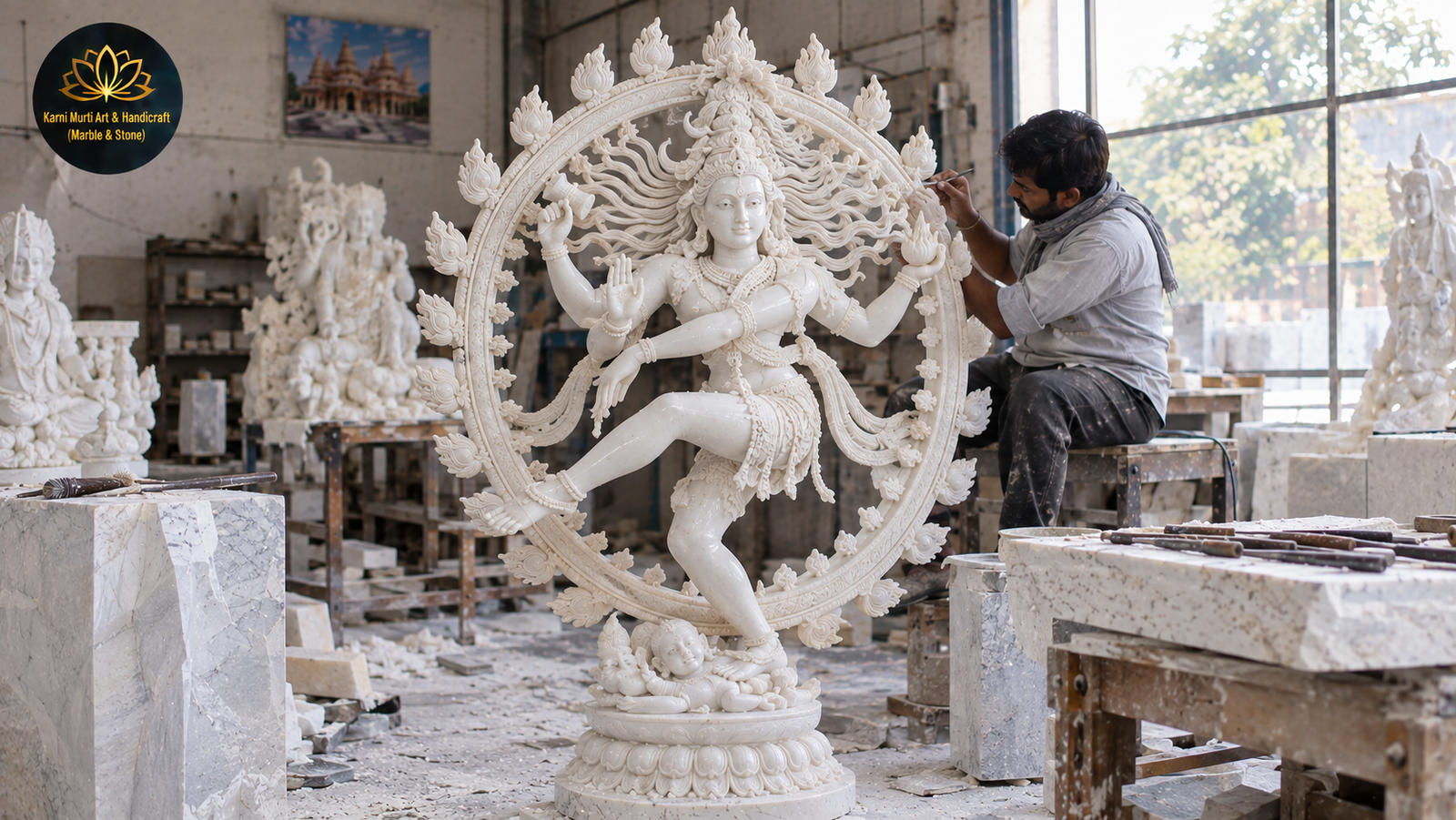
The second is a workshop that carves its own statues. At Kamal Moorti & Painting Kala Kendra in Jaipur, artisans work each piece by hand, from a raw marble block to the final polish. Alongside the established Krishna and Radha Krishna collections, hand carved Shiva statues are a newer part of the range, and Nataraj is one of the forms customers ask about. Orders are shipped to buyers in Chennai and across Tamil Nadu.
What Makes a Nataraj Hard to Carve
If you have ever stood in front of a Nataraj and wondered how anyone makes this from a single block of stone, you are asking the right question. The form is packed with detail, and almost every part of it is a challenge for a carver.
Shiva stands on one leg, balanced on a small figure of the dwarf Apasmara, who represents ignorance. The other leg is lifted and crossed in front of the body. One of his hands holds the small drum, the damaru, and another holds a flame. A third hand is raised in a gesture of reassurance, and the fourth points down towards the lifted foot. His long matted locks fly out on either side. Around everything runs the ring of fire, the prabhavali.
In marble, each of these has to be placed so the statue stays strong. The lifted leg, the flying locks and the arch are the points where a statue can chip over the years. A good carver plans how the arch joins the figure and the base, keeps the thin parts thick enough to last, and chooses a block with an even grain. This is why it is worth asking a workshop directly how they handle those parts of the design before you place an order.
Forms and Finishes You Can Ask For
The classic form is Nataraj within a full ring of fire, standing on a lotus base. This is the one most families picture, and it is the most elaborate.
Some buyers prefer a Nataraj without the full arch, with just the dancing figure on a base. It is simpler to carve and easier to place on a shelf. Others ask for a smaller table-top Nataraj for a dance studio or a desk.
On finish, a plain polished white marble Nataraj has a calm, sculptural look that suits a modern home. A painted one, with colour on the damaru, the flame and the jewellery and gold on the crown, feels closer to the traditional temple image. Neither is more correct. It depends on the room and on what your family is used to seeing.
Nataraj in a City of Dancers
Chennai is also one of the great centres of Bharatanatyam, and Nataraja is the dancer’s own deity. Many dance schools keep an image of Nataraja in the classroom, and dancers commonly offer a prayer to him before they perform. Every year the December and January music and dance season fills the city’s halls with performances.
For that reason, a marble Nataraj is a thoughtful gift for a young dancer, a dance teacher or a school. Families sometimes choose one to mark a milestone such as a first stage performance. If you are thinking along these lines, a compact table-top size is usually the practical choice, and it is worth mentioning the purpose when you speak to the workshop.
How Ordering From Chennai Works
You do not need to travel to Jaipur to order. The usual route starts with a conversation. You tell the workshop which form you want, how big the space is, whether you would like the full ring of fire, and how much painted detail you prefer. A few reference photos make this much easier, particularly for a form as detailed as Nataraj.
Because this is a newer line and a complex form, ask the workshop to confirm the design is workable before you commit, and ask for a rough timeline. During carving, progress photos can usually be shared, which is useful when you cannot visit. When the statue is finished, it is packed and shipped to Chennai.
Shipping From Jaipur to Chennai
Chennai is a long way from Jaipur, and a Nataraj has more delicate parts than most statues. The arch, the raised leg and the hands all need protection. Before you confirm an order, ask how the statue will be padded and crated, whether the arch travels attached or separately, and whether the packing is built to the shape of the piece. A statue that is properly packed will make the road journey without trouble. A poorly packed one is the usual reason for chips on arrival.
Where a Nataraj Sits at Home
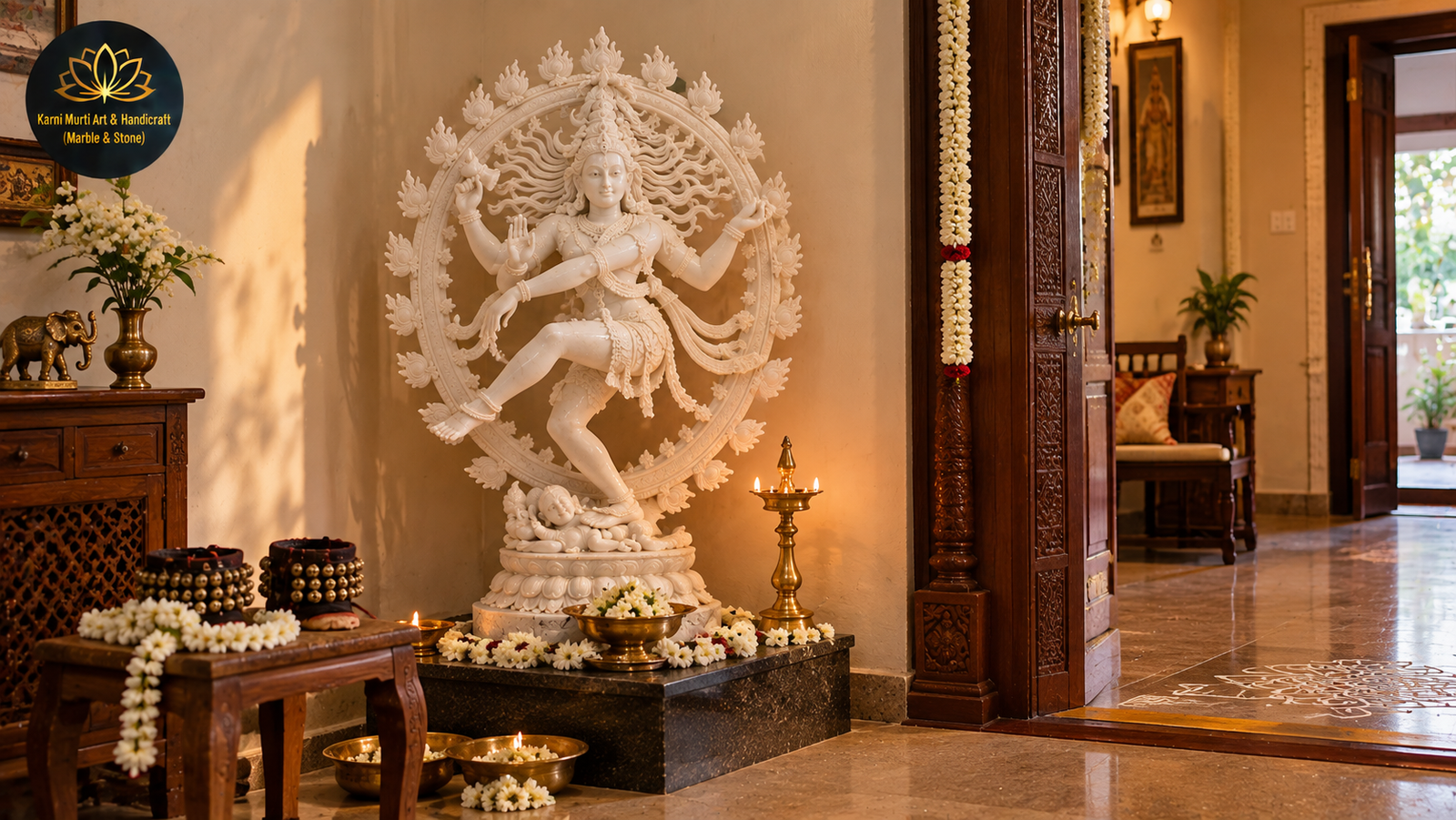
Families place Nataraja in different ways. Some keep him in the pooja room, others in a living space or a dance room, and customs vary between households and traditions. If your family follows a particular practice, follow that. The practical points are simpler. Choose a firm, level surface, leave some space around the arch so it is not knocked, and check that the shelf can take the weight, since marble is heavy. Our guide to marble statue weight covers this in more detail.
Questions to Ask Any Seller
Whether you are comparing a Jaipur workshop with a shop in Chennai, or two workshops with each other, ask the same questions each time. Do they carve the statue themselves, or resell it? What is it made of? Composite material sold as marble is common enough in the wider market that this is worth asking, and our guide to identifying authentic marble statues explains simple checks you can try. Can they show progress photos? How will the arch and limbs be protected in transit?
A seller who answers these plainly, without hurrying you, is usually one you can trust.
Frequently Asked Questions
Is marble Nataraj manufacturing done in Chennai?
Chennai and Tamil Nadu are famous for bronze casting and stone temple sculpture. Hand carved white marble idols mostly come from Jaipur, so buyers in Chennai usually order from a workshop there.
How long does a marble Nataraj take to make?
It depends on the size and how detailed the figure and arch are. A Nataraj generally takes longer than a simple standing figure. Ask the workshop for an estimate once the design is fixed, plus shipping time to Chennai.
Can I get a Nataraj with the full ring of fire?
It can be requested, and it is the classic form. Because the arch is a delicate part of a marble statue, confirm with the workshop how it will be built and supported before you order.
Is a marble Nataraj suitable for a dance school?
Yes, many buyers choose a compact marble Nataraj for a dance studio or as a gift for a dancer. A table-top size is usually the easiest to place.
How is a Nataraj kept safe on the way to Chennai?
It should be padded and crated to the shape of the piece, with extra care around the arch, raised leg and hands. Ask the workshop about packing before you order.
A Nataraj Made by Hand for Your Chennai Home
A marble Nataraj is one of the more difficult pieces a carver can take on, and it is worth speaking to the people who make it before you decide. Kamal Moorti offers hand carved Shiva statues as a newer addition alongside its established range of marble Krishna statues and Shree Radhe Krishna pair designs. If you are also planning a home shrine, the marble temple collection is worth a look. Everything is made in the Jaipur workshop and shipped across India, including Chennai and the rest of Tamil Nadu.
To discuss your Nataraj, share reference images and get a quote and timeline for delivery to Chennai, reach out through the contact page, read more on the About Us page, or call +91-9829678999 to place your order.