Families in St. Catharines and the wider Niagara region are part of Ontario’s large Hindu community, and Shiva is central to how many of them worship at home. A Shiva temple serving the region, the Niagara Hindu Samaj Shiv Mandir, sits in nearby Niagara Falls, and for the big nights of the year, especially Maha Shivaratri, many households also travel to larger temples in Hamilton or the Toronto area. A marble Shiva statue lets a family keep that devotion at home the rest of the year. What buyers here often haven’t worked out is where a hand-carved statue comes from, and what to check before ordering one from overseas.
Kamal Moorti & Painting Kala Kendra, the manufacturer behind statuesworld.com, carves marble Shiva statues at its own facility in Jaipur, Rajasthan, alongside a wide catalog of other Hindu deity moortis. Its range includes a Shiv Ji statue and a Shiv Parivar statue showing the divine family together. This guide covers how the manufacturing works, what the details of a Shiva statue mean, and the practical side of ordering one for delivery to St. Catharines.
Manufacturing in Jaipur, Not Ontario
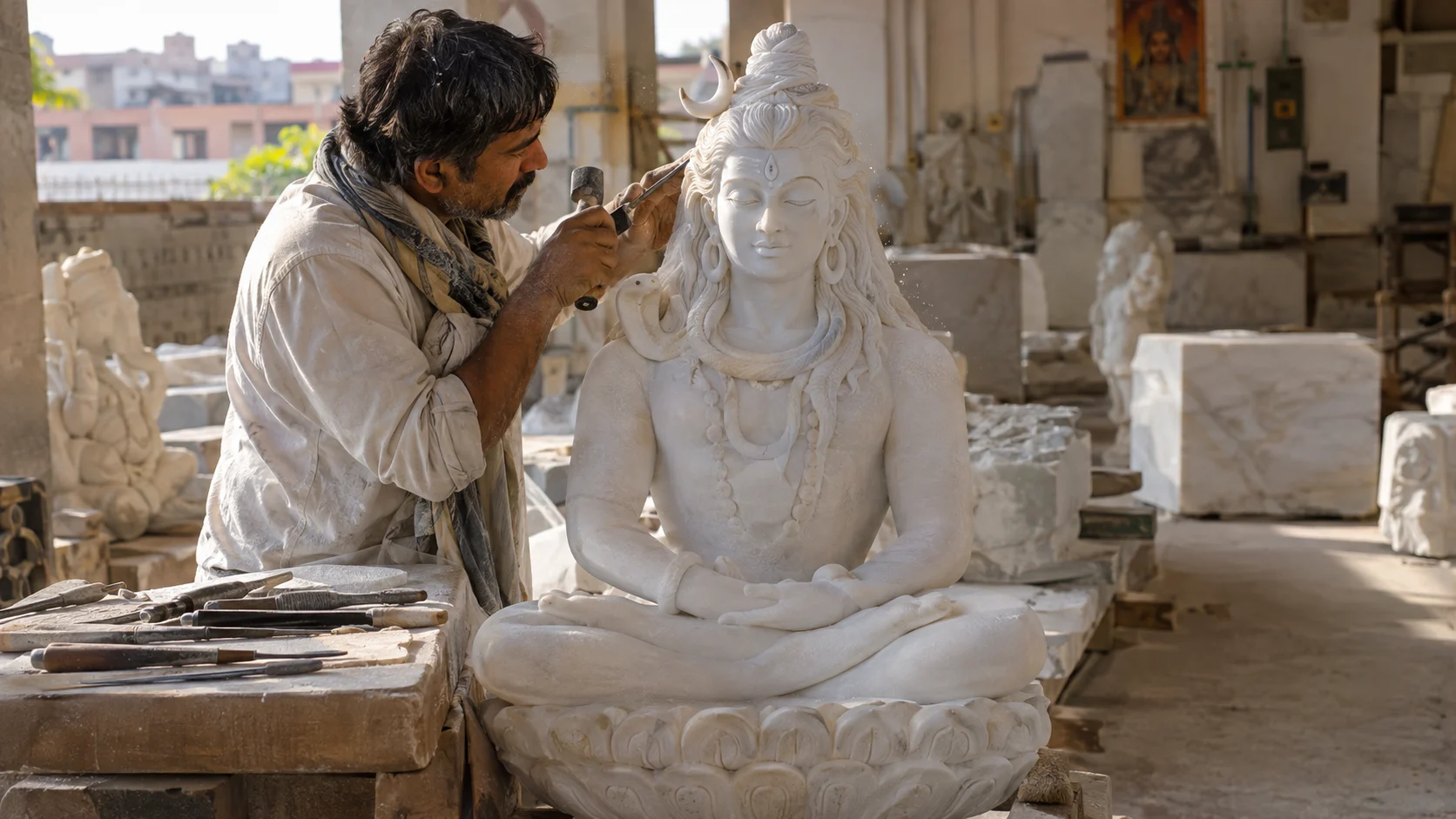
To be clear from the start, the carving happens in Jaipur. When someone searches for a “Shiva statue supplier in Ontario,” they usually mean a manufacturer that reliably ships to and serves this province, not a workshop based here. Kamal Moorti & Painting Kala Kendra runs an in-house operation with a fabrication unit, a design unit and a warehouse, built around polishing machines, electrical cutting saws and other stone-working equipment. That matters because each statue goes through selection, carving, polishing and finishing under one roof, instead of being sourced from unrelated third parties and resold.
What a Shiva Statue Represents
Shiva is shown with a set of attributes that each carry meaning. His matted hair holds a crescent moon, often read as a sign of time and its cycles, and the river Ganga flows from it, a reference to the story of him catching the falling river in his hair to protect the earth. A third eye sits in the middle of his forehead, representing insight beyond ordinary sight. His throat is blue, from the poison he held there to save the world, which is why he is called Neelkantha. Ash is smeared on his body as a reminder that life is temporary, and he often holds a trident and a small drum called a damaru, with a snake around his neck. A bull named Nandi, his companion and gatekeeper, often sits in front of him.
The most common home statue shows Shiva seated in meditation. The Shiv Parivar form shows Shiva with Parvati, Ganesh and Kartikeya, which many families prefer for a household altar. A carving that leaves out the third eye, the crescent moon or the flowing Ganga loses part of what makes it recognizably Shiva, so check these details in product photos before ordering.
Why Hand-Carved Marble Holds Up
Marble is a metamorphic rock, formed when limestone recrystallizes under intense heat and pressure over long geological periods. Its main mineral, calcite, sits at roughly 3 on the Mohs hardness scale, soft enough to allow fine detail like matted locks and a third eye, while the recrystallized structure still gives the finished stone real durability. Denser, higher-grade marble is also less porous, which is why a well-finished statue keeps its polish and resists staining far longer than a lower-grade block.
According to the manufacturer’s own description of its process, raw marble selection, carving, polishing and final detailing are treated as separate stages, with artisans combining hand-carving and modern tools to get proportions and expression right. On a Shiva statue, the calm of the face and the flow of the hair are usually where skill differences between workshops show up first. For a closer comparison of hand-carved and factory-made work, the hand-carved versus factory marble quality guide for Canadian buyers goes into more detail.
Choosing the Right Statue for a St. Catharines Home
Homes in St. Catharines range from older houses in the downtown and Port Dalhousie areas to newer builds on the city’s edges, so size varies a lot. A meditating Shiva on a low base fits a shelf or a small altar, while a Shiv Parivar with several figures needs a wider, deeper surface. The size and space planning guide for Canadian homes is a useful starting point, since a solid carved statue cannot be resized after delivery.
Timing matters too. Maha Shivaratri falls in late winter, and many families bring a new statue home before it. Because international stone shipments take real time, and winter weather can slow the final leg of delivery, order well ahead of the date.
Customization
Because the statues come from an in-house workshop and not a fixed third-party catalog, there is generally more room to request changes than with a pre-made import. That can mean the pose, whether Nandi is included, a plain white finish instead of a painted one, or a particular base. The custom marble statue guide for Canadian homes and climates explains how these requests usually affect cost and turnaround.
What Affects the Price
A few factors consistently drive the cost of a marble Shiva statue:
- Number of figures. A Shiv Parivar with four figures takes far more carving time than a single seated Shiva.
- Size. Cost does not rise in a straight line with height, because larger pieces need proportionally more raw marble and carving time.
- Marble grade. Whiter, more uniform stone with fewer visible veins costs more than marble with heavy natural streaking.
- Detail level. Fine work on the hair, the snake and the Ganga takes longer than a simpler finish.
- Customization. Any request outside the standard design adds cost and lead time.
Shipping From Jaipur to St. Catharines
A few things are worth confirming before you order, not after:
Packaging and insurance. Ask how the statue will be crated and whether the shipment is insured for its full value against transit damage. Marble cracks or chips instead of flexing if it shifts inside a poorly padded crate, and a trident or a trailing lock of hair is a thin, exposed section.
Customs and import charges. Shipments into Canada go through the Canada Border Services Agency, and both tariff classification and GST typically apply to imported goods, though the exact treatment depends on how the item is classified and can change over time. Confirm current classification and charges with CBSA or a licensed customs broker before finalizing the order. Because Ontario also applies provincial sales tax rules, ask your broker to confirm the full tax picture for your delivery address.
Timeline. International stone shipments take real time. St. Catharines sits close to the Toronto area, so the final leg after clearing customs is usually shorter than for prairie or Atlantic destinations, but it is still worth confirming an estimated delivery window with the manufacturer directly.
Caring for the Statue Through an Ontario Winter
Niagara’s climate is milder than much of Canada, with lake-effect snow and humid summers, but indoor heating still dries the air for months. Dust the statue with a soft, dry cloth instead of a wet one where possible, keep it out of the direct airflow of a heating vent, and keep it away from acidic liquids. This one matters for Shiva statues in particular, because milk, honey and fruit juices are used in some abhishekam rituals, and marble is calcium carbonate that reacts with acids, so juices and other acidic offerings can dull or etch the surface. Wipe the statue dry soon after any ritual bathing. The winter care and freeze-thaw guide for Canadian marble statues and the year-round preservation guide for Canadian seasons go into more depth than fits here.
A Shiva statue often becomes a long-term family piece. The guide to marble statues as Canadian family heirlooms and the climate-integrated home display guide are worth reading if you are thinking about where the statue will live for years.
Checking for Authenticity
Not everything sold as a “marble Shiva statue” online is solid carved marble. Some are marble-dust composite or resin pieces finished to look similar in photographs. Genuine marble feels heavy for its size, is cool to the touch and shows faint, non-repeating natural veining, since no two blocks of marble carve identically. A composite piece tends to be lighter, warmer and more uniform in surface texture. The natural versus artificial marble guide walks through how to tell the two apart before ordering internationally.
If you are comparing sourcing details from another Canadian market, the Shiva marble statue manufacturing guide for Calgary buyers covers much of the same ground.
Frequently Asked Questions
Is the Shiva statue carved in St. Catharines or somewhere else?
It is carved at the manufacturer’s facility in Jaipur, India. St. Catharines is the destination the statue ships to, not where it is produced.
Why is Shiva’s throat blue?
According to the traditional story, Shiva held a deadly poison in his throat to save the world, and it left a blue mark. That is why he is called Neelkantha, the blue-throated one.
What is the difference between a Shiva statue and a Shiv Parivar statue?
A Shiva statue shows him alone, usually in meditation. A Shiv Parivar shows the whole family, with Parvati, Ganesh and Kartikeya beside him, and needs more space.
Can I pour milk or juice over a marble Shiva statue?
Milk and honey are used in some rituals, but marble is sensitive to acids, so fruit juices can damage the surface. Wipe the statue dry soon after any ritual bathing, and ask the manufacturer for finishing advice if you plan to perform abhishekam regularly.
Will I owe duty or GST when the statue arrives in Ontario?
Possibly. Import charges depend on how the shipment is classified at the border, and rates and classifications can change, so confirm current details with the Canada Border Services Agency or a customs broker before ordering.
Getting in Touch
If you are considering a Shiva statue for a St. Catharines home or temple and want guidance on size, pose or customization, Kamal Moorti & Painting Kala Kendra can be reached at +91-9829678999 or +91-7014383187, or by email at mahendra4royals@gmail.com. The full catalog of marble moortis is available at statuesworld.com.