The Portland area has a dedicated Hanuman temple of its own: the Jaya Hanuman Temple in Beaverton, which serves devotees across the metro area and keeps Hanuman as its primary deity. For a lot of households in and around Portland, that kind of temple is where the big occasions happen, especially Hanuman Jayanti, the festival marking his birth. A marble Hanuman statue lets a family keep that devotion at home the rest of the year. What many buyers haven’t worked out yet is where a hand-carved statue comes from, and what to check before ordering one from overseas.
Kamal Moorti & Painting Kala Kendra, the manufacturer behind statuesworld.com, carves marble Hanuman statues at its own facility in Jaipur, Rajasthan, alongside a wide catalog of other Hindu deity moortis. Its range includes Hanuman Ji and Sarangpur Hanuman Ji statues, as well as a Ram Darbar statue. This guide covers how the manufacturing works, what the details of a Hanuman statue mean, and the practical side of ordering one for delivery to Portland.
Manufacturing in Jaipur, Serving the Portland Market
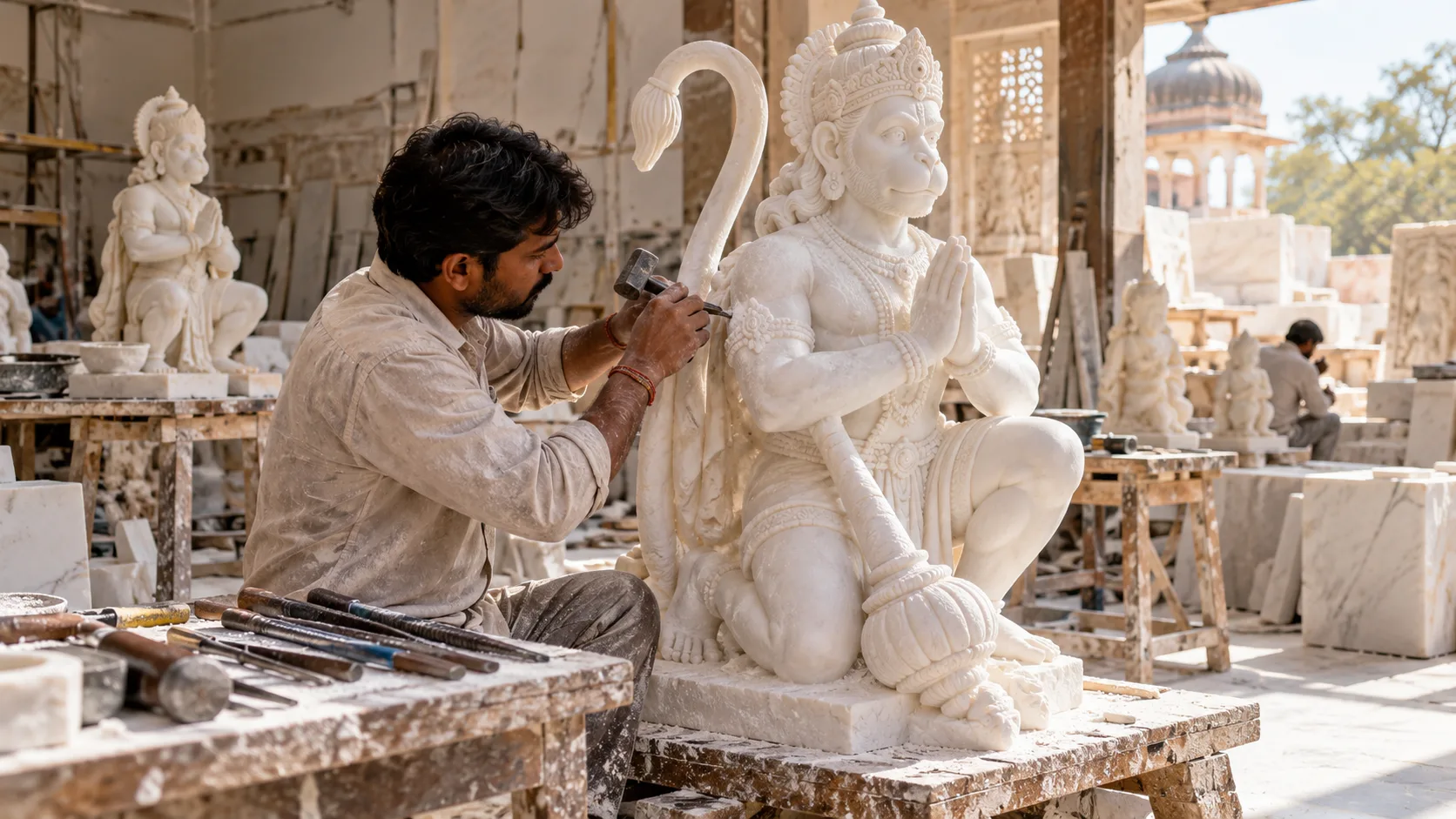
To be clear from the start, the carving happens in Jaipur, not Oregon. When someone searches for a “Hanuman statue supplier in Oregon,” they usually mean a manufacturer that reliably ships to and serves this market, not a workshop based here. Kamal Moorti & Painting Kala Kendra runs an in-house operation with a fabrication unit, a design unit and a warehouse, built around polishing machines, electrical cutting saws and other stone-working equipment. That matters because each statue goes through selection, carving, polishing and finishing under one roof, instead of being sourced from unrelated third parties and resold.
What a Hanuman Statue Represents
Hanuman is the Ramayana’s great devotee of Rama, and his image is built around that loyalty. He is usually shown with powerful shoulders and chest, and often carries a mace, the gada, which stands for the strength used to defend dharma. In one very common pose he holds a mountain in his raised palm, recalling the moment he lifted an entire Himalayan mountain to bring the Sanjeevani herb that saved Lakshmana’s life. In another, he tears open his chest to reveal Rama and Sita seated in his heart, a picture of devotion with nothing held back. Many temple images are covered in vermilion, linked to the story of Hanuman smearing himself with the red powder Sita wore.
He is often placed beside Rama, standing a little lower than Rama’s hip or chest, with a hand raised in devotion. Many families who keep Rama and Sita on the altar add a Hanuman to complete it, and the Ram Darbar statue, which shows Rama, Sita, Lakshmana and Hanuman together, is one way to do that in a single piece.
These details matter when comparing statues, since a carving that gets the mace, the mountain or the chest-opening pose wrong loses part of what makes it recognizably Hanuman rather than a generic monkey figure.
Why Hand-Carved Marble Holds Up
Marble is a metamorphic rock, formed when limestone recrystallizes under intense heat and pressure over long geological periods. Its main mineral, calcite, sits at roughly 3 on the Mohs hardness scale, soft enough to allow fine detail in muscles and a mace, while the recrystallized structure still gives the finished stone real durability. Denser, higher-grade marble is also less porous, which is why a well-finished statue keeps its polish and resists staining far longer than a lower-grade block.
According to the manufacturer’s own description of its process, raw marble selection, carving, polishing and final detailing are treated as separate stages, with artisans combining hand-carving and modern tools to get proportions and expression right. On a Hanuman statue, the face and the balance of the pose are usually where skill differences between workshops show up first. For a closer comparison of hand-carved and factory-made work, the hand-carved versus factory marble comparison and the quality standards guide go into more detail.
Choosing the Right Statue for a Portland Home
Homes in Portland range from older bungalows in the inner neighborhoods to larger houses in Beaverton, Hillsboro and Lake Oswego, so size varies a lot. A kneeling or seated Hanuman fits a shelf comfortably, while a standing pose with a mace and a mountain needs more vertical clearance and a stable base. The statue size guide for American homes is a useful starting point, since a solid carved statue cannot be resized after delivery.
Timing matters too. Many families bring a new statue home before Hanuman Jayanti, which falls in spring. Because international stone shipments take real time, order well ahead of the date.
Customization
Because the statues come from an in-house workshop and not a fixed third-party catalog, there is generally more room to request changes than with a pre-made import. That can mean the pose, whether the mountain or mace is included, a plain white finish instead of a painted one, or a particular base. The custom marble statue design and pricing process explains how these requests usually affect cost and turnaround.
What Affects the Price
A few factors consistently drive the cost of a marble Hanuman statue:
- Pose. A standing figure with a mace, a mountain and a flowing tail takes more carving time and structural care than a seated one.
- Size. Cost does not rise in a straight line with height, because larger pieces need proportionally more raw marble and carving time.
- Marble grade. Whiter, more uniform stone with fewer visible veins costs more than marble with heavy natural streaking, and the black and white marble comparison guide helps if you are weighing finishes.
- Detail level. Fine work on the muscles, the crown and the jewelry takes longer than a simpler finish.
- Customization. Any request outside the standard design adds cost and lead time.
Shipping From Jaipur to Portland
A few things are worth confirming before you order, not after:
Packaging and insurance. Ask how the statue will be crated and whether the shipment is insured for its full value against transit damage. Marble cracks or chips instead of flexing if it shifts inside a poorly padded crate, and a raised mace or a held mountain is a thin, exposed section.
Customs classification. Under U.S. tariff rules, “original sculptures and statuary” made by a recognized professional artist, generally one-of-a-kind or very limited-edition pieces, can qualify for a duty-free classification. A manufactured devotional statue produced as part of a standard catalog is typically classified differently and may carry duty. Because classifications and rates change and can vary by country of origin, confirm current details with U.S. Customs and Border Protection or a licensed customs broker before finalizing an order.
Timeline. International stone shipments take real time. Portland is a West Coast port region, but the final leg still depends on where the shipment clears customs, so confirm an estimated delivery window with the manufacturer directly.
Caring for the Statue in the Pacific Northwest
Portland has mild, damp winters and dry summers. Dust the statue with a soft, dry cloth instead of a wet one where possible, and keep it away from damp corners and acidic liquids, since marble is calcium carbonate and reacts with acids, which can dull or etch the surface. Hanuman worship brings one extra concern: vermilion paste and oil are traditionally applied to his statue, and both can stain light marble, especially if left to soak in. If you plan to apply them, test a small hidden spot first, wipe off excess promptly, and ask the manufacturer for finishing advice. The USA-focused marble statue care guide covers a fuller routine.
A Hanuman statue often becomes a long-term family piece. The guide to marble statues as heirlooms is worth a read if you are thinking about how long the statue will stay in your home.
Checking for Authenticity
Not everything sold as a “marble Hanuman statue” online is solid carved marble. Some are marble-dust composite or resin pieces finished to look similar in photographs. Genuine marble feels heavy for its size, is cool to the touch and shows faint, non-repeating natural veining, since no two blocks of marble carve identically. A composite piece tends to be lighter, warmer and more uniform in surface texture. The natural versus artificial marble guide walks through how to tell the two apart before ordering internationally.
If you are comparing sourcing details from another West Coast market, the Hanuman marble statue manufacturing guide for Los Angeles buyers covers much of the same ground.
Frequently Asked Questions
Is the Hanuman statue carved in Portland or somewhere else?
It is carved at the manufacturer’s facility in Jaipur, India. Portland is the destination the statue ships to, not where it is produced.
Why does Hanuman hold a mountain?
It recalls the Ramayana episode in which he carried an entire mountain from the Himalayas to bring the Sanjeevani herb that saved Lakshmana’s life. It is read as a picture of devotion that goes to any length.
Why is Hanuman often shown with his chest open?
That pose shows Rama and Sita seated in his heart. It is one of the best-known images of his devotion.
Can I apply vermilion or oil to a marble Hanuman statue?
Both are traditional, but they can stain marble. Test a hidden spot first, wipe off excess promptly and ask the manufacturer for finishing advice.
Will I owe customs duty on a statue shipped to Oregon?
Possibly, depending on how the shipment is classified under current U.S. tariff rules. Since classifications and rates change, confirm details with U.S. Customs and Border Protection or a customs broker before ordering.
Getting in Touch
If you are considering a Hanuman statue for a Portland home or temple and want guidance on size, pose or customization, Kamal Moorti & Painting Kala Kendra can be reached at +91-9829678999 or +91-7014383187, or by email at mahendra4royals@gmail.com. The full catalog of marble moortis is available at statuesworld.com.