Most of the blogs people read about marble idols are written for buyers in other cities, explaining why a Ganesh marble moorti manufacturing Jaipur is worth ordering from far away. If you live in Jaipur, you are in a different position. You are standing in the middle of the craft. The workshops are a short drive away, and you can, if you want to, watch the stone being shaped.
That is a real advantage, and it is worth knowing how to use it. This guide is for anyone in Jaipur or elsewhere in Rajasthan who wants to buy a Ganesh marble moorti and would like to understand what separates a well made one from an ordinary one, how to deal with a workshop directly, and what to ask before you pay.
Why Jaipur Is Where Marble Ganesh Idols Are Made
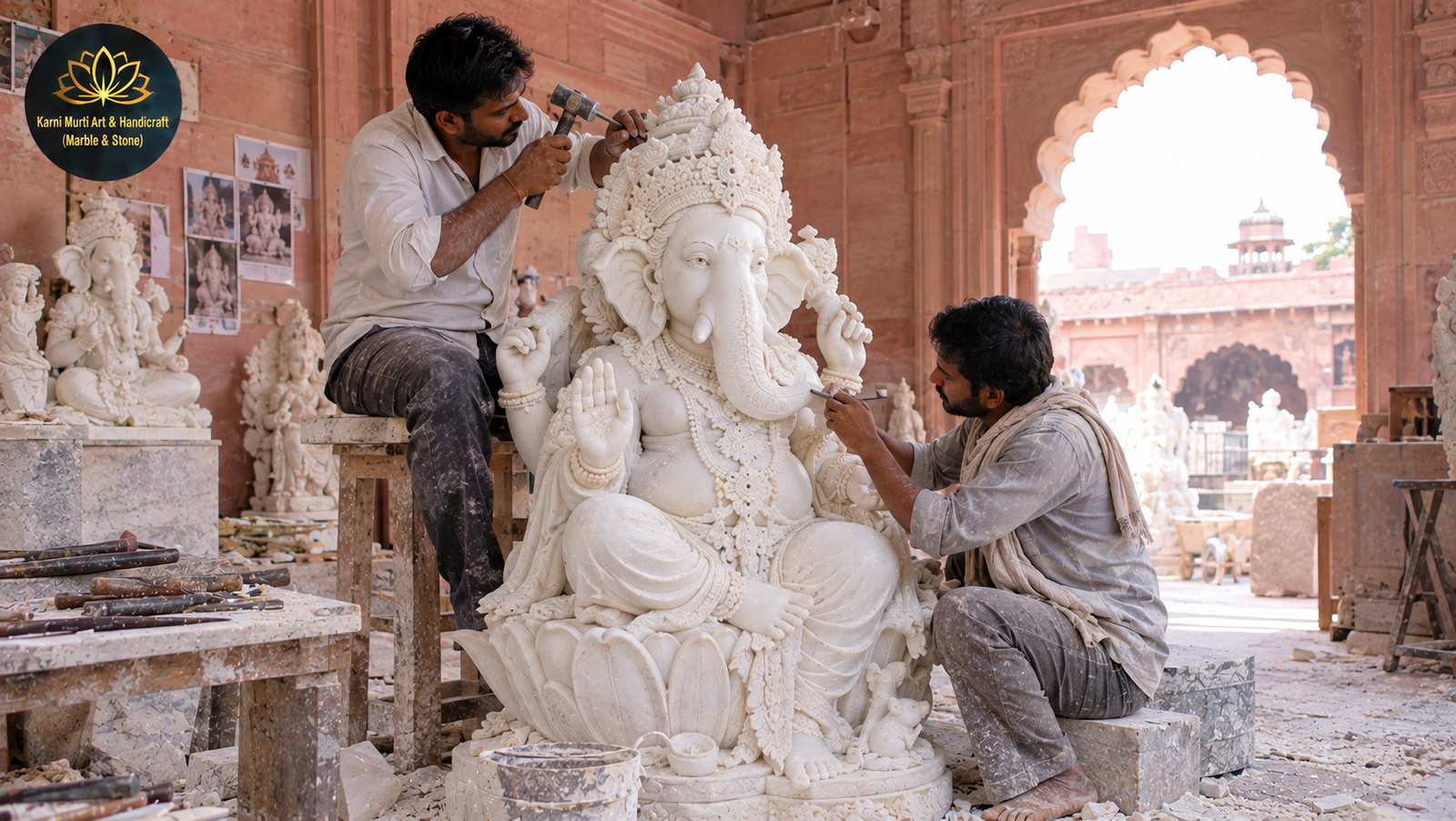
Marble idol carving in Jaipur is not a recent business. The stone comes from Rajasthan, and the skill has been handed down inside carving families for generations. A young carver learns by working beside an older one, usually for years, starting with simple jobs like roughing out a block and moving gradually to faces, hands and fine ornament.
That long apprenticeship matters most in a figure like Ganesh. His face is the whole statue. The trunk has to curve naturally, the eyes have to look calm and kind, and the large ears and round belly have to be in proportion without looking like a cartoon. An experienced carver gets these right almost by habit. A rushed one does not.
Who Actually Makes the Statue
Search for a Ganesh moorti supplier in Rajasthan and you will find a wide mix. Some are workshops that carve their own statues. Others are showrooms and traders that buy finished pieces and sell them on. Both exist in Jaipur, sometimes on the same street, and from the outside they can look very similar.
At Kamal Moorti & Painting Kala Kendra, statues are hand carved in the workshop’s own facility at Chandpol Bazar, Jaipur. Artisans shape each piece from a raw block of marble through to the final finish, and the painting is done in the same place. Ganesh statues are a newer addition to the range, alongside the established Krishna and Radha Krishna collections.
Why does this matter? Because the person who carved the statue is the person who can answer your questions. If you want the trunk turned the other way, a different base or less paint on the crown, you are talking to the people who can do it.
What Being Local Lets You Do
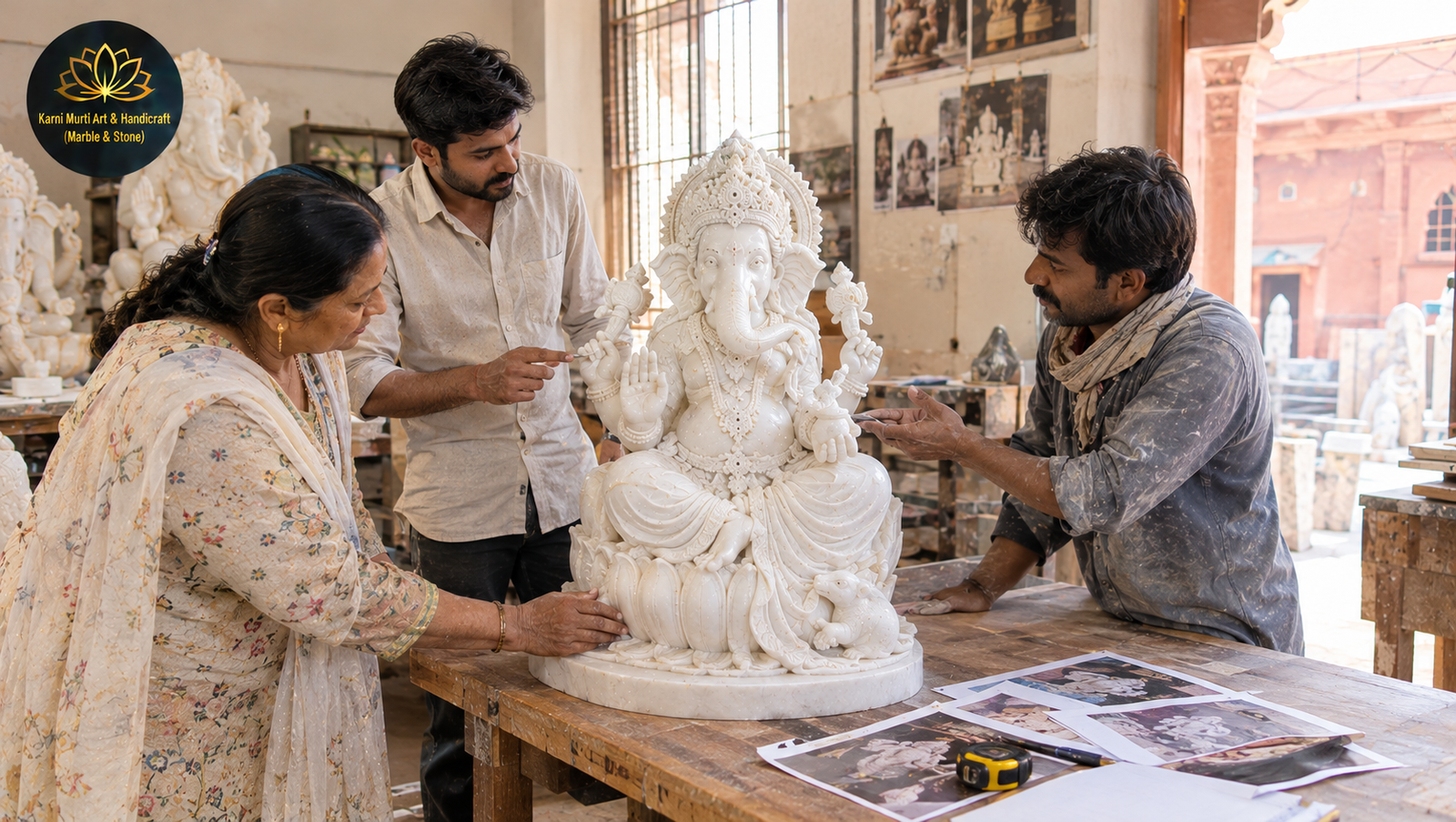
If you are in Jaipur, you have options that an out-of-town buyer does not. You can discuss the design face to face, look at a statue in progress, and check the finish in daylight rather than relying on a phone photo. It is sensible to call before you go, so the team knows when to expect you.
A few things are worth doing during a visit.
Look at the face from several angles, not just the front. Run your eye along the lines of the trunk and the folds of the dhoti and see whether they flow or look stiff. Check the base, which is often where hurried work shows. Ask to see the back of the statue, since the back is where a carver who cuts corners is most likely to have done so. And ask how long a piece of that size takes, so you plan around real timelines.
Choosing the Right Form of Ganesh
Ganesh is carved in many forms, and the choice depends on where the statue will sit and what it is for.
The seated Ganesh holding a modak, with the trunk curving toward the sweet, is the most common form for a home temple. It has a settled, gentle look and works at nearly any size. The Lalbaugcha Raja style of seated Ganesh, larger and more ornate, is often asked for by families who want a festival presence.
A standing or dancing Ganesh has more movement and is a good choice for an entrance or a living room. Ganesh with Riddhi and Siddhi suits a larger pooja room or a shop. A small Ganesh with a mouse at his feet is a popular size for a car dashboard, a desk or a gift.
For the trunk, many families prefer a left-turning trunk for home worship, while a right-turning one is often considered to need stricter rituals. Customs differ between households and traditions, so ask your own family or priest, and tell the workshop what you need.
Finish: Painted, Gold Accents or Plain White
A plain polished white marble Ganesh looks calm and lets the carving speak for itself. It suits a modern home and tends to age well. A fully painted one, with colour on the clothes and gold on the crown and jewellery, feels closer to a traditional temple image and is more eye-catching on a festival day.
A middle path is white marble with a little gold on the crown, the ornaments and the edge of the dhoti. It adds warmth without covering the stone. Painted details need gentler care over the years, so think about how much upkeep you want to take on.
Size and Weight
Marble is heavy, and a Ganesh statue gets heavy quickly as it grows in size. Before you decide, measure the shelf, platform or corner where the statue will stand, and think about whether the surface can take the weight. A small statue is easy to carry. A large one needs two or more people and sometimes a trolley.
If you are in a Jaipur flat with a lift, check the lift door width. In an older house in the walled city, check the staircase. Our guide to marble statue weight goes into this in more detail, and our guide to Krishna statue placement by room size explains how to match a statue to a space, which applies equally to a Ganesh.
Timing: Ganesh Chaturthi and New Beginnings
Ganesh is invoked at the start of everything, so many families order a new statue for a griha pravesh, a shop opening or the start of a business. Ganesh Chaturthi is the other peak, and workshops get busy in the weeks before it.
Hand carving cannot be rushed without it showing in the finish. If you want a custom piece by a certain date, ask early, and ask the workshop for an honest timeline instead of assuming it can be done in a week.
How to Tell a Genuinely Carved Statue From a Resale or a Composite
Not everything sold as a marble Ganesh is solid hand carved marble. Some pieces are cast from marble dust and resin, and some are plain plaster. A few simple checks help.
Pick the statue up. Real marble feels heavy for its size. Touch it. Real marble feels cool and stays cool for a moment. Look at the surface. Natural marble has irregular veining, not a repeating pattern. Ask directly what the statue is made of and who carved it. Our guide to identifying authentic marble statues covers these checks in more detail.
A reliable seller will welcome these questions.
Ordering From Outside Jaipur
If you are reading this from another city in Rajasthan, you do not need to travel. A typical order starts with a call or message describing the form, size and finish you want, with reference photos if you have them. The workshop confirms what is possible, gives a timeline and quote, and shares progress photos during carving. The finished statue is packed and sent to you.
Kamal Moorti ships across India, and buyers abroad can discuss international orders directly with the team.
Packing and Handling
A well packed statue is the difference between a piece that arrives perfectly and one that arrives chipped. The trunk, ears and the edge of the base are the most fragile points on a Ganesh statue. Ask how the statue will be padded and crated, whether delicate parts get extra support, and who will handle the delivery. If you are collecting it in person, bring a blanket or padded box and move it with two people.
Questions to Ask Before You Buy
Ask whether the workshop carves the statue itself or resells it. Ask what marble is used and where it comes from. Ask whether you can see work in progress. Ask what customisations are possible and what they do to the timeline. Ask how the statue will be packed. And ask for the quote in writing, so you know what is included.
Frequently Asked Questions
Where can I buy a hand carved Ganesh marble idol in Jaipur?
You can order directly from a workshop that carves its own statues. Kamal Moorti & Painting Kala Kendra makes hand carved marble statues at its workshop in Chandpol Bazar, Jaipur, and Ganesh statues are a newer part of the range. Call ahead before visiting.
Is it cheaper to buy a Ganesh moorti directly from the workshop?
Often, yes, because there is no extra reseller margin, and you also get more say over size, finish and design. The final price depends on size, detail and finish.
How long does a hand carved Ganesh statue take?
It depends on the size and the amount of detail and painting. Small simple pieces take less time than large ornate ones. Ask for an estimate once your design is fixed, and allow extra time before Ganesh Chaturthi.
Can I choose the direction of the trunk?
Yes. Because each statue is carved individually, the trunk direction, pose, base and finish can be discussed before carving begins. Check your family’s custom first.
Do you ship Ganesh statues outside Jaipur?
Yes. Statues are packed and shipped across India, and buyers abroad can discuss international orders with the team.
Bringing Home a Ganesh Made Where the Craft Began
If you live in Jaipur, you have the rare chance to buy a statue from the people who carve it, in the city where marble idol making has long been at home. Kamal Moorti makes hand carved Ganesh statues alongside its established range of marble Krishna statues and Shree Radhe Krishna pair designs. If you are planning a full shrine, the marble temple collection is worth a look.
To discuss your Ganesh moorti, share reference images and get a quote and timeline, reach out through the contact page, read more on the About Us page, or call +91-9829678999 to arrange a visit or place your order.