Hanuman has a particular place in Varanasi. The Sankat Mochan temple near the Assi side of the city is traditionally linked with Tulsidas, the poet who wrote the Ramcharitmanas here, and on Tuesdays and Saturdays the queue to enter can stretch down the lane. Wrestling akharas across the old city still keep an image of Hanuman at the centre of their training ground. For many families in Varanasi, Hanuman is not a distant deity but the one you turn to when something goes wrong.
So it is natural that people here want a proper Hanuman statue at home, and if you have started looking for Hanuman marble moorti manufacturing in Varanasi, you have probably noticed something. There are plenty of places to buy a statue, but very few that can tell you where it was carved. In most cases the answer is Jaipur. This guide explains why, how to choose well, and what to think about before a heavy marble statue is carried into a Varanasi house Hanuman marble moorti manufacturing Varanasi.
Where Marble Hanuman Idols Are Really Made
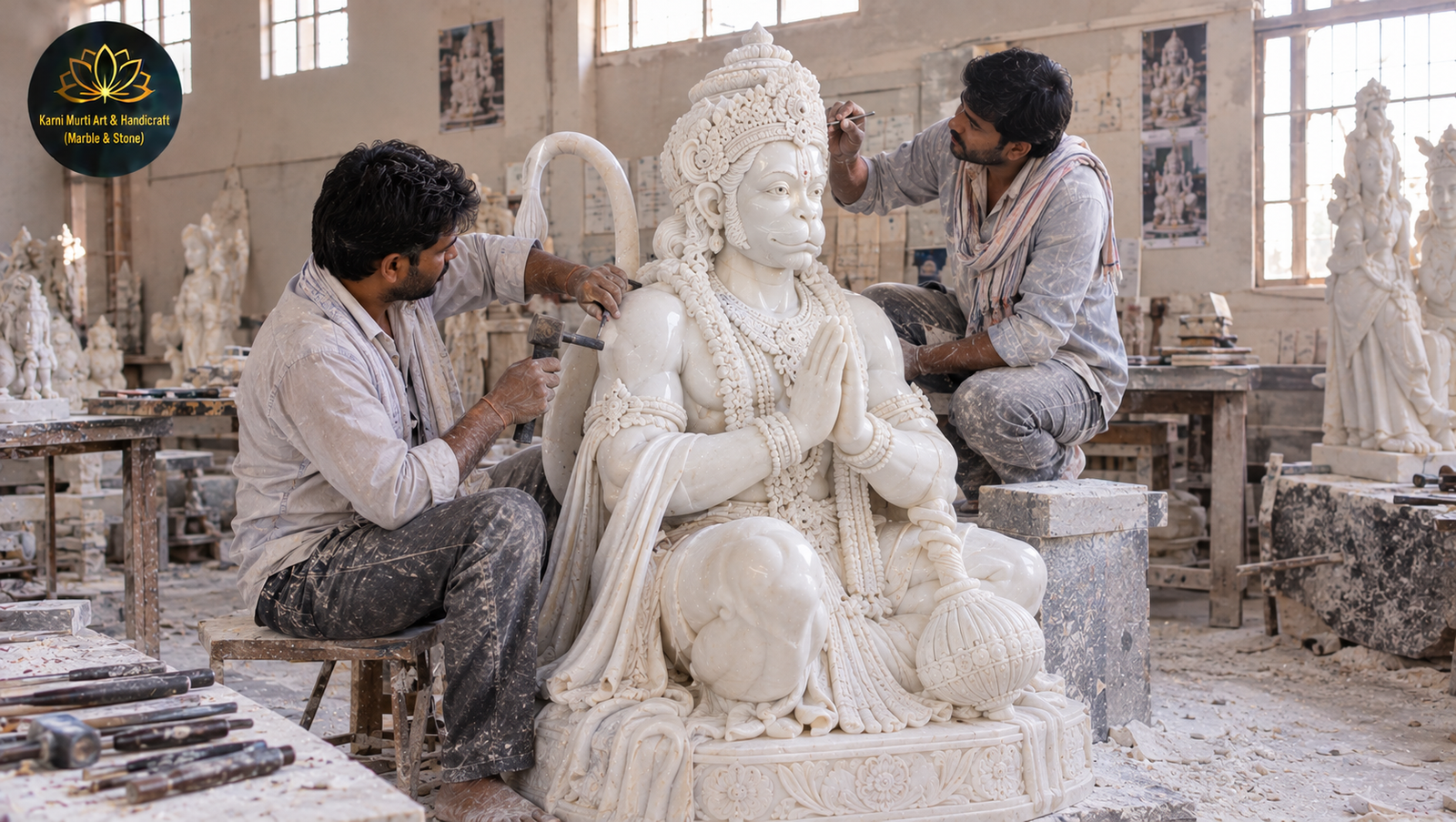
Varanasi is famous for silk weaving, wooden toys, brass work and music. Hand carving white marble idols has never been one of its crafts. That trade grew up around Jaipur, where the stone is sourced within reach and the skill is handed down inside carving families. A young carver learns by working beside an older one for years, moving from rough blocking out to faces, hands and fine ornament.
Hanuman is a demanding subject for that training. The body has to look strong without looking stiff. The face has to be devoted and calm, not fierce for the sake of it. The mace, the folded hands, the tail and the crown all have to be proportionate. When these are right, the statue feels alive. When they are rushed, it looks like a toy.
What a Local Search Usually Turns Up
Look for a Hanuman moorti supplier in Uttar Pradesh and you will mostly meet two kinds of seller.
The first is a retail shop that buys finished statues from a distributor and sells them on. These shops are convenient, and seeing the statue before you pay has real value. But they often cannot tell you who carved a piece, what the marble is, or whether a different pose is possible.
The second is a workshop that carves its own statues. At Kamal Moorti & Painting Kala Kendra in Jaipur, artisans shape each piece by hand from a raw marble block through to the final polish, and the painting is done in the same place. Hand carved Hanuman statues are a newer part of the range, alongside the established Krishna and Radha Krishna collections, and orders are shipped to Varanasi and across Uttar Pradesh.
What You Gain by Ordering From the Workshop
Dealing with the maker changes three things. You get straight answers, because the person who handled the block can tell you what it is and how it was finished. You get choices, since pose, size, base and the amount of painted detail can usually be discussed before carving begins. And you usually get a fairer price, because every reseller between the workshop and your home adds a margin.
Choosing a Form of Hanuman
Hanuman is carved in several forms, and the best one depends on where the statue will stand and what it means to your family.
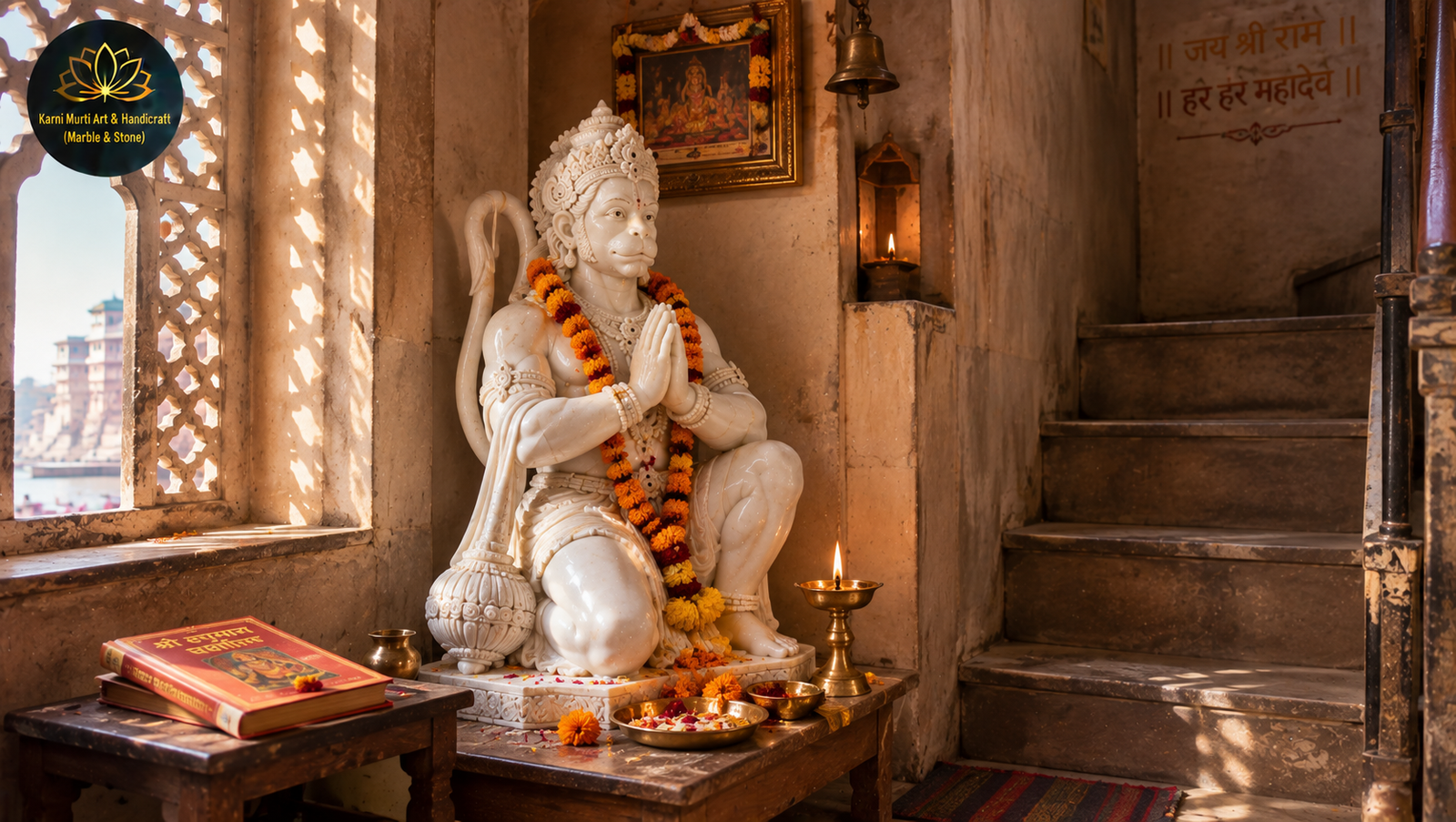
Standing with folded hands. Hanuman in humble devotion, usually facing toward Ram. This is the most common form for a home shrine and sits easily in a small pooja corner.
Seated Hanuman. A calm, settled posture. It works well in a room where people sit to read the Hanuman Chalisa, and it is a good choice for a smaller shelf.
Hanuman with the mace (gada). A protective, strong form, often placed near an entrance or in a gym or akhara.
Hanuman carrying the Sanjeevani mountain. The well known scene from the Ramayana. It is dramatic and detailed, and it needs careful carving of the mountain and the raised arm.
Hanuman tearing open his chest to show Ram and Sita. A form beloved for its message of devotion, and one that families often choose for a main pooja room.
Because Hanuman is so often worshipped with Ram, some families ask whether a Ram Darbar can be made to match. Ask the workshop what is practical for the size and budget you have in mind.
Finish: Natural White or Painted
Many Hanuman statues are painted in saffron or vermilion tones with gold detail on the crown and ornaments, which gives the traditional look. A plain white marble Hanuman is calmer and lets the carving speak for itself. A common middle path is white marble with a little saffron and gold on the clothing and jewellery.
Painted details need gentler care over the years, so consider how much upkeep suits your household.
Size, Weight and Varanasi’s Lanes
This is the part many buyers in Varanasi do not think about until it is too late. Marble is heavy, and a Hanuman statue with a base gets heavy quickly. In the old city, the lanes around the ghats and the narrow staircases of older houses can make it hard to carry a large statue in. Before you choose a size, measure your door width, your stairs and any tight turns, not just the place where the statue will stand.
Think about who will carry it, too. A small statue can be moved by one person. A medium one needs two. A large one may need a trolley, and in some lanes a trolley will not fit. If you live in a multi-storey house with a steep stair, tell the workshop so they can advise on a size you can actually bring home.
Our guide to marble statue weight goes into this in detail, and our guide to Krishna statue placement by room size explains how to match a statue to a space, which applies just as well to Hanuman.
When Families Bring a Hanuman Home
Tuesday and Saturday are the days most associated with Hanuman worship, and many families like to install a new statue on one of those days. Hanuman Jayanti is the biggest occasion, and demand for statues rises beforehand. Others bring a Hanuman home for a housewarming, after a recovery from illness, or before a child starts a demanding exam or a new job.
Hand carving cannot be rushed without it showing in the finish, and shipping takes extra days. If you want your statue in place for a particular day, enquire several weeks ahead and ask the workshop for an honest estimate.
How Ordering From Varanasi Works
You do not need to travel to Jaipur. A typical order starts with a conversation. You describe the form you want, the size that fits your space and the finish you prefer. Reference photos help a great deal. Since Hanuman is a newer line, it is worth asking the workshop to confirm the design is workable and to give you a rough timeline before you commit.
During carving, progress photos can usually be shared. When the statue is finished, it is packed and sent to Varanasi by road.
Packing and Delivery
The fragile points on a Hanuman statue are the mace, the raised hand if he carries the mountain, the tip of the tail and the edge of the base. Ask how the statue will be padded and crated and whether those parts get extra protection. It also helps to confirm who will handle the final delivery to your door, given the lanes. A well packed statue makes the journey from Jaipur without trouble. A poorly packed one is the usual reason for chips on arrival.
Checking What You Are Buying
Not everything sold as a marble Hanuman is solid carved marble. Some pieces are cast from marble dust and resin, and some are plaster. A few simple checks help. Real marble feels heavy for its size, feels cool to the touch and has irregular natural veining. Ask directly what the statue is made of and who carved it. Our guide to identifying authentic marble statues covers these checks in more detail.
Questions to Ask Any Seller
Ask whether the workshop carves the statue itself or resells it. Ask what marble is used and where it comes from. Ask whether you can see work in progress. Ask what customisations are possible and how they affect the timeline. Ask how the statue will be packed and delivered. And ask for the quote in writing, so you know what is included.
Frequently Asked Questions
Is there marble Hanuman moorti manufacturing in Varanasi itself?
Hand carved marble idols mostly come from Jaipur. Varanasi has shops that sell them, but the carving usually happens in Rajasthan. Ordering from the workshop gives you a clearer picture of how the statue was made.
How long does a Hanuman statue take to reach Varanasi?
It depends on the size and the amount of detail. Expect a few weeks for carving and finishing, plus shipping time. Confirm an estimate once your design is fixed, especially before Hanuman Jayanti.
Can I choose the pose, such as Hanuman carrying the mountain?
Yes. Because each statue is carved individually, the pose, size, base and finish can be discussed before carving begins. Complex poses take longer, so ask the workshop to confirm what is practical.
Will a large statue fit through the lanes of the old city?
That depends on your lane and your staircase. Measure doors, stairs and turns before you choose a size, and tell the workshop about any tight access so they can advise.
How is a marble Hanuman statue kept safe on the way to Varanasi?
It should be padded and crated to the shape of the piece, with extra care around the mace, the arms and the tail. Ask the workshop about packing before you order.
A Hanuman Made by Hand for Your Varanasi Home
If you want a Hanuman moorti carved by hand from real marble, the simplest step is to talk directly to the people who make it. Kamal Moorti offers hand carved Hanuman statues as a newer addition alongside its established range of marble Krishna statues and Shree Radhe Krishna pair designs. If you are planning a full shrine, the marble temple collection is worth a look. Everything is made in the Jaipur workshop and shipped across India, including Varanasi and the rest of Uttar Pradesh.
To discuss your requirements, share reference images and get a quote and timeline for delivery to Varanasi, reach out through the contact page, read more on the About Us page, or call +91-9829678999 to place your order.