Chandigarh is a city of students. Panjab University alone fills the area with young people every year, and the schools, colleges and coaching centres of the tricity, which includes Mohali and Panchkula, add thousands more. There is also a steady music, theatre and dance scene, from school competitions to college festivals. Saraswati, the goddess of knowledge, music and the arts, fits this city well.
Each year around Basant Panchami, when much of Punjab turns yellow with clothes, flowers and kites, many families here think about bringing a Saraswati statue home. And a lot of them start with the same search: Saraswati marble moorti manufacturing in Chandigarh. What they find is mostly shops. The carving itself almost always happens in Jaipur.
This guide explains why, what to look for when you choose a Saraswati idol, and how to order one from Chandigarh without making the trip to Rajasthan Saraswati marble moorti manufacturing Chandigarh.
Why Marble Saraswati Idols Are Carved in Jaipur
Chandigarh is known for its planned layout and its modern architecture, not for carving devotional figures. Hand carved white marble idols belong to a trade that grew up around Jaipur, where the stone is sourced within reach and where the skill is passed down inside carving families. A young carver there learns by working beside an older one for years, starting with rough shaping and slowly moving on to faces, hands and fine ornament.
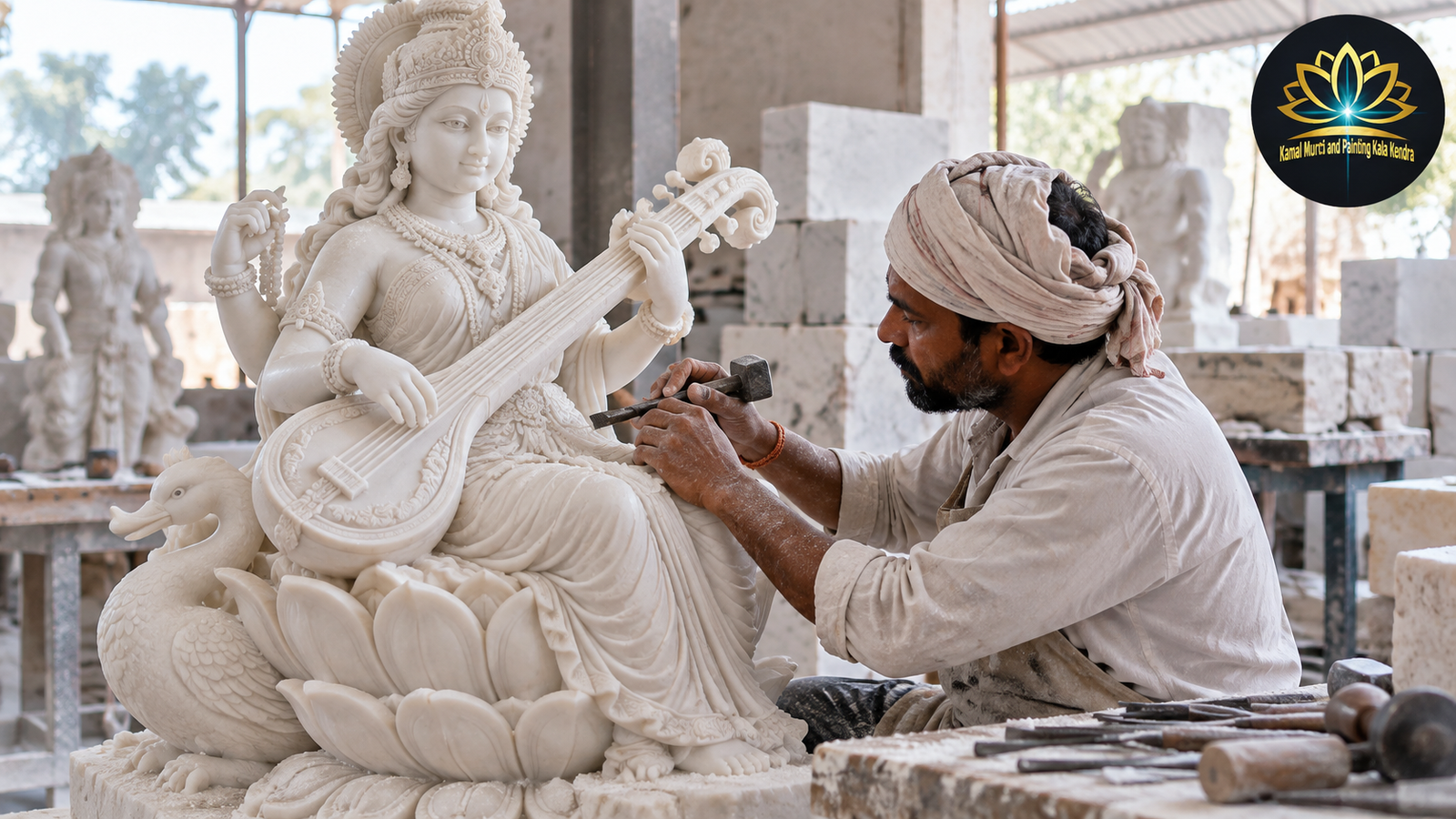
Saraswati shows why that training matters. The face has to look calm and attentive. The veena needs to be shaped so that it looks like a real instrument, with its curved neck and strings, not a flat plank. The lotus, the sari and the jewellery all need proportion. When these are well done, the statue has a quiet dignity. When they are rushed, you can see it from across the room.
What a Local Search Usually Turns Up
Look for a Saraswati moorti supplier in Punjab or around Chandigarh and you will mostly meet two kinds of seller.
The first is a retail shop that buys finished statues from a distributor and sells them on. These shops are convenient, and seeing a statue in person before you pay counts for something. But they often cannot tell you who carved a piece, what the marble is, or whether a different size or pose can be made.
The second is a workshop that carves its own statues. At Kamal Moorti & Painting Kala Kendra in Jaipur, artisans work each piece by hand from a raw marble block to the final polish, and the painting is done in the same place. Hand carved Saraswati statues are a newer addition to the range, next to the established Krishna and Radha Krishna collections. Orders are shipped to Chandigarh and across Punjab.
What You Gain by Ordering From the Workshop
Dealing with the maker changes three things. You get straight answers, because the person who handled the block can tell you what it is and how it was finished. You get choices, since pose, size, base and the amount of painted detail can usually be discussed before carving begins. And you usually get a fairer price, because every seller between the workshop and your door adds a margin.
Who Brings Saraswati Home in Chandigarh
The reasons vary, and it helps to know which one is yours before you choose a form and a size.
Parents often place Saraswati near a child’s study table, especially before board exams or at the start of a new school year. College students away from home sometimes keep a small statue in a hostel room or a rented flat. Music teachers and students want one in the practice room. Dancers, singers and theatre people often keep an image of Saraswati near where they rehearse.
Some families simply want a calm, devotional presence in the home temple, with Saraswati beside Ganesh and Lakshmi.
Basant Panchami in Punjab
Basant Panchami marks the arrival of spring, and in Punjab it is a colourful occasion. People wear yellow, cook yellow dishes and fly kites. For families who worship Saraswati, it is also the day most closely tied to her. Schools and colleges mark it, and many homes set up a small puja with books, pens and musical instruments placed before the goddess.
If you want a new statue in place for Basant Panchami, plan early. Hand carving cannot be rushed without affecting the finish, and shipping takes extra days. Enquire several weeks ahead, and ask the workshop for an honest estimate instead of assuming it can be done in a week.
Forms of Saraswati to Consider
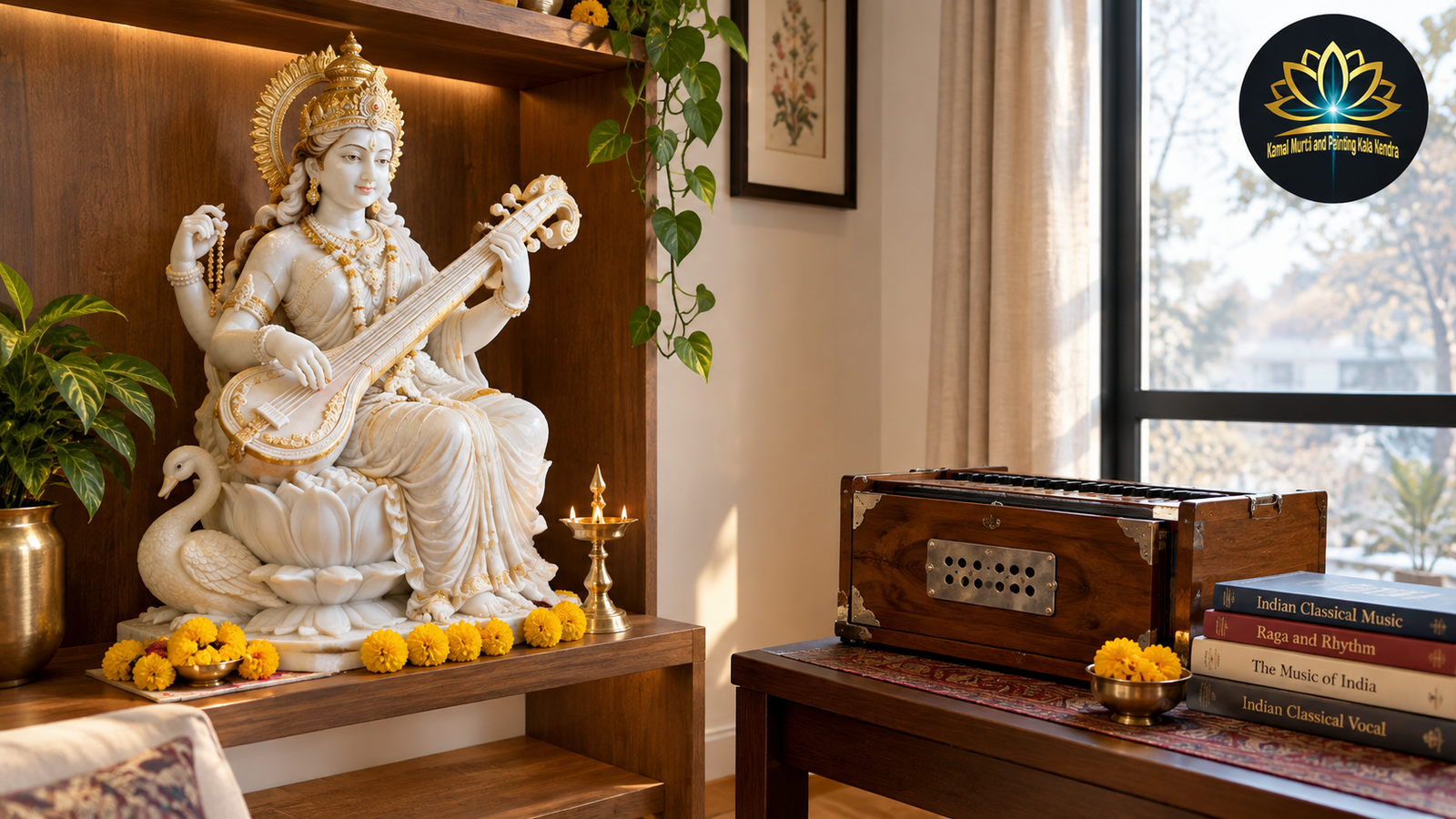
Seated on a lotus with a veena. The classic form, calm and graceful, and the one most people picture. It suits a home temple, a study shelf or a music room.
With a book and a veena. Saraswati holding a book or palm leaves as well as the instrument. Families often choose this for a child’s room because it points directly to learning.
With a swan. The swan is a symbol of discernment, and some buyers like to have one beside her.
Standing Saraswati. A less common form that works well in a larger pooja room or a school.
Our guide to Krishna statue poses and meanings explains how forms and gestures are chosen, and the same thinking applies when you plan a Saraswati.
Finish: White, Yellow Accents or Fully Painted
Saraswati is traditionally shown in white, and a plain polished white marble statue looks serene and suits a modern flat. Some buyers add soft yellow on the sari border or gold on the crown and jewellery, which fits well with Basant Panchami. A fully painted statue feels closer to a temple image. Painted details need gentler care over the years, so think about how much upkeep you want.
Size and Placement
Many Saraswati statues end up on a study table or a bookshelf, so size matters more than usual. Measure the shelf depth and height, not just the width, and remember that the base takes up room. Leave a little space for a diya or flowers. A compact statue is usually enough for a desk. A larger piece suits a pooja room or a music room.
Marble is heavy for its size. Check that the shelf can carry the weight, and avoid placing the statue near the edge of a desk where a child might knock it. Our guide to marble statue weight goes into this in more detail, and our guide to Krishna statue placement by room size explains how to match a statue to a space.
Chandigarh’s Weather and Looking After Marble
Chandigarh has hot summers, a monsoon season and cold, foggy winters. Marble copes with all of these well, but dust can settle on a polished surface and mix with humidity to leave a film. Wipe the statue regularly with a soft dry cloth, keep painted areas out of direct afternoon sun, and avoid chemical cleaners. In winter, keep the statue indoors and away from a heater that blows hot air straight onto it. Our guide to marble Krishna statue durability goes into weather in more detail, and the advice applies to a Saraswati too.
How Ordering From Chandigarh Works
You do not need to travel to Jaipur. A typical order starts with a conversation. You describe the form, the size that fits your space and the finish you prefer. Reference photos help a great deal. Since Saraswati is a newer line, it is worth asking the workshop to confirm the design is workable and to give you a rough timeline before you commit.
During carving, progress photos can usually be shared. When the statue is finished, it is packed and sent to Chandigarh by road.
Packing and Delivery
The fragile points on a Saraswati statue are the neck of the veena, the fingers, the edge of the sari and the rim of the lotus base. Ask how the statue will be padded and crated and whether those parts get extra protection. If you live in a flat in a Mohali or Panchkula society, check any delivery timings and lift rules in advance, and have two people ready to carry it. Unpack it in front of the delivery person so any transit damage can be recorded immediately.
Checking What You Are Buying
Not everything sold as a marble Saraswati is solid carved marble. Some pieces are cast from marble dust and resin, and some are plaster. A few simple checks help. Real marble feels heavy for its size, feels cool to the touch and has irregular natural veining. Ask directly what the statue is made of and who carved it. Our guide to identifying authentic marble statues covers these checks in more detail.
Questions to Ask Any Seller
Ask whether the workshop carves the statue itself or resells it. Ask what marble is used and where it comes from. Ask whether you can see work in progress. Ask what customisations are possible and how they affect the timeline. Ask how the statue will be packed and delivered. And ask for the quote in writing, so you know what is included.
Frequently Asked Questions
Is there marble Saraswati moorti manufacturing in Chandigarh itself?
Hand carved marble idols mostly come from Jaipur. Chandigarh and the tricity have shops that sell them, but the carving usually happens in Rajasthan. Ordering from the workshop gives you a clearer picture of how the statue was made.
How long does a Saraswati statue take to reach Chandigarh?
It depends on the size and the amount of detail. Expect a few weeks for carving and finishing, plus shipping time. Confirm an estimate once your design is fixed, especially before Basant Panchami.
Can I get a small Saraswati statue for a study table?
Yes. A compact seated Saraswati is a common choice for a desk or bookshelf. Measure the space first and tell the workshop what size you need.
Is a plain white or a painted finish better?
Neither is better. White is traditional and easy to look after. A painted statue looks closer to a temple image but needs gentler care.
How is a marble Saraswati statue kept safe on the way to Chandigarh?
It should be padded and crated to the shape of the piece, with extra care around the veena and the hands. Ask the workshop about packing before you order.
A Saraswati Made by Hand for Your Chandigarh Home
If you want a Saraswati moorti carved by hand from real marble, the simplest step is to talk directly to the people who make it. Kamal Moorti offers hand carved Saraswati statues as a newer addition alongside its established range of marble Krishna statues and Shree Radhe Krishna pair designs. If you are planning a full shrine, the marble temple collection is worth a look. Everything is made in the Jaipur workshop and shipped across India, including Chandigarh and the rest of Punjab.
To discuss your requirements, share reference images and get a quote and timeline for delivery to Chandigarh, reach out through the contact page, read more on the About Us page, or call +91-9829678999 to place your order.