
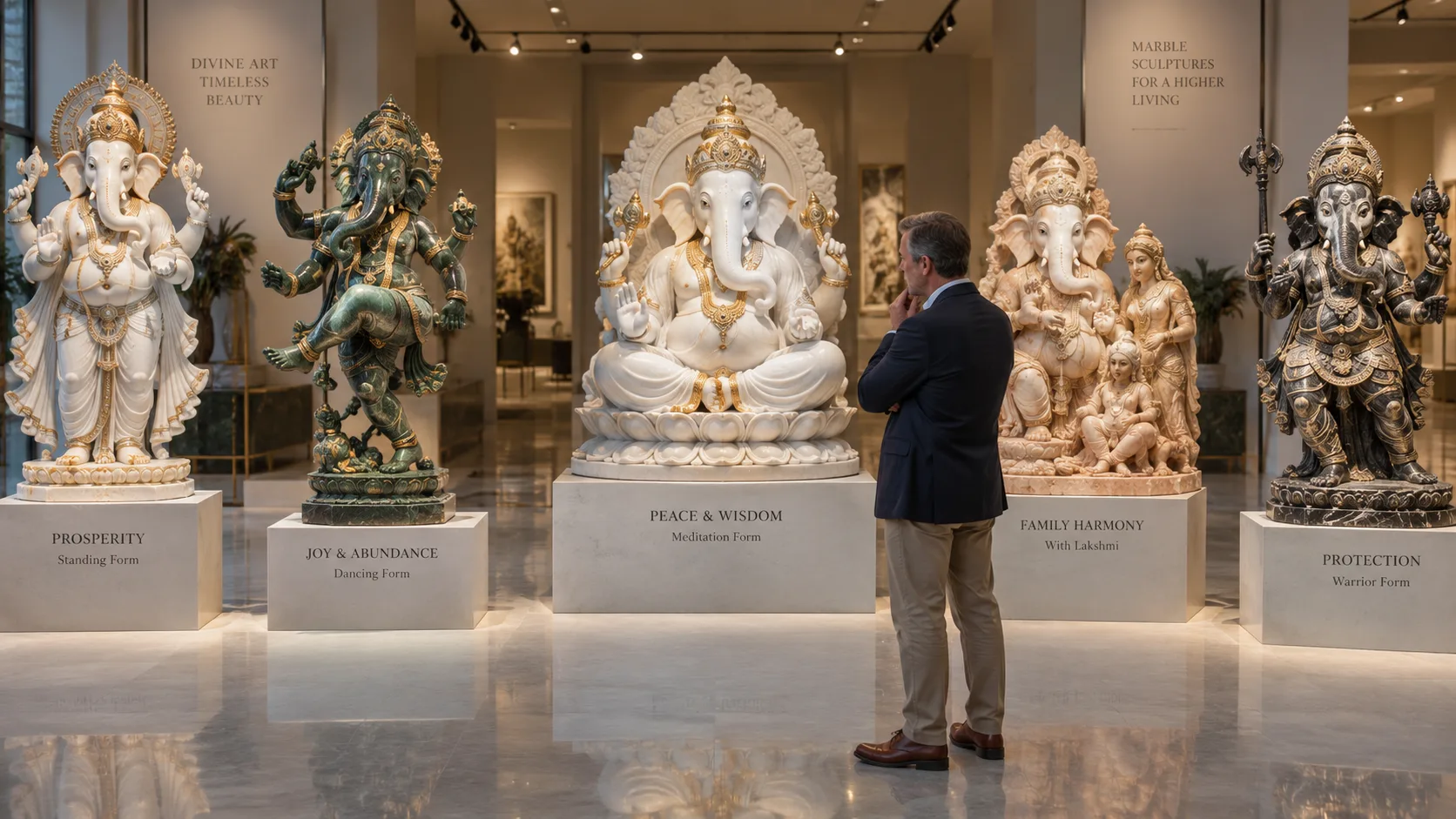
Ganesh appears in almost every Hindu home. He’s the remover of obstacles, the deity of new beginnings, the lord of intelligence and wisdom. But Ganesh isn’t one thing. He appears in different forms. He carries different meanings in different contexts. A Ganesh statue you choose for your American home should match not just your aesthetic preference but your actual spiritual need.
Most people don’t think this deeply when selecting Ganesh. They see a statue, like how it looks, and buy it. They miss the opportunity to align their physical representation with their spiritual practice specifically.
Understanding Ganesh deeply transforms your relationship with the statue. You’re not just buying decoration. You’re inviting a specific spiritual force into your home. That force varies depending on which Ganesh form you choose.
At Kamal Moorti’s USA marble statue collection, we create Ganesh statues constantly. We understand the symbolism deeply. We know which forms serve which spiritual purposes. We help customers match their needs with the right Ganesh representation.
This guide covers Ganesh comprehensively. His symbolism. His different forms. How to select the right Ganesh for your specific spiritual path and American home.
Who Is Ganesh: Core Symbolism
Ganesh is the elephant-headed deity. But he’s far more than a visual description.
Ganesh removes obstacles. This is his primary function. Any endeavor you begin, any barrier you face, Ganesh removes impediments. Call on Ganesh when starting something new. When facing obstacles. When needing clarity in confusion.
Ganesh is the lord of intelligence and wisdom. He’s not just power. He has discriminative power. The ability to see clearly. To make wise choices. To understand what matters from what doesn’t.
Ganesh is the remover of ego. He teaches that pride and self-importance create obstacles. True wisdom involves recognizing your limitations. Ganesh humbles and enlightens simultaneously.
Ganesh is the lord of new beginnings. Before any auspicious work, any new venture, Ganesh is invoked first. He opens doors. He creates possibility.
Ganesh is associated with material prosperity. He brings success in business and material endeavors. Many business owners keep Ganesh statues in workspaces.
These symbolisms overlap. A single Ganesh statue can serve multiple purposes depending on your focus.
The Spiritual Elephant: Trunk and Tusks
Ganesh’s elephant form carries deep meaning.
The trunk represents the sacred sound Om, the fundamental vibration of existence. The trunk’s flexibility symbolizes adaptability and grace in navigating complexity.
The broken tusk (Ganesh typically has one broken tusk) represents sacrifice. Ganesh broke his tusk to write the Mahabharata. It symbolizes willingness to sacrifice ego for a higher purpose.
The large elephant ears represent listening. Ganesh teaches the importance of hearing. Not just with ears but with heart and mind.
The round belly symbolizes completeness and abundance. It’s where creative energy resides. Ganesh’s belly contains universal energy.
The small mouse or rat (sometimes depicted with Ganesh) represents ego. Ganesh rides the mouse, symbolizing mastery over ego.
Understanding these elements enriches your relationship with any Ganesh statue you choose.
Different Ganesh Forms and Their Meanings
Ganesh appears in various representations. Each carries distinct spiritual significance.
Sitting Ganesh
Ganesh is shown seated, often cross-legged or in a meditation pose. This represents introspection, stillness, and contemplation. Seated Ganesh invites you inward. He’s the teacher within. The inner guru.
Use seated Ganesh when your practice emphasizes meditation, inner work, or spiritual development. Bedroom or meditation room placement works well.
Standing Ganesh
Ganesh is shown upright, sometimes holding implements like an axe or rope. Standing Ganesh is active, present, and protective. He’s the Ganesh of removal and action. Standing Ganesh removes obstacles actively rather than passively.
Use standing Ganesh in living rooms or workspaces where active obstacle removal matters. Use when facing specific challenges.
Dancing Ganesh
Ganesh is shown in dynamic movement, sometimes called Nritya Ganesh. Dancing Ganesh celebrates joy, playfulness, and freedom. He represents spirituality as joyful rather than solemn.
Use dancing Ganesh when your practice emphasizes devotional celebration, or you want to invoke joy and freedom.
Ganesh with Mount (On Mouse or Vahana)
Sometimes Ganesh is shown with his vehicle, typically a mouse or rat. This represents Ganesh in his glory, with companions. It’s a more complete representation.
This form works in temple spaces or larger installations where space permits.
When exploring different forms and designs, clear visual presentation can also make it easier to compare artistic details, materials, and sizes before making a choice. A thoughtfully created digital experience can help present such collections in an organized way while keeping the focus on the artwork itself.
Ganesh with Retinue
Ganesh is shown with family or attendants. Sometimes with Lakshmi (prosperity), sometimes with Shiva (wisdom), sometimes with Parvati (divine mother). This represents Ganesh in a cosmic context, surrounded by spiritual forces.
This elaborate form works in dedicated temple spaces or for practitioners working with multiple deities.
Ganesh as Protector (Vighnesvara)
Ganesh is shown in a powerful stance, sometimes with multiple arms holding implements. This is Ganesh as a fierce obstacle-remover. He’s protective and powerful.
Use this form when facing significant obstacles or needing spiritual protection.
Ganesh in Meditation (Dhyana Ganesh)
Ganesh is shown in a deep contemplative state, sometimes with eyes closed. This is the Ganesh of inner wisdom. He’s withdrawn from external activity, focused entirely inward.
Use this form when meditation and inner development are the primary focus.
Yantra Ganesh or Symbolic Ganesh
Sometimes Ganesh is represented more abstractly or symbolically. These forms emphasize energy over literal representation.
These suit practitioners working with esoteric practices or energy-focused traditions.
Size Considerations for Ganesh Statues
Ganesh sizing follows the same principles as other statues, but with specific considerations.
Small Ganesh (6-12 inches).
Suitable for personal altars, bedside tables, and office desks. These work when you want an intimate connection with Ganesh. Small Ganesh is approachable. It’s for personal practice.
Medium Ganesh (18-30 inches).
The most common size for American homes. Fits living room tables, altar tables, meditation spaces. Medium Ganesh has a good presence without overwhelming the space.
Large Ganesh (36-60 inches).
Statement pieces for dedicated temple spaces. Large Ganesh commands attention. He becomes the room’s focal point.
Specific form sizing:
Sitting Ganesh typically needs less vertical space but more horizontal depth. A 24-inch sitting Ganesh needs a substantial table surface.
Standing Ganesh is more space-efficient. Vertical height but smaller footprint.
Dancing Ganesh needs space to display the dynamic form. Cramped placement diminishes the movement.
Match sizing to your space and spiritual need.
Selecting Your Ganesh: Practical Guidance
How do you actually choose the right Ganesh?
Consider your primary spiritual need:
Starting something new? Standing Ganesh invokes active support.
Deepening meditation? Seated Ganesh invites introspection.
Celebrating spirituality joyfully? Dancing Ganesh aligns with that energy.
Facing obstacles? Protector Ganesh provides power.
Seeking prosperity? Ganesh with Lakshmi or wealth-associated imagery resonates.
Your spiritual need should drive your choice more than aesthetics alone.
Consider your space:
Small apartment? Small or medium Ganesh fits without being overwhelming.
Spacious American home? A larger Ganesh becomes a beautiful focal point.
Dedicated temple space? Any size works. Multiple sizes create richness.
Office or workspace? Medium Ganesh works well. Standing or active forms suit business contexts.
Consider your artistic preference:
Do you prefer traditional representation or more contemporary artistic interpretation?
Do you want ornate, detailed carving or a simpler, elegant form?
Do you prefer white marble’s luminous quality or black marble’s drama?
Artistic preference matters. You’ll live with this statue daily.
Consider your spiritual tradition:
Different Hindu lineages relate to Ganesh differently. Some emphasize Ganesh as the remover of obstacles. Others emphasize inner wisdom. Some traditions emphasize prosperity aspects.
Your lineage or practice tradition might have specific Ganesh preferences. Honor those.
Consider placement:
Where will the statue go? The bedroom requires different energy than the living room workspace.
Bedroom Ganesh is often smaller, meditative. Workspace Ganesh is often active and obstacle-removing.
Temple Ganesh can be in any form. The space is specifically for spiritual practice.
Marble Type Selection for Ganesh
Material choice affects how Ganesh presents spiritually and practically.
White marble Ganesh:
Luminous, spiritual, peaceful quality. White marble creates a serene atmosphere. Details show clearly in white marble.
Best for meditation rooms, bedroom altars, introspective practice.
Black marble Ganesh:
Dramatic, powerful, protective quality. Black marble suggests strength and dignity.
Best for obstacle-removal focus, business contexts, protective Ganesh forms.
Colored marble Ganesh:
Rose, green, or other colored marble brings specific energy. Rose marble suggests devotion. Green suggests growth.
Choose based on spiritual need and aesthetic preference.
The marble color doesn’t change Ganesh’s function. But it affects the spiritual atmosphere surrounding the statue.
Placement of Ganesh in American Homes
Where you place Ganesh affects how his energy functions.
Entrance or Doorway
Ganesh at the entry removes obstacles as you enter. He protects the home’s threshold. This is traditional placement. Ganesh literally removes impediments at your threshold.
Living Room or Family Space
Ganesh in gathering spaces blesses family activities. He removes obstacles for the whole household. Workspace contexts benefit from Ganesh’s prosperity and wisdom.
Bedroom or Personal Space
Ganesh in intimate spaces supports personal practice. Meditative Ganesh here invites inner work.
Home Office or Workspace
Ganesh removes obstacles in work and business. Standing or active Ganesh works well. Prosperity-associated forms support success.
Temple or Dedicated Spiritual Space
Ganesh can be a primary or secondary deity. If secondary, he’s usually placed prominently but doesn’t dominate. Traditional placements work in dedicated spaces.
Not Recommended Placements
Bathroom or toilet areas. Ganesh deserves respect. Bathrooms are inappropriate.
Below eye level only if elevated enough to command respect. Ganesh shouldn’t feel diminished.
Noisy, chaotic areas. Ganesh prefers relatively peaceful placement.
Avoid placement that makes Ganesh feel compromised spiritually.
Practical Selection Process
Here’s how to actually choose your Ganesh:
Step 1: Clarify your primary spiritual need.
Obstacle removal? Meditation? Prosperity? New beginnings? Know what you’re seeking.
Step 2: Research Ganesh forms.
Learn which forms align with your needs. Read about different representations.
Step 3: Assess your space.
Measure available space. Consider placement. Determine the size that fits.
Step 4: Consider aesthetic preference.
Look at available options. Which form draws you? Which marble appeals?
Step 5: Consult professionals if uncertain.
Our USA team provides guidance. Describe your needs. Get recommendations.
Step 6: Commit to your choice.
Once selected, commit fully. Your Ganesh becomes your spiritual companion.
Step 7: Place mindfully.
Don’t just position the statue. Place it with intention. Welcome Ganesh into your home spiritually.
Ganesh for Specific Life Situations
Different circumstances call for different Ganesh approaches.
Starting a business or new venture:
Standing Ganesh. Active obstacle-removal form. Prosperity-associated Ganesh. Place in workspace.
Facing major obstacles:
Protector Ganesh. Powerful forms. Some practitioners use fierce Ganesh representations for serious challenges.
Deepening spiritual practice:
Meditative Ganesh. Seated forms. Placement in meditation space. Smaller intimate scale.
Blessing a home:
Ganesh at the entrance. Multiple Ganesh statues in different rooms. Mixed sizes and forms representing different aspects.
Seeking wisdom or clarity:
Ganesh of intelligence. Sometimes shown with sacred texts or implements of learning.
Spiritual celebration:
Dancing Ganesh. Joyful representations. Placement where you’ll see it daily.
Family harmony:
Ganesh with family or retinue. Family contexts benefit from Ganesh’s wisdom and obstacle removal.
Cost Considerations for Ganesh Statues
Ganesh pricing varies based on size, marble type, and carving complexity.
Small hand-carved Ganesh (6-12 inches): $500 to $1,200
Medium hand-carved Ganesh (18-30 inches): $1,200 to $3,500
Large hand-carved Ganesh (36-60 inches): $3,500 to $10,000+
Custom Ganesh commissions: Variable based on specifications
Hand-carved work costs more than factory-made work. But hand-carved Ganesh statues last for decades. They’re investments.
Discuss pricing and options with our team based on your specific needs.
Common Ganesh Mistakes
Learning from others prevents errors.
Mistake 1: Choosing only on aesthetics.
A beautiful statue that doesn’t align with spiritual need disappoints over time. Let spiritual need guide aesthetics.
Mistake 2: Choosing the wrong size for the space.
Too small in a large room feels insignificant. Too large in a small space is overwhelming. Measure first.
Mistake 3: Ignoring tradition.
Your spiritual lineage might have specific Ganesh preferences. Honor them.
Mistake 4: Inappropriate placement.
Bathroom or disrespectful positioning diminishes Ganesh’s spiritual function.
Mistake 5: Selecting factory-made without understanding the difference.
Hand-carved Ganesh carries a different energy than mass-produced alternatives.
Mistake 6: No intention in selection.
Random purchase without clarity about spiritual need misses the point.
Avoid these. Choose thoughtfully.
Moving Forward With Your Ganesh Selection
Browse our USA Ganesh collection and study different forms. Look at images. Feel which Ganesh calls to you.
Pay attention to your intuition. Your initial response to an image matters.
Then verify that the intuitive choice aligns with your actual spiritual need.
Consult if needed. Our team provides guidance matching spiritual need with the ideal Ganesh representation.
Your Ganesh becomes your spiritual companion. He removes obstacles in your American home. He invites wisdom. He opens doors.
Choose thoughtfully. Choose meaningfully. Choose the Ganesh your spirit actually needs.

Pingback: Ganesh Marble Statue Manufacturing Chicago | Statues World
Pingback: Ganesh Marble Statue Manufacturing Vancouver | Statues World
Pingback: Lakshmi Marble Statue Manufacturing Dallas: Kamal Moorti
Pingback: Ganesh Statue Manufacturing Philadelphia: Kamal Moorti
Pingback: Lakshmi Marble Statue Manufacturing Miami: Kamal Moorti