
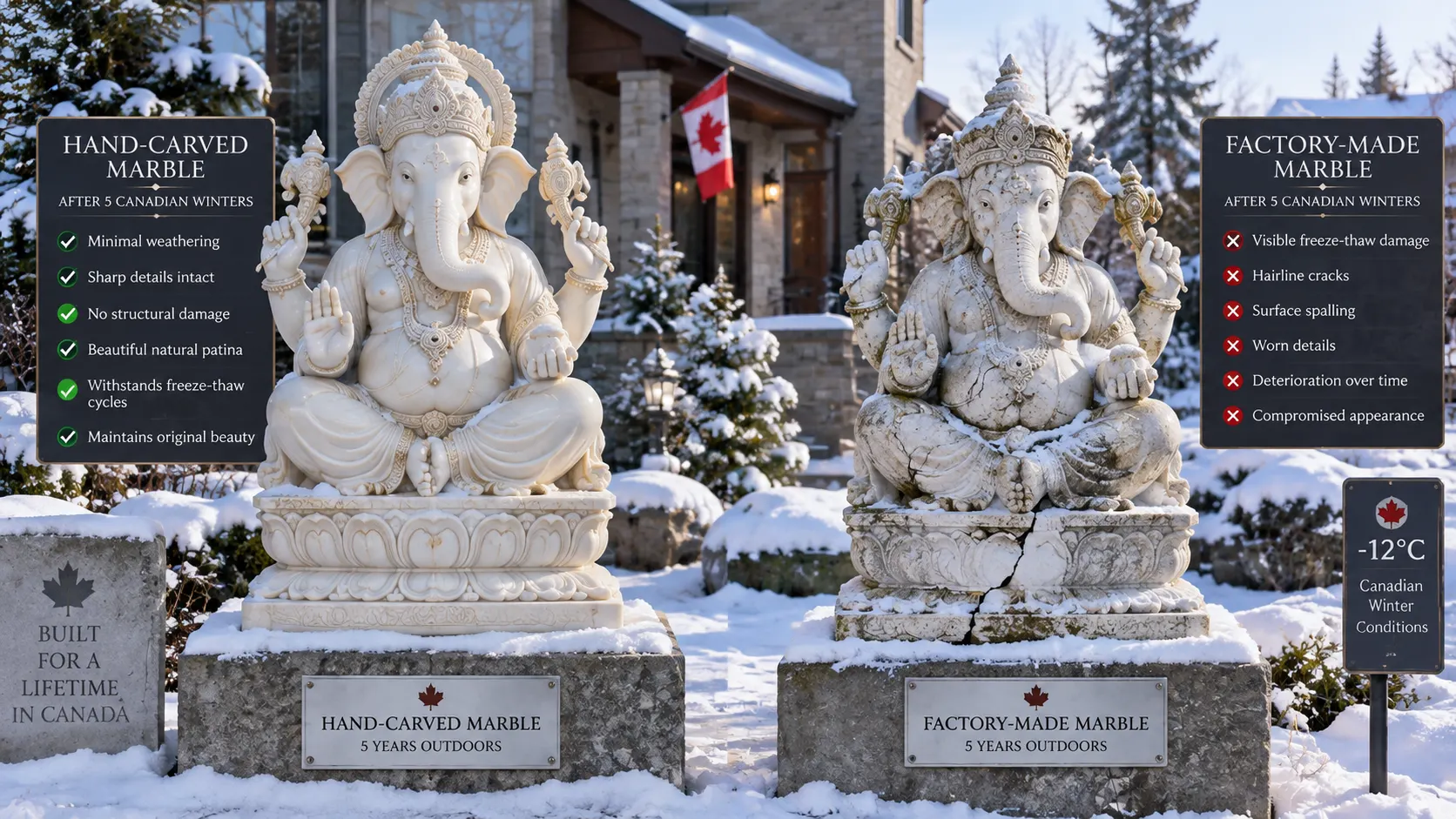
You discover two marble Ganesh statues. Identical design. Drastically different prices. One costs $800. One costs $2,200. Same deity. Same apparent size. Same basic appearance. Why would anyone pay nearly three times more for what looks like the same thing?
Then you install them both outdoors in your Canadian home. Winter arrives with freeze-thaw cycles, temperature swings, and moisture penetration. After three harsh Canadian winters, the cheaper statue shows cracks. Details are weathered. The surface looks compromised. The expensive statue? It looks almost new. Details remain sharp. The surface shows a beautiful patina but no damage.
This isn’t a coincidence. It’s the difference between hand-carved and factory-made marble. And in Canada’s climate, that difference matters enormously.
At Kamal Moorti’s Canada marble collection, we create only hand-carved pieces. We understand Canadian climate demands. We know which production methods actually survive Canadian winters. We’ve learned through years of shipping statues across Canada exactly which quality standards matter.
This guide explains what actually differentiates hand-carved from factory-made marble specifically in the Canadian context. Not just cosmetically. But structurally, materially, and in terms of real survival through Canadian seasons.
How Factory-Made Marble Works
Factory production prioritizes efficiency. That’s the fundamental difference from hand-carving.
Most factory-made marble statues start with molds or presses. A master form is created. Then marble is poured, compressed, or shaped using that mold repeatedly. The result is multiple identical statues from one mold.
Some factories use actual marble dust mixed with binders, creating artificial marble. Some use low-grade natural marble. Some involve minimal hand-finishing after molding.
From a manufacturing perspective, this is brilliant efficiency. One mold produces hundreds of identical pieces. Labor is minimized. Costs are reduced dramatically. That’s why factory pieces are affordable.
But efficiency has consequences. Especially in the Canadian climate.
Structural characteristics of factory-made marble:
Identical uniform grain and structure across all pieces. No variation.
Marble was selected for cost minimization, not climate suitability. Lower-grade marble used.
Carving follows molds without regard for marble’s actual grain or hidden stress points.
Thin sections created without reinforcement. Molds can’t adapt to material specifics.
Standardized finishing without climate-specific sealing or protection.
Minimal individual artisan attention. Quality control means consistency, not durability.
These aren’t manufacturing flaws. They’re consequences of mass production economics. In mild climates, factory marble performs adequately. In Canada’s climate, these shortcuts create problems.
How Hand-Carved Marble Works
Hand-carving is fundamentally different.
Master artisans select marble carefully. They examine grain. They identify flaws. They choose stone specifically for the piece. A statue carved from premium marble that’s been personally selected performs differently than a statue formed from standardized lower-grade marble.
The carving itself is responsive. The artisan responds to the marble. They feel the grain direction. They discover hidden stress points. They reinforce vulnerable sections. They carve around flaws rather than assuming molds can ignore material variability.
This individual attention to marble specificity means the finished piece is optimized for durability in ways molds can’t achieve.
Structural characteristics of hand-carved marble:
Carefully selected premium marble sourced for durability.
Grain structure examined and worked with, not against.
Vulnerable sections are reinforced during the carving process.
Carving technique adapted to marble’s specific characteristics.
Individual finishing, including climate-specific sealing and protection.
Artisan expertise applied to maximize structural integrity.
These characteristics matter fundamentally for Canadian durability.
Why Canadian Climate Makes Quality Critical
Canada’s climate is what transforms the hand-carved versus factory-made difference from a cosmetic preference to a survival requirement.
Freeze-thaw cycles dominate Canadian winters. Water enters marble. Temperatures drop. Water freezes. Expansion creates internal pressure. The next day, temperatures rise. Ice melts. Pressure releases. This repeats daily for months.
Marble tolerates this once, twice, maybe three times. But repeated freeze-thaw cycling creates cumulative damage. Hairline cracks develop. Flaking begins. Weak points fail.
Factory-made marble survives this poorly. Here’s why.
Lower-grade factory marble already has internal stress points. Factory carving doesn’t reinforce these. Freeze-thaw cycles expand existing vulnerabilities. Damage accelerates faster.
Factory marble hasn’t been sealed to reduce water absorption as carefully. More water penetrates. More water means more freeze-thaw stress. The cycle intensifies.
Hand-carved marble, by contrast, survives freeze-thaw better. Premium marble has fewer inherent weak points. Careful carving reinforces actual vulnerabilities. Professional sealing reduces water penetration. The cumulative effect is a dramatically better Canadian winter performance.
This isn’t theoretical. Canadian customers with both types report this reality directly.
Visual Quality Differences
The easiest way to understand the difference is through visual examination.
Facial Expression and Detail:
Factory-made statues have generic faces. Pleasant but impersonal. Features look simplified. Eyes, nose, and mouth are present but lack subtlety.
Hand-carved statues show genuine expression. Eyes appear alive. Facial features carry emotional depth. The face feels like an individual person rather than a template reproduction.
Carved Detail Complexity:
Factory pieces show basic representation. Jewelry simplified. Clothing flat. Ornaments look like surface decoration.
Hand-carved pieces show intricate three-dimensional complexity. Necklaces drape. Bracelets show individual links. Clothing displays actual folds. Decorative elements feel textured.
Overall Artistic Quality:
Factory pieces look manufactured. They look like products.
Hand-carved pieces look artisanal. They look like art. Even damaged pieces retain artistic integrity.
Aging Pattern Differences:
Factory-made marble weathers unevenly. Damage looks like deterioration. Cracks appear random. Flaking looks destructive.
Hand-carved marble ages gracefully. Patina develops beautifully. Aging looks like natural development rather than degradation.
These differences become obvious when comparing pieces side by side.
Durability Through Canadian Seasons
Real-world performance is what matters most for Canadian customers.
Spring Performance:
Factory marble shows winter damage. Cracks visible after thaw. Surface flaking evident. Water absorption created problems throughout winter.
Hand-carved marble shows minimal winter damage. A beautiful patina developed. Details remain intact. Professional sealing protects against moisture penetration.
Summer Performance:
Factory damage from winter often becomes more pronounced as the weather warms. Cracks that appeared small in spring expand as material stress continues.
Hand-carved marble maintains beauty through summer. Patina deepens. The statue improves with age.
Fall Performance:
Factory marble requires immediate attention before winter arrives. Cracks must be sealed, or winter will expand them further. Professional restoration might be necessary.
Hand-carved marble requires routine sealing as a preventative measure, not emergency repair.
Winter Performance:
Factory marble deteriorates visibly through the Canadian winter. Freeze-thaw cycles damage low-grade marble consistently.
Hand-carved marble survives winter with minimal additional stress. Premium marble and careful carving endure freeze-thaw cycles better.
Over five years, the difference is dramatic. Over ten years, factory marble might be significantly compromised, while hand-carved marble remains beautiful.
Material Quality Differences
The marble itself performs differently.
Premium Hand-Carved Marble:
Dense even grain structure. Minimal internal stress points. Resists freeze-thaw better.
Lower-grade Factory Marble:**
Weaker grain structure. Existing internal stress points. Vulnerable to freeze-thaw expansion.
When water penetrates and freezes, expansion stresses marble. Weak grain fails first.
Moisture Absorption:
Hand-carved marble, properly sealed, absorbs minimal water. Professional sealing dramatically reduces porosity.
Factory marble, often insufficiently sealed, absorbs more water. More water means more freeze-thaw stress.
The combination of weaker material and more water penetration creates a multiplicative damage risk.
Structural Reinforcement During Carving
How marble is carved affects freeze-thaw survival dramatically.
Hand-Carved Approach:
The artisan carves carefully, observing how marble responds. Weak sections are reinforced. Thin areas are strengthened. Vulnerable points are protected through the carving technique.
A skilled carver doesn’t create unnecessary weak points. They optimize structure for survival.
Factory Approach:
Molds create whatever form is required regardless of marble’s actual structure. If a design calls for a thin section, molds create thin sections. If grain is weak, molds ignore it. They create uniform results without material-specific adaptation.
This means factory statues contain inherent structural vulnerabilities that artisans would never create.
Sealing and Protection Differences
How marble is finished affects Canadian performance.
Hand-Carved Finishing:
Professional sealing is applied as standard. Multiple layers of protection. Climate-specific products selected.
The finishing process accounts for the Canadian climate specifically. Statues are sealed before shipping. Additional sealing is recommended before the first harsh winter.
Factory Finishing:
Basic finishing without climate-specific consideration. Minimal sealing. Cost minimization extends to protection.
Factory pieces often arrive with insufficient sealing for Canadian conditions. Canadian customers must immediately invest in professional sealing.
By then, some damage had already occurred during transport and initial outdoor exposure.
Investment Value for Canadian Customers
Pricing differences reflect real material and durability differences.
Hand-carved statues cost more.
Better marble, more labor, and superior finishing all cost more. But the statue lasts decades.
Factory statues cost less.
Lower-grade marble, minimized labor, and basic finishing all reduce cost. But the statue requires replacement or restoration within a few years.
The real question for Canadian customers is the cost per year of durability, not the initial purchase price.
Long-term Canadian math:
Hand-carved statue: $2,000 purchase, lasting 50 years of outdoor use. The cost per year is $40.
Factory statue: $600 purchase, needing replacement after 10 years of outdoor use. The cost per year is $60 for 10 years, then repeat the cycle.
Hand-carved work is a cheaper long-term investment for Canadian customers.
Resale and Legacy Value
Hand-carved marble holds value better than factory-made marble.
Hand-carved statues appreciate or maintain their value.
Because they’re unique artisan pieces, they retain investment value. Collectors value hand-carved work. Canadian resale market values authenticity.
A beautiful hand-carved statue that’s properly maintained remains beautiful and valuable decades later.
Factory statues depreciate rapidly.
Because they’re manufactured products, they follow typical product depreciation. The initial value drops quickly. Resale value is minimal.
An older factory marble statue has limited resale value. It’s a worn-out product, not an appreciated artwork.
Spiritual and Cultural Authenticity
Beyond physical quality, authenticity matters.
Hand-carved statues connect to traditions. Master artisans learn from family, from elders, from centuries of tradition. They’re creating within an authentic cultural lineage.
Factory-made statues are products. They might represent deities, but they lack the cultural authenticity of hand-carved work.
Many serious spiritual practitioners specifically seek hand-carved work because of this authenticity. Factory pieces feel insufficient for genuine spiritual practice.
How to Verify Quality When Purchasing
When shopping for marble statues in Canada, how do you verify what you’re actually buying?
Ask for artist information:
Who carved the statue? Get the artisan’s name. Factory-made uses anonymous labor. Hand-carved has individual artisans.
Examine uniformity:
If you see multiple identical pieces, it’s likely factory-made. Hand-carved pieces show variation.
Study facial details:
Examine the face closely. Factory faces look generic. Hand-carved faces show nuance.
Check decorative depth:
Jewelry, clothing, and ornaments should show three-dimensional complexity. Surface-level details suggest factory work.
Request marble information:
Reputable hand-carved suppliers discuss marble type and selection. Factory suppliers use standardized lower-grade marble.
Inspect for reinforcement:
Hand-carved work reinforces potential weak points. Factory work creates vulnerabilities that molds can’t address.
Ask about climate suitability:
Canadian retailers should discuss how marble performs in the Canadian climate. Factory suppliers often don’t consider this.
Request process documentation:
Legitimate hand-carved suppliers provide photos of the carving process. Factory producers can’t show individual artisan work.
Our Canada team can verify the hand-carved origin of any statue you’re considering. We document everything.
Making the Canadian Quality Choice
Ultimately, this is about what you value.
Do you want the cheapest option regardless of longevity? Factory-made serves that need.
Do you want a statue that survives Canadian winters beautifully? That becomes a family heirloom? That improves with age? Hand-carved work is worth the investment.
For Canadian customers specifically, hand-carved is often the only sensible choice long-term.
Moving Forward With Your Canadian Marble Selection
Browse our Canadian marble collection and examine pieces closely. Look at facial expressions. Study decorative details. Understand the artistry.
Compare to factory-made alternatives you find elsewhere. The difference becomes obvious immediately.
Then decide based on your values and Canadian climate reality. Both paths exist. But for Canadian longevity and value, hand-carved marble makes superior sense.
Hand-carved statues will survive Canadian winters. They’ll age beautifully. They’ll become family treasures. That’s worth investing in.



Pingback: Saraswati Marble Statue Manufacturing Edmonton: Kamal Moorti
Pingback: Lakshmi Marble Statue Manufacturing Winnipeg: Kamal Moorti
Pingback: Swaminarayan Statue Manufacturing Halifax: Kamal Moorti
Pingback: Durga Statue Manufacturing Victoria BC: Kamal Moorti
Pingback: Nataraj Marble Statue Manufacturing Saskatoon: Kamal Moorti
Pingback: Shiva Statue Manufacturing St. Catharines: Kamal Moorti
Pingback: Lakshmi Marble Statue Manufacturing Brampton: Kamal Moorti