A Durga statue is rarely an impulse purchase. Families usually think about it for a long time, and then ask the hard questions: who can carve the face with the right calm and strength, how a statue travels thousands of miles, and whether it will stay in good condition once it is home. If you are researching Durga marble statue manufacturing Charlotte, this guide takes those questions one at a time. First, a clear statement of who we are discussing. Kamal Moorti & Painting Kala Kendra is based in Jaipur, Rajasthan, with its address at Chandpol Bazar. It does not claim a workshop in Charlotte, so this article is written for buyers in North Carolina who order from India.
Who Is Looking for a Durga Statue Supplier in North Carolina
A search for a Durga statue supplier North Carolina can mean a statue for a home puja room, a gift for a new house, or a piece for a community group. The checks are the same in each case: is the stone genuine, is the carving careful, does the size suit the space, and is the delivery plan clear?
Charlotte has a well-established Hindu community. The Museum of the New South notes that the Hindu Center of Charlotte opened on July 24, 1982, calls it one of the oldest temples in the Southeast, and says its network now includes more than 3,000 families. The same page cites an American Community Survey estimate of 35,724 Indian immigrants in Charlotte in 2022 and says the community’s growth called for a new temple. For many of these families, a marble murti at home sits alongside worship at the temple.
Who Durga Is
Britannica describes Durga as a principal form of the supreme Goddess, also known as Devi and Shakti, and says that Durga Puja and Navratri are held annually in her honour. According to the legend it retells, the male gods created her to slay the buffalo demon Mahishasura, and in that form she is known as Mahishasuramardini, the slayer of Mahishasura. The same entry says that, unlike Lakshmi and several other goddesses, she is not generally considered the consort of a male deity.
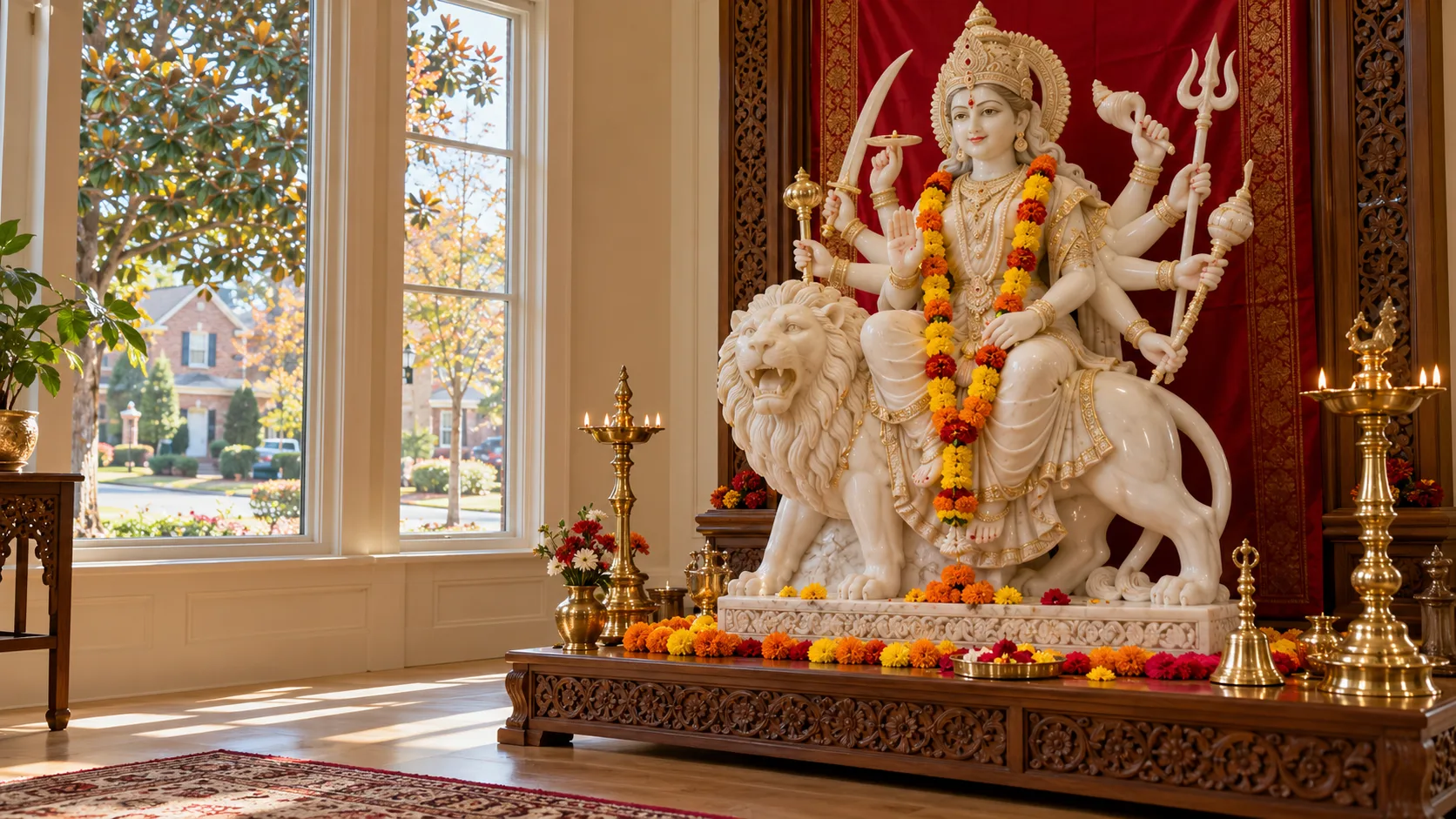
Wikipedia adds that she is seen as a motherly figure and is often shown as a warrior, riding a lion or tiger, with many arms, each carrying a weapon. That mix of protection and power is what people usually want in the statue: a face that looks calm, and a stance that looks strong.
What to Look for in the Carving
A Durga statue carries a lot of detail, so every part should look deliberate.
The face. It should look composed and steady, not fierce for its own sake. This is the part to judge first, and the hardest to correct later.
The lion. Britannica notes that images for Durga Puja show the goddess astride a lion, attacking the demon king. Check that the lion’s body, mane and posture are well proportioned and that it supports the statue without looking cramped.
The arms and weapons. Wikipedia describes her with many arms, each carrying a weapon. Ask the carver how many arms the statue has and which objects each hand holds. Fingers and weapons are easy to rush, so look closely at close-up photographs.
The scene. Some statues show Mahishasura beneath her; others show the goddess alone with the lion. Decide which you want before you ask for quotes.
Ask for photographs of finished work in the same form. A phrase like “traditional style” means different things to different carvers.
Festivals, Immersion and Why Marble Is Different
Britannica says Durga Puja is traditionally held for ten days in the month of Ashvina (September to October) and begins on the same day as Navratri, a nine-night festival. It also notes that the celebrations end with Vijayadashami, when sacred images are carried in procession to rivers and immersed. That is why festival statues in India are usually made of clay.
A marble murti is a different kind of object. It is a lasting piece for a home puja room or a temple space, and it is not made for immersion. Think about how you will use it through the year, not only at festival time. If you are unsure how a marble statue fits your family’s practice, ask your family priest.
What the Company Says About Its Marble
According to Kamal Moorti & Painting Kala Kendra, only high-quality natural marble is selected for each sculpture, and it says this gives durability, a smooth finish and a lasting natural shine. Those are the company’s own claims, so ask for confirmation of the material for your own order.
Marble has traits you should understand. It is made of calcium carbonate, so acids can dissolve a thin layer of the surface and leave a dull mark called an etch. It is also porous enough for liquids, oils and pigments to soak in. Both facts shape how you clean the statue and where you place offerings.
The company’s page on natural and artificial marble idols explains how to tell real stone from imitation.
How a Hand-Carved Durga Statue Manufacturer Works
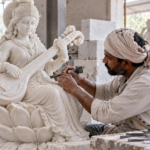
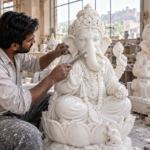
The phrase hand-carved Durga statue manufacturer gets used loosely, so ask for specifics. The company’s website names four stages: raw marble selection, carving, polishing and final detailing. It says its artisans combine traditional hand-carving with modern tools and describes them as having decades of hands-on experience. The About page lists a fabrication unit, a designing unit, a warehouse, and equipment such as polishing machines, electrical saws and cutting tools. A testimonial on the home page, from a customer in Jaipur, mentions a custom Maa Durga moorti ordered for a temple and praises the detailing and finish. Treat that as one customer’s account, not a guarantee for your order.
Before you pay a deposit, ask for the following in writing:
- Confirmation that the statue is natural marble.
- Photographs or a short video of your actual piece, or a very close match.
- Final height, width and weight, including the base.
- The finish, polished or matte.
- The packing method and any insurance for the trip.
Two of the company’s pages explain quality in plain language: its guide to hand-carved marble statue quality standards and its comparison of hand-carved and factory marble statues.
Size and Placement
Measure the exact spot and add the height of any pedestal. A Durga statue with a lion has more width than a simple standing figure, so measure width as well as height. Leave enough viewing distance for the whole form to be seen, and think about where light falls in the room.
Weight is just as important. Marble is heavy, so a large statue needs a stable floor position or a strong platform, not a light shelf. Check doorways, stairs and turning space for delivery day, and ask the company for the packed weight and the finished weight separately.
The company’s marble statue size guide for American homes is a good place to start before you measure.
Customisation
The company says it can customise marble moortis by style, design and colour, and can adapt pieces for a home, office, temple or gift. When you write, confirm which options apply to a Durga statue, such as the number of arms, the objects in each hand, whether Mahishasura is shown, and the base design. Its guide to the custom design process and pricing will help you describe what you want.
The website’s product list includes Maa Durga as a category, and the footer lists a Marble Maa Durga Statue. State the size and form you want in your first message.
What a Fair Quote Should Include
Prices depend on the statue, so this article does not quote one. The company says it aims for fair and transparent prices. The practical test is a written quote that shows what you are paying for.
| What to ask | Why it matters |
| Final height, width and weight | Bigger statues use more marble and cost more to pack |
| Number of figures and arms | A lion, many arms and a demon scene take more carving time |
| Finish and any painting | Polished, matte and painted work are different jobs |
| Base or pedestal | It may be included or priced separately |
| Packing, insurance and delivery | These can change the final figure noticeably |
| Customs, duties and taxes | Confirm in writing who pays and who handles the paperwork |
If two quotes differ widely, compare them line by line before choosing the lower one.
What “Premium” Should Mean
The phrase premium Durga marble statue appears on many websites, so test it yourself. Look at the stone: is the colour even and does the veining look natural? Look at the face: are the eyes, nose and mouth balanced and calm? Look at the hands and weapons, which are easy to rush. Check the lion for clean lines and a steady stance. Look for chisel marks or patchy polish, and make sure the base sits level. A statue that passes these checks deserves the word. One that only comes with glossy photographs does not.
Finding the Best Durga Statue in Charlotte
People often search for the best Durga statue Charlotte offers, but the answer depends on the room and the family. A smaller, well-carved statue in a quiet puja corner can be a better choice than a large one that crowds a living room.
Four questions help. Does it suit the space? Is the carving clean up close? Is the supplier clear about the material, size, weight and delivery? Would you be happy to see it every day? If the answer to all four is yes, you are close. If the statue is meant to be passed down, the company’s article on marble statues as heirlooms and long-term value looks at the longer view.
From Jaipur to North Carolina: Delivery Questions
The company’s website lists Shipping Policy and Return and Exchange pages in its footer. Read both before you commit. Then ask how the statue will be packed, how it is insured in transit, how long delivery to North Carolina takes, and what happens if it arrives damaged. Do not assume anything about shipping to Charlotte from a website alone. Get the answers in writing, and ask for photographs of the packed statue before it leaves Jaipur. If you want it in place for Navratri or Durga Puja, which fall in the autumn, enquire well ahead.
Looking After Marble in the Carolinas
Charlotte has a humid subtropical climate, with hot, humid summers and mild winters. One climate summary based on NOAA data puts average July highs near 89°F and January lows near freezing. A marble murti belongs indoors, in a stable spot, away from damp areas. If you are considering a porch, patio or garden, ask the company first whether that particular statue suits it.
Daily cleaning is simple if you avoid acid. The Marble Institute of America advises against vinegar, lemon juice and other acidic cleaners on marble and recommends mild soap and water with a soft, non-abrasive cloth. Soap and water will not remove etching or stains that have already soaked in, so prevention is the point. Dry the statue after wiping it, and clean up drops of oil, colour or offerings quickly. Keep flowers, fruit and sweets on a plate or tray, not directly on the stone. For a fuller routine, the company’s marble statue care guide for the USA covers maintenance in more detail.
More Durga Pages From the Company
For comparison, the company has a Durga marble statue manufacturing page for San Francisco, its most recent Durga page for a US city, and a Durga marble moorti manufacturing page for Kolkata. Each one is written for its own audience, so use them to see the range, not as a price list.
FAQs
Does Kamal Moorti & Painting Kala Kendra manufacture in Charlotte?
No. The business is based in Jaipur, Rajasthan. Charlotte is the market this guide is written for, so orders would come from India, and you should confirm shipping details before you pay.
Can I customise a Durga marble statue?
The company says it customises marble moortis by style, design and colour. Confirm the exact options for a Durga statue when you enquire.
How can I tell the statue is natural marble?
Ask for written confirmation and close-up photographs. The company says it selects only high-quality natural marble, and its article on natural and artificial marble idols explains what to look for.
Can a marble Durga statue be immersed in water?
A marble statue is a lasting piece for a home or temple room. Immersion statues for Durga Puja are usually made of clay, so ask your family priest how your marble statue fits your family’s practice.
How do I clean a marble Durga statue?
Use mild soap and warm water with a soft cloth, dry it afterwards, and keep vinegar, lemon and other acids away from it.
What size is right for a home puja room?
Measure the space, including width for the lion, add the pedestal, and check the packed weight against the surface it will stand on. The size guide linked above is a good starting point.
Talk to Kamal Moorti & Painting Kala Kendra
If you are planning a Durga statue for a home or community space in Charlotte, start the conversation with Kamal Moorti & Painting Kala Kendra. Tell them your city, the form you have in mind, the space you have measured and any customisation you want, and ask for a written quote with delivery terms.
You can call +91-9829678999 or +91-7014383187, or email mahendra4royals@gmail.com. The address is 2459, Khazane Walo Ka Rasta, 3rd Crossing, Near Shree Adhi Gour Se. Sr. School, Chandpol Bazar, Jaipur (302001).