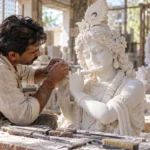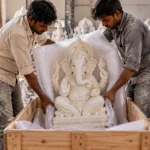

If you are searching for Ganesh marble statue manufacturing Seattle families and temples can rely on, it helps to start with one plain fact. Seattle is where the statue will live. The statue itself is carved in Jaipur, Rajasthan, at the workshop of Kamal Moorti & Painting Kala Kendra, with the address listed in Chandpol Bazar, Jaipur. That is not a drawback. It means you deal with the people who select the marble, carve the figure and finish the surface, instead of a reseller who has never seen the workshop.
This guide is written for buyers in Seattle and across Washington who want a Ganesh moorti for a home temple, an office entrance, a community hall or a gift. It covers how a hand-carved Ganesh statue is made, what separates a premium Ganesh marble statue from an ordinary one, how to choose the right size, what to ask any supplier before you pay, and how to look after white marble in a wet climate.
What “Ganesh Marble Statue Manufacturing Seattle” Really Means
Buyers type a city name into a search for different reasons. Some want a showroom they can walk into. Others want a maker who understands that a statue bound for a Seattle apartment has different needs from one going into a large family home in Rajasthan. Both are reasonable expectations, so here is how it works with us.
Kamal Moorti & Painting Kala Kendra produces its marble work in-house in Jaipur. Its website describes a fabrication unit, a designing unit, a warehouse and modern machinery, all supporting hand-carved Marble Moortis, Marble Temples, decorative sculptures and fully customized marble artworks. Nothing on the website says there is a manufacturing unit in Washington, and this article does not claim one. What the Seattle market gets is a workshop that makes Ganesh statues to order and to specification, and a buyer who can ask detailed questions before committing.
If you are comparing suppliers, this is the honest way to read “Ganesh statue supplier Washington.” A good supplier should be able to tell you where the statue is made, what stone it is made from, how it is finished and how it will reach you. Later in this guide you will find a list of questions to ask.
Why Ganesha, and Why Marble
Ganesha is widely known as the remover of obstacles, which is why his image appears at the start of so many things: a new home, a new business, a new year’s accounts. Our website notes that the Ganesha idol is widely seen in homes, workplaces and temples for this reason. Ganesh Chaturthi, which celebrates his birth, fell on Monday, 14 September 2026 this year, and the ten-day festival closed with Visarjan on Anant Chaturdashi, 25 September 2026. The next date many families look toward is Diwali, which falls on 8 November 2026 according to most Panchang-based calendars, when Lakshmi Puja honors Goddess Lakshmi and Lord Ganesha together.
Seattle has its own Ganesh celebrations. The annual Ganesh festival in downtown Redmond, organised by Beats of Redmond since 2019, has drawn a crowd reported at around 20,000 people, and its 15-foot idol was set up outdoors in the Pacific Northwest’s rain and cold. Bellevue’s city calendar also lists a WA Ganesh Festival at Crossroads Community Park. Those events show how many households in the region keep the tradition alive, and many of them also keep a permanent Ganesh at home.
This is where marble makes sense. Festival idols, especially clay ones, are made for immersion. A marble moorti is made to stay. Marble has long been a favoured material for Indian sculpture, and the website describes good marble idols as keeping their shine and freshness for many years. For a home shrine you will look at every morning, that permanence is the point.
How a Hand-Carved Ganesh Statue Is Made
A hand-carved Ganesh statue manufacturer is only as good as its process, so it is worth knowing what the process looks like. According to Kamal Moorti & Painting Kala Kendra, every sculpture passes through raw marble selection, carving, polishing and final detailing, with each stage done carefully to hold the workshop’s standard. Its artisans combine traditional hand-carving with modern tools, and the website says they have decades of hands-on experience.
Selecting the marble
The statue begins with the block. The website says only high-quality natural marble is used, and the choice matters because marble is not uniform. Colour, grain and veining vary from block to block. A careful maker looks for a piece that is clean enough to carry fine detail on a face, which is the hardest part of any deity statue to get right. If you want to understand the difference between genuine stone and substitutes, the workshop’s guide to natural versus artificial marble moortis explains what to look for, and its piece on choosing quality material covers the foundation of a good sculpture.
Carving, polishing and detailing
Once the block is chosen, the rough form is cut, then carved by hand. Powered tools do the heavy, repetitive cutting. The face, the ornaments and the expression are where a human hand matters. The website lists polishing machines, electrical saws and cutting tools among the equipment in its production unit. Polishing comes after carving, and final detailing comes last. You can read more about the craft in the workshop’s article on hand-carved marble moortis.
Why in-house production matters to a buyer
When carving, finishing and storage happen under one roof, it is easier to answer specific questions, and to make specific changes. The website says the designing unit allows customization of each product to a buyer’s requirements. For a Seattle customer ordering from a distance, that direct line to the maker is worth more than a glossy catalogue.
What Makes a Premium Ganesh Marble Statue
“Premium” is an overused word, so here is a practical way to test it. Look at four things.
The stone. A premium Ganesh marble statue should be made from natural marble with a clean, even surface. Ask what type of marble it is and whether it is natural. Do not accept a vague answer.
The carving. Look closely at the face, the eyes, the trunk and the ornaments. Hand-carved work shows crisp edges where they are meant to be crisp and soft transitions where the form turns. If you want a longer comparison, the workshop has a clear article on hand-carved marble versus factory-made statues.
The proportions. A Ganesh figure has to look balanced from the front and from the sides. A head that is too large or a base that is too narrow is a sign of rushed work.
The finish. The surface should be smooth and evenly polished, with no rough patches in the folds of the ornaments. The website describes a smooth finish and long-lasting natural shine as part of its standard.
A premium statue is not always the largest or the most decorated. A plain, well-proportioned Ganesh in clean white marble often looks better in a modern home than an overloaded one.
Choosing the Best Ganesh Statue Seattle Homes and Offices Can Hold
The phrase “best Ganesh statue Seattle” means different things to different buyers. The best one is the one that fits your space, your worship and your budget. Think through these points before you order.
Size and weight
Marble is heavy, and a statue that looks modest in a photograph can be surprisingly weighty on a shelf. Measure the exact spot first, and then ask for the statue’s height, width and weight in writing. The workshop publishes a useful marble statue size guide for American homes, which is a good place to start when you are matching a statue to a room.
Placement
A home temple corner, a dedicated puja room, an office reception and a shop counter all call for different sizes and different bases. Many Seattle homes are compact, and a mid-sized statue on a sturdy console often suits them better than a floor-standing figure. If the statue is going into a community hall or temple, you will want to think about viewing distance and pedestal height.
Customization
The website says customization is available for style, design and colour, based on the buyer’s requirements. If you want a particular posture, a specific size or a detail that matches a family tradition, say so at the start. The workshop’s article on custom marble statue design and pricing explains how that conversation usually goes.
Budget
Price will depend on the size, the amount of carving detail and any customization. The sensible approach is to ask for a written quote that lists what is included, then compare it like for like with any other supplier.
What to Ask a Ganesh Statue Supplier Serving Washington
Whether you buy from us or from anyone else, these questions protect you. They are especially useful when you are ordering from a distance.
| Question | Why it matters |
| What type of marble is this, and is it natural? | Natural stone and substitutes look similar in photographs but behave very differently over time. |
| Is the statue hand-carved, and can I see photographs of the actual piece? | You want to see the real statue, not a stock image of a similar one. |
| What are the exact height, width and weight? | You need this to plan the shelf, the floor and the transport. |
| Can the design be customized? | Posture, size and detailing are easier to settle before carving begins. |
| How will it be packed and shipped, and who handles delivery? | Marble can chip, so packaging is not a minor detail. Read the Shipping Policy link in the website footer and confirm the terms for your address in writing. |
| What is the return and exchange policy? | The website footer lists a Return & Exchange page. Read it before you pay. |
| How long will it take? | Hand-carved work needs time, so get a realistic timeline rather than a rough estimate. |
If a supplier cannot answer these clearly, that tells you something. If you want a direct answer from the workshop, contact details are at the end of this article.
Caring for a Marble Ganesh in a Pacific Northwest Home
Seattle’s wet weather is one of the things people love and complain about in equal measure, and it is worth thinking about when you place a marble statue. Marble is mainly calcium carbonate, and calcium carbonate reacts to acids. Stone manufacturer Polycor’s care guide notes that marble is sensitive to acidic solutions and recommends mild, non-acidic cleaners. It specifically warns that citrus-based and vinegar-based products can dull or etch calcareous stones.
Everyday care
Keep it simple. A soft, dry cloth for dust is enough most of the time. A fine-art restoration studio advises that marble sculptures should not be cleaned regularly, only lightly dusted, because repeated cleaning can wear down the surface and soften fine details on faces and drapery. If something spills, blot it rather than wiping, then rinse with water and a little mild soap and dry the area thoroughly.
The habit that matters most in a puja room is keeping offerings away from the stone itself. Lemon, vinegar-based products and some flower and fruit juices are acidic. Place offerings on a plate or tray rather than directly on the marble. The workshop’s own professional marble statue care guide for the USA goes into more detail.
Indoors or outdoors
Conservation specialists point out that external marble sculptures are vulnerable to weathering, because moisture combined with gases in the air forms weakly acidic solutions that can break down the stone over time. For a rainy region like Seattle, that is a good reason to keep a Ganesh statue indoors or under a covered, sheltered area. If you are planning a garden or an open courtyard placement, talk to the maker first and ask which stone and finish they recommend.
Securing a heavy statue in earthquake country
Washington is seismically active. Central Washington University’s safety page notes that the state sees hundreds of earthquakes every year and that damaging ones have occurred within the past 130 years. The Washington Military Department’s preparedness guidance advises anchoring top-heavy objects and heavy artwork. A marble statue is exactly that kind of object. Place it on a low, stable, well-supported surface, avoid narrow shelves at height, and ask a qualified installer about anchoring if the piece is large.
A Regional Note for Pacific Northwest Buyers
Kamal Moorti & Painting Kala Kendra has published location pages for several North American cities. If you are in the region, you may also find it useful to read the workshop’s pages on Ganesh marble statue manufacturing for Vancouver and Ganesh marble statue manufacturing for Chicago. For a wider look at choosing the right figure, there is also a guide to Ganesh marble statue symbolism and selection in the USA, and a piece on selecting and caring for a Ganesh statue in Canadian temples that applies just as well to community spaces in Washington. If you would like to see where the workshop’s Ganesh work begins, read its Mumbai page.
A marble moorti can also last for many years. If you are buying one for the family rather than for a single season, the article on marble statues as heirlooms is worth a read.
Frequently Asked Questions
Is Ganesh marble statue manufacturing actually done in Seattle?
No. Kamal Moorti & Painting Kala Kendra makes its marble statues at its production unit in Jaipur, and its listed address is in Chandpol Bazar, Jaipur. The Seattle connection is the customer: people in Seattle and across Washington who want a Ganesh statue made to order.
How can I tell whether a marble Ganesh statue is made of natural marble?
Ask the supplier directly and ask for it in writing. Look at the stone in well-lit photographs and request close-ups of the face and base. The workshop’s guide to natural versus artificial marble is a helpful checklist.
Can I order a custom Ganesh statue?
The website says customization is available for style, design and colour, based on your requirements. Share your preferred size, posture and any detailing you want at the start, and ask for a written quote.
What size of Ganesh statue suits a Seattle apartment?
It depends on the shelf or console you have in mind. Measure the space, then check weight as well as height. The size guide for American homes will help you narrow it down.
How do I clean a marble Ganesh statue?
Dust it lightly with a soft dry cloth. Avoid vinegar, citrus cleaners and scouring powders. If something spills, blot it, rinse with water and a little mild soap, and dry it well. For stains, consult a stone conservator rather than trying household products.
Should I keep the statue outdoors?
For a rainy region, indoors or a covered space is the safer choice. Outdoor marble is exposed to weathering over time, so ask the maker before placing a statue in a garden.
Talk to the Workshop
If you are considering a hand-carved marble Ganesh for your home, office or temple in Seattle or elsewhere in Washington, the simplest next step is a conversation. Tell the team where the statue will stand, the size you have in mind and any customization you want, and ask the practical questions from the table above.
You can reach Kamal Moorti & Painting Kala Kendra through the official website, by phone at +91-9829678999 or +91-7014383187, or by email at mahendra4royals@gmail.com. The workshop address is 2459, Khazane Walo Ka Rasta, 3rd Crossing, Near Shree Adhi Gour Se. Sr. School, Chandpol Bazar, Jaipur (302001). You can also browse more guides on the blog.