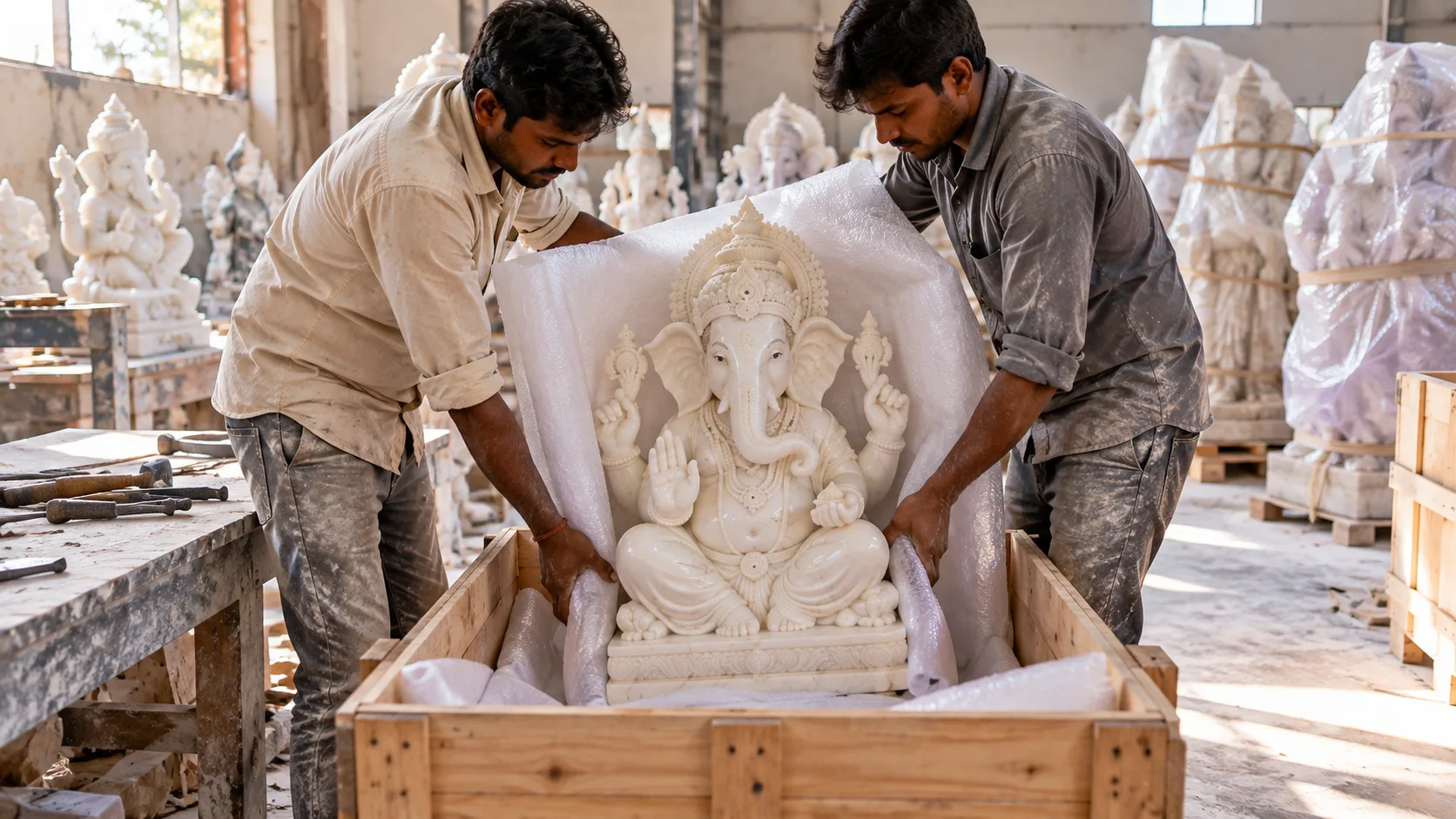
If you are searching for Ganesh marble statue manufacturing Hamilton families and temples can rely on, start with one plain fact. Hamilton, Ontario is where the statue will live. The statue itself is carved in Jaipur, Rajasthan, at the workshop of Kamal Moorti & Painting Kala Kendra, whose listed address is in Chandpol Bazar, Jaipur. That is not a weakness. It means you are speaking to the people who choose the marble, carve the figure and finish the surface, not to a middleman who has never seen the workshop.
This guide is for buyers in Hamilton and across Ontario who want a Ganesh moorti for a home temple, a shop or office entrance, a community hall or a gift. It explains how a hand-carved Ganesh statue is made, what makes a premium Ganesh marble statue, how to choose a size, what to ask about shipping to Canada, and how to protect white marble through an Ontario winter.
What “Ganesh Marble Statue Manufacturing Hamilton” Really Means
Some buyers add a city name to a search because they want a showroom nearby. Others want a maker who understands how a statue will be used in a Canadian home. Both are sensible, so here is how it works.
Kamal Moorti & Painting Kala Kendra makes its marble work in-house in Jaipur. Its website describes a fabrication unit, a designing unit, a warehouse and modern machinery, supporting hand-carved Marble Moortis, Marble Temples, decorative sculptures and fully customized marble artworks. Nothing on the website says there is a manufacturing unit in Ontario, and this article does not claim one. What Hamilton buyers get is a workshop that makes Ganesh statues to order and to specification, and the chance to ask detailed questions before committing.
That is also the honest way to read “Ganesh statue supplier Ontario.” A good supplier should tell you where the statue is made, what stone it is made from, how it is finished and how it will reach you. A list of questions to ask follows later in this guide.
Why Ganesha, and Why Marble
Ganesha is known as the remover of obstacles, which is why his image is placed at the start of so many things: a new home, a new shop, a new venture. The Kamal Moorti website notes that the Ganesha idol is widely seen in homes, workplaces and temples for this reason. Ganesh Chaturthi, the festival of his birth, fell on Monday, 14 September 2026 according to Panchang calendars, and the ten-day festival closed with Visarjan on Anant Chaturdashi, 25 September 2026. The next date many families plan around is Diwali on 8 November 2026 according to most calendars, when Lakshmi Puja honors Goddess Lakshmi and Lord Ganesha together.
Hamilton has a growing community that keeps these traditions. According to Statistics Canada figures reported by New Canadian Media, Hindus made up 1.8 per cent of Hamilton’s population of 569,353 in 2021, up from 0.8 per cent in 2011. The Hindu Samaj of Hamilton and Region has served the community since 1975 and acts as a centre of worship and cultural events for Hindus across the Golden Horseshoe. Its religious secretary told New Canadian Media that more than 5,000 devotees came to the temple for Shivratri in a recent year. The region also has other well-known temples in Brampton, Toronto and Mississauga, so many Hamilton families already move easily within a wider network of worship.
A marble moorti suits a household that wants a permanent presence at home. Festival idols, especially clay ones, are made for immersion. Marble is made to stay. The Kamal Moorti website describes good marble idols as keeping their shine and freshness for many years, which matters if you will see the statue every morning.
How a Hand-Carved Ganesh Statue Is Made
A hand-carved Ganesh statue manufacturer is only as good as its process, so it helps to know what the process looks like. According to Kamal Moorti & Painting Kala Kendra, each sculpture passes through raw marble selection, carving, polishing and final detailing. Its artisans combine traditional hand-carving with modern tools, and the website says they have decades of hands-on experience.
Selecting the marble
Everything begins with the block. The website says only high-quality natural marble is used, which matters because marble is not uniform. Colour, grain and veining vary from block to block, and a clean, even piece holds fine detail better, especially on a face. The workshop’s guide to natural versus artificial marble moortis explains what to look for, and its article on quality material covers why the stone comes first.
Carving, polishing and detailing
The rough form is cut first, then carved by hand. Machines handle heavy, repetitive cutting. The face, the ornaments and the expression are where a human hand matters. The website lists polishing machines, electrical saws and cutting tools among the equipment in its production unit. Polishing follows carving, and detailing comes last. You can read more in the workshop’s piece on hand-carved marble moortis.
Why in-house production helps a buyer
When carving, finishing and storage happen under one roof, it is easier to answer specific questions and to make specific changes. The website says the designing unit allows each product to be customized to the buyer’s requirements. For a customer ordering from another continent, that direct line to the maker is worth more than a catalogue photo.
What Makes a Premium Ganesh Marble Statue
“Premium” is an overused word, so here is a practical way to test it. Look at four things.
The stone. A premium Ganesh marble statue should be made from natural marble with a clean, even surface. Ask what type of marble it is and whether it is natural. Do not accept a vague answer.
The carving. Look closely at the face, eyes, trunk and ornaments. Hand-carved work shows crisp edges where they are meant to be crisp and soft transitions where the form turns. The workshop has a clear article on hand-carved marble versus factory-made statues, and another on hand-carved and factory marble quality for Canadian buyers.
The proportions. A Ganesh figure has to look balanced from the front and from the sides. An oversized head or a narrow base is a sign of rushed work.
The finish. The surface should be smooth and evenly polished, including in the folds of the ornaments. The website describes a smooth finish and long-lasting natural shine as part of its standard.
A premium statue is not always the largest or the most decorated. A plain, well-proportioned Ganesh in clean white marble often looks better in a modern Hamilton home than an overloaded one.
Choosing the Best Ganesh Statue Hamilton Homes Can Hold
The phrase “best Ganesh statue Hamilton” means different things to different households. The best one fits your space, your worship and your budget. Think through these points before you order.
Size and weight
Marble is heavy, and a statue that looks modest in a photograph can be surprisingly weighty on a shelf. Measure the exact spot, then ask for height, width and weight in writing. The workshop’s guide to marble statue sizes and space planning in Canadian homes is a useful place to start.
Placement
A home temple corner, a puja room, a shop counter and a community hall all call for different sizes and bases. A mid-sized statue on a sturdy console often suits a typical living room better than a floor-standing figure. For a temple or hall, think about viewing distance and pedestal height.
Customization
The website says customization is available for style, design and colour, based on the buyer’s requirements. If you want a particular posture, size or detail that matches a family tradition, say so at the start. The article on custom marble statue design and pricing explains how that conversation usually goes.
Budget
Price depends on size, the amount of carving detail and any customization. Ask for a written quote that lists what is included, then compare it like for like with other suppliers.
What to Ask a Ganesh Statue Supplier Serving Ontario
Whether you buy from us or from anyone else, these questions protect you, especially when ordering across borders.
| Question | Why it matters |
| What type of marble is this, and is it natural? | Natural stone and substitutes can look alike in photographs but behave differently over time. |
| Is the statue hand-carved, and can I see photographs of the actual piece? | You want to see the real statue, not a stock image of a similar one. |
| What are the exact height, width and weight? | You need this to plan the shelf, the floor and the delivery. |
| Can the design be customized? | Posture, size and detailing are easier to settle before carving begins. |
| How will it be packed and shipped, and who handles customs? | Marble can chip, so packaging matters, and duties and taxes may apply on arrival in Canada. |
| What is the return and exchange policy? | The website footer lists Shipping Policy and Return & Exchange pages. Read them before you pay. |
| How long will it take? | Hand-carved work needs time, so ask for a realistic timeline in writing. |
A note on customs in Canada
A statue made in Jaipur and sent to Hamilton crosses a border, and the Canada Border Services Agency reviews international mail and courier shipments. According to the CBSA, it decides whether goods may enter Canada and whether any duty or taxes apply. Most imported goods are also subject to GST or, in some provinces, HST, and the amount you owe depends on factors such as the item’s value in Canadian dollars. The CBSA also notes that courier companies may charge brokerage or handling fees for customs work. The website does not state shipping terms to Canada, so confirm in writing who arranges the shipment, what is included in the price and what you may need to pay on arrival.
Caring for a Marble Ganesh Through an Ontario Winter
Hamilton winters bring snow, salt and swings between freezing and thawing, so it is worth planning where a marble statue will stand.
Everyday care
Marble is mainly calcium carbonate, which reacts to acids. Stone producer Polycor’s care guide says calcium carbonate is sensitive to acidic solutions, recommends mild non-acidic cleaners and warns that citrus and vinegar products can dull or etch calcareous stones. A fine-art restoration studio advises that marble sculptures should only be lightly dusted rather than cleaned regularly, because constant cleaning can soften fine detail on faces. If something spills, blot it, rinse with water and a little mild soap, and dry it thoroughly.
In a puja room, keep offerings on a plate or tray rather than directly on the stone. Lemon, vinegar-based products and some fruit juices are acidic. The workshop’s seasonal guide to preserving marble statues in Canada covers this in more depth.
Why indoors is safer in winter
Stone specialists explain that freezing alone does not damage stone. The trouble comes when a stone absorbs water that then freezes and expands. A conservation firm notes that repeated freeze-thaw cycles can crack stone, with damage often appearing at fine points such as fingers and noses. A Ganesh statue has a trunk and ornaments that are exactly that kind of delicate detail. For an Ontario home, keeping the statue indoors is the simpler and safer choice. If you are thinking about a garden or porch placement, read the workshop’s guide to marble statue winter care and freeze-thaw in Canada and talk to the maker first.
Indoor spaces have their own winter risk. A marble care specialist notes that interior damage often comes from tracking in salts, sand and de-icing agents. If your statue stands near an entrance, keep it well away from the boot tray and the salt.
Regional Guides for Ontario Buyers
If you are still researching, the workshop has published location pages and guides that may help. There is a page on Ganesh marble statue manufacturing for Vancouver, the most recent Ganesh post on the site, and one for Krishna marble statue manufacturing in Toronto. For temples and community halls, the guide to selecting and caring for a Ganesh statue in Canadian temples applies directly. If you are buying with the next generation in mind, read about marble statues as family heirlooms in Canada.
Frequently Asked Questions
Is Ganesh marble statue manufacturing actually done in Hamilton?
No. Kamal Moorti & Painting Kala Kendra makes its marble statues at its production unit in Jaipur, and its listed address is in Chandpol Bazar, Jaipur. The Hamilton connection is the customer: people in Hamilton and across Ontario who want a Ganesh statue made to order.
How can I tell whether a marble Ganesh statue is natural marble?
Ask the supplier directly and get the answer in writing. Request close-up photographs of the face and base in good light. The workshop’s guide to natural versus artificial marble works as a checklist.
Can I order a custom Ganesh statue?
The website says customization is available for style, design and colour, based on your requirements. Share your preferred size, posture and any special detailing at the start, and ask for a written quote.
Will I pay duty or taxes on a statue shipped to Ontario?
You may. The CBSA determines whether duty and taxes apply, and the amount depends on factors such as the item’s value in Canadian dollars. Ask who handles customs, and confirm which costs are included before you pay.
How do I clean a marble Ganesh statue?
Dust it lightly with a soft dry cloth. Avoid vinegar, citrus cleaners and scouring powders. If something spills, blot it, rinse with water and a little mild soap, and dry it well. For stains, consult a stone conservator rather than using household products.
Can I keep the statue outdoors in Ontario?
It is safer indoors. Water that enters marble can freeze and expand, and repeated freeze-thaw cycles can crack stone. Ask the maker before placing any marble statue in a garden.
Talk to the Workshop
If you are considering a hand-carved marble Ganesh for your home, shop or temple in Hamilton or elsewhere in Ontario, the simplest next step is a conversation. Tell the team where the statue will stand, the size you have in mind and any customization you want, and ask the practical questions from the table above.
You can reach Kamal Moorti & Painting Kala Kendra through the official website, by phone at +91-9829678999 or +91-7014383187, or by email at mahendra4royals@gmail.com. The workshop address is 2459, Khazane Walo Ka Rasta, 3rd Crossing, Near Shree Adhi Gour Se. Sr. School, Chandpol Bazar, Jaipur (302001). You can also browse more guides on the blog.